In November 2018, relatives mourn the death of Ahmad Al-Najjar, who died of wounds after the Israeli army intervened in the ‘Great March of Return’ protest at the Gaza border. (Ashraf Amra/Anadolu Agency/AFP)
Pretoria recalled its ambassador to Tel Aviv, Sisa Ngombane, in May 2018, after 15 Palestinians were killed in one day during the Gaza border protests. Three years later, with more than 200 fatalities since last week and warnings of civil war, the government maintains downgraded diplomatic ties with Israel but has edged closer to branding it an apartheid state.
The change in tone is inevitable, insiders say, because Prime Minister Benjamin Netanyahu has forced South Africa to recalibrate a historic position, agreed with former Palestinian leader Yasser Arafat, that it would maintain relations with Israeli leaders at a level that would give it leverage as a trusted broker between the two sides.
But, for now, Pretoria is not likely to bow to internal pressure to sever ties or call for sanctions against Israel. It last spoke of the status of its Tel Aviv mission in 2019.
Steven Friedman, professor of political studies at the University of Johannesburg, says the ambiguity is part of a balancing act of the ruling party that cannot fully turn its natural, historical pro-Palestinian sympathies into government policy for fear of alienating the United States and Europe.
“I don’t think there is a clear answer because these things get fudged. It is a way of having it both ways and not wanting to upset the US and EU too much,” he said, noting that the government has clearly become firmer in its condemnation of Israel than it was in the early days of the country’s nascent democracy.
The difference in tone between the ANC and the government remains evident in statements put out this month by the party on the one hand, and by President Cyril Ramaphosa on the other, as shifting international opinion on the conflict backs US President Joe Biden into an uncomfortable corner.
The ANC on 9 May urged the United Nations to act to stop what it termed Israel’s “campaign of systematic repression and ruthless brutality against the people of Palestine” and repeatedly called Israel an apartheid state. “We urge the international community to rise to the occasion and stop apartheid Israel from expanding its illegal occupation of Palestinian lands and property, and ensure that apartheid Israeli is held accountable for perpetrating crimes against humanity. Apartheid Israel cannot continue to violate international law with impunity.”
On Monday, Ramaphosa too termed Israel’s actions a violation of international law and used the word apartheid twice, in emotively equating the suffering of Palestinians to those of South Africans who endured the humiliation of forced removal from their homes.
In an interview with France24 aired on Wednesday, Ramaphosa reiterated that the violence in Gaza “brings back very terrible memories of our own history of apartheid … for us it is very close to our own suffering under apartheid, and when see those images we cannot but side with the Palestinians”.
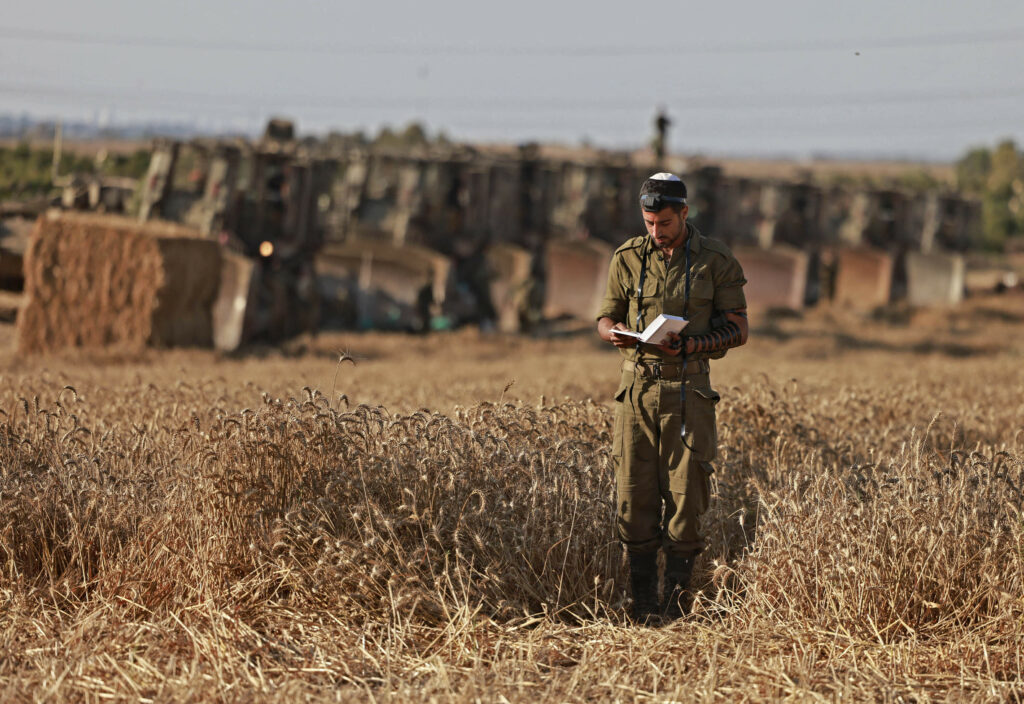 Cruel war: An Israeli soldier prays at a position in southern Israel along the border with the Gaza Strip on May 14 this year. (Photo by Menahem KAHANA / AFP)
Asked point-blank if he considered Israel an apartheid state, Ramaphosa fudged it a little, replying that given its current actions “one could quite easily characterise it as being an apartheid-type of state because I have no other reference point to describe what the Israelis are doing”.
While calling for restraint on both sides and a brokered ceasefire, he has confirmed South Africa’s commitment to a two-state agreement as a resolution to the conflict.
“The two-state solution remains the most viable option for the peoples of Israel and Palestine, and must continue to be supported,” the president said in his weekly newsletter.
Rowan Polovin, the chairperson of the South African Zionist Federation, said the organisation rejects the latest statement by Ramaphosa.
“In the last few days, Israel has experienced an unprecedented number of sophisticated missile and munition attacks against innocent women and children, including the numerous killings of Palestinian civilians by Hamas rockets. We have yet to hear a word of condemnation from the South African government about these atrocities or about the right of Israel to defend itself like any other sovereign state.
“We continue to call for even-handedness and a South African foreign policy that is in line with the Constitution.”
William Shoki, a coordinator of South Africa’s Boycott, Divestment and Sanctions coalition, said Ramaphosa’s words did signal an escalation of tone by the government but at the same time he stuck to the timeworn international consensus of a territorial compromise as the best hope of ending the conflict.
Heidi Grunebaum, the director of the Flagship on Critical Thought in African Humanities at the University of the Western Cape, said this was inevitable because South Africa’s policy on the Israeli-Palestine question has, under every democratic president since Nelson Mandela, been formulated after consultations with Palestinian leaders.
This is how it came to support a two-state solution and any future shift would require the same.
“The Palestinians engaged in the Oslo process at a particular moment in history in order to negotiate a two-state solution — and they asked us to support this and to assist them where, when, and how we could. In solidarity, we did that too. This position was the same under Mbeki, Zuma and today, Ramaphosa,” she said.
International opinion was increasingly that the situation in Israel-Palestine is apartheid, both in law and in fact.
“This creates a new policy context, which will require a re-appraisal of our own policy — in consultation with Palestinian representative bodies and groups,” Grunebaum said.
“Neither the ANC nor the South African government has in the past or will in the future make their policies towards Israel-Palestine without actively consulting Palestinian representative bodies prior to doing so.”
Friedman termed the hope of a two-state solution a farce. Fellow academic Salim Vally, of the University of Johannesburg, echoed that it was a mirage, given the permanent, institutionalised nature of Israeli settlements in the West Bank and the belief that Israel’s commitment to a two-state solution has always been cynical.
“The various accords to this effect have just been holding operations while Israel takes more land and expels more people,” Vally said.
He argued that Netanyahu’s strategy was one of provocation as a way to reinforce perceptions of victimhood and perpetuate violence. For many, Netanyahu’s drive to extend Israeli sovereignty over the West Bank buries the two-state ideal.
Shoki said the ANC’s resolution on the Middle East at its Nasrec conference in December 2017 had invited Palestinians to reconsider the viability of the two-state solution as a preferred outcome.
The idea of a single, secular, shared Israeli-Palestinian state is not unanimously seen as an alternative, but proponents argue that South Africa is an obvious authority on how to build a constitutional democracy where once was segregation and bloodshed.
Sceptics caution that it would fail along the inevitable faultlines of thwarted nationalist leanings and entrenched economic equality. Both threaten the modest success of the South African project but Shoki argues that the country still carries the moral authority to adopt a bolder stance on the international plain.
He believes the government’s immediate obligation is to sever diplomatic ties with Israel, denounce it as an apartheid state and call for it to be investigated by the International Criminal Court for human rights abuses against Palestinians.
“Logically and legally and ethically there has to be consequences to that step within the structures and conventions of the United Nations,” he said.
“And it is crucial that South Africa, as the country with which apartheid is associated, unequivocally term what is happening in Israel apartheid.”
Friedman foresees that the government will not try to take a firm leading role but rather eventually arrive at a policy consistent with long-held ANC convictions as international thinking on the conflict evolves.
“For now, I think this is as far as it goes,” he said of Ramaphosa’s statement.
“It does not mean that it will not change, but I think the international climate on Palestine is changing. I am pretty convinced that the current South African position, which at the moment is quite daring by international standards, is not going to be daring for that long.”
Friedman points out that the US’s Democratic Party was experiencing its own, partly generational shift by members on the Middle East, while still being beholden to the pro-Israel lobby when push comes to shove.
“You are increasingly seeing that with pro-Israeli resolutions in the Senate, there would be one vote in opposition. Bernie Sanders would vote against it. Now you have 20, 30 Democrats voting against.
“I think the gulf is slowly becoming unsustainable. In Europe, more and more parliaments are recognising Palestine.”
Ramaphosa’s initial remarks came before he flew to Paris for an investor summit on Africa, where diplomats believe the Middle East was discussed on the sidelines and the president gave his interview to foreign television.
On Tuesday, France called for a UN resolution on a ceasefire. On Wednesday, Biden told Netanyahu he expected “a significant de-escalation today on the path to a ceasefire”. Egypt called for a brokered end to hostilities, as Ramaphosa did.
The notion that the Arab world was divided this time around after the United Arab Emirates and Bahrain formalised ties with Israel has been debunked by their own populations’ mounting anger at their silence.
[/membership]