Minister of Human Settlements, Water and Sanitation, Lindiwe Sisulu and next to her in the middle is Deputy Ambassador of Cuba in South Africa during the introduction Cuban engineers who will be working on the country's water system on April 22, 2021 in Pretoria. (Photo by Deaan Vivier/Beeld/Gallo Images via Getty Images)
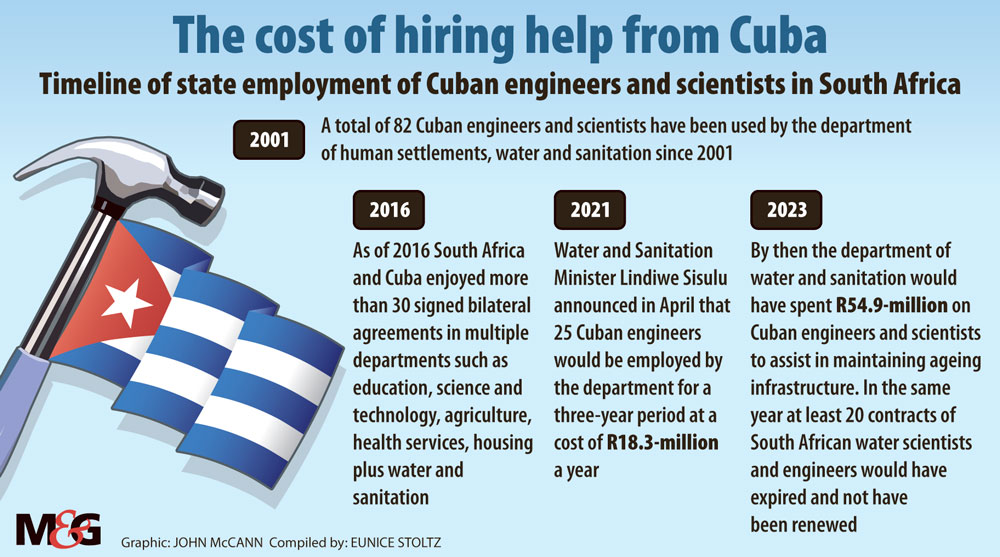
Employing 25 Cuban engineers to assist with water-infrastructure maintenance at a cost of R54.9-million for three years has allegedly resulted in South African, government-educated scientists being cast aside.
Sources close to the human settlements, water and sanitation department have alleged that at least 20 South African water scientists and engineers, who received assistance of up to R500 000 towards their academic qualifications, would not have their contracts renewed because the department had no funds to retain them.
The contracts, the sources said, would expire between this year and 2023, which coincides with the tenure of the Cubans.
The Mail & Guardian spoke to two of the funded scientists who did not have their contracts renewed earlier this year. Both said they had spent about five years working for the department on infrastructure-maintenance projects.
The scientists, who asked to remain anonymous, said they received bursaries from the department and spent the first three years after completing their studies as “graduate trainees” as repayment for the bursaries.
Their allegations follow an April announcement by Water and Sanitation Minister Lindiwe Sisulu that 25 Cuban engineers would be employed by the department for a three-year period, at a cost of R18.3-million a year, to assist with maintenance of South Africa’s aged water infrastructure.
In a replying affidavit after legal action to halt the programme was instituted by the trade union Solidarity, the department’s acting director general, Deborah Mochotlhi, said the Cuban engineers were working in the country after a “co-operation agreement” was signed by the respective governments in February last year.
Mochotlhi added that the use of Cuban engineers was “based on their rare and exclusive expertise in relation to maintaining and prolonging the lifespan of water- and sanitation-related infrastructure”.
Solidarity disputed the costs provided by Sisulu’s amount because of the “extensive fringe benefits” the Cubans would receive, which include trips home. The union says the agreement will cost R75-million — not R54.9-million, as the department has claimed.
The union wants the agreement to be reviewed, but Mochotlhi argued that administrative decisions could not be taken on review because the constitution empowered the executive to negotiate and sign international agreements.
“It is, therefore, evident that the conclusion of international agreements falls within the sole domain of the national executive. The executive of the Republic of South Africa is the president [Cyril Ramaphosa] together with other members of cabinet, as provided for in section 85 of the constitution,” Mochotlhi argued.
In other words, Sisulu was within her rights to sign a bilateral agreement.
Since 2001, a total of 82 Cuban engineers and scientists have been used by the department.
But one of the graduate scientists said it was baffling that the department would make a “hefty investment” in local graduates and then not trust them with the maintenance of South Africa’s infrastructure.
“They [the department] had every right to take us out and not renew our contracts if they didn’t have funds. But it doesn’t make sense if money is made available for Cubans after the department managed to get us registered with Sacnasp [South African Council for Natural Scientific Professions] and Ecsa [Engineering Council of South Africa].”
[related_posts_sc article_id=”355694″]
The scientist claimed to have been paid an annual salary that exceeded R500 000 over three years when working for the department.
These assertions were echoed by the other graduate scientist, who also acknowledged that the department did not have to extend their contracts, but that it was now difficult for them to find employment in the private sector because of “localised deployment” after completing their trainee programmes.
“For example, if you do water licensing, it is localised and you only specialise in that field. Now I cannot go and seek employment in the private sector because of the limited skills I have,” they said.
Sisulu’s spokesperson, Steve Motale, said there was “absolutely no truth” to the “ridiculous allegations”.
“The Cuban engineers issue has been dealt with and I hope you are aware that the matter is in court. If you are truly interested in knowing how the programme is funded, we challenge you to get our court papers which, by the way, are public documents,” he said.
But, in a subsequent response, Motale said all graduate trainees were still contracted to the department.
“After [contract] expiry in 2023, they can apply for posts in the department as per normal public-service regulations. Those that were transferred … have contracts that expire at different times. Their contracts are usually extended [until] they have professional registration,” Motale said.
“After professional registration they have to apply via normal processes … Contracts may run out and may not be renewed for various valid reasons, but no person on contract can ever be guaranteed a permanent post,” Motale added.
He did not answer questions about whether the department was worried about a possible loss of skilled South Africans in favour of foreign nationals.
Department of water and sanitation spokesperson Sputnik Ratau said Cuba’s international relations have been stifled because of the “blockade” against it, a reference to the US economic blockade of Cuba after the Cuban Revolution in 1959.
He said the Cubans working in South Africa were in a “win-win situation”.
“What we are asking for is that Cuba come and exchange their experience as to how they’ve been able to keep their infrastructure even within the blockade, while they are not able to really upgrade to the same extent as we have been able to,” Ratau said.
He added that a lack of engineers and scientists in rural areas and some rural municipalities’ inability to keep up with maintenance provided further reasons for using Cuban engineers and scientists.
“Smaller municipalities and some of the more rural municipalities … you’d find that there is such high unemployment, there is a lack of revenue coming in, and there is a lack of attraction for some of our own skilled people,” Ratau said.
[/membership]