Gains: The ANC’s KZN chairperson Sihle Zikalala says the party is stabilising in the province. (Delwyn Verasamy/M&G)
Despite going through what was possibly the most difficult period in the ANC’s history since liberation, KwaZulu-Natal party chairperson Sihle Zikalala believes his provincial executive committee has made significant progress in uniting the party.
Zikalala — who is set to stand for re-election at the provincial conference in Durban today — also believes that external conditions and decisions by the party’s national leadership around former president Jacob Zuma and the step-aside rule have further complicated an already difficult time in the ANC’s history.
Zikalala is likely to face a challenge for the position from MPL Siboniso Duma, finance MEC Nomusa DubeNcube, AmaZulu FC owner Sandile Zungu and his advisor and former director general, Nhlanhla Ngidi, all of whom have indicated their intention to stand.
While all the candidates have a history in the ANC — along with varying levels of support at branch level across the party’s 11 regions — it is Zikalala who is the frontrunner going into the conference.
In an interview with Mail & Guardian this week, he said while the past four years represented “one of the toughest terms in the organisation, maybe [the toughest] since the ascendancy of the ANC to power,” the province was more united that it was in 2015, when he first stood as chairperson.
The 2015 provincial executive committee (PEC) backed the bid for the presidency of Nkosazana DlaminiZuma and was dominated by supporters of the former president but was prevented from attending the 2017 national conference by the courts due to a challenge to its legitimacy.
It was dissolved in 2018 by the ANC national executive committee (NEC) but Zikalala was reelected, this time on President Cyril Ramaphosa’s “unity” ticket, along with secretary Mdumiseni Ntuli, after several attempts to hold a provincial conference.
Zikalala’s shift made him a target for his former comrades, despite his continuing to champion the radical economic transformation cause as premier and his ongoing public support for Zuma, whose incarceration on contempt of court charges he has criticised.
“We have united the ANC. The groupings that were there in 2015 are not there now. Yes, there is contestation, but it’s not the same,” he said. Zikalala said they managed to bring ANC members who had stood against the party in the 2016 local government elections back into the fold during last year’s poll and this was not one of the factors that contributed to the party’s loss of its majority in Durban and other key municipalities.
“At local government, yes, we have gone through some decline, but not because there were ANC comrades who were standing against the ANC. In fact, we managed to bring them back, most of those who contested as independents as 2016,” he said.
Zikalala said the holding of the 11 regional conferences, which had been delayed by Covid-19 regulations, had gone more smoothly than in 2015 — and with fewer difficulties than in some other provinces during the current conference cycle.
The prolonged period during which the ANC’s structures were run by interim leadership had, he said, undermined its ability to contest the elections as they did not “command the authority of an elected structure”.
“Immediately after the restrictions were lifted, we’ve managed to launch all regional conferences. There is no regional conference that has gone beyond time.”
“We’ve gone through the process of rebuilding in a way that restores the integrity of the organisation, and in a way that brings hope, and brings everyone together,” he said.
In eThekwini, the most heavily contested region, leaders of the losing slate were co-opted onto the regional executive committee as additional members to ensure that the ANC did not “lose” them due to alienation after the conference.
“You wouldn’t have seen that before, the way divisions were so sharp. We’ve managed to stabilise the organisation … I think we’ve succeeded on that. But you will know that is the work under construction, you will always have to work on unity,” Zikalala said.
The step-aside resolution had, he said, been handled badly by the NEC — of which he is a member — as there had not been proper guidelines developed for its application and implementation from day one.
One weakness had been to see step-aside as “a book”, or an end in itself, rather than as one of a series of measures aimed at preventing corruption by party cadres deployed to government.
“The first weakness was to consider step-aside as a book. It is not a book, it is one element in the book. The whole [effort] should be about how do we prevent corruption.”
The lack of clarity about at what point the rule should be applied had intensified the “perception that has always been in the organisation about the use of state organs to pursue political interest [and] deal with others through their use”.
Likewise, the “staggered approach” and the revision of the conditions preventing charged persons from standing had created the perception that “step aside is designed for political interests rather than the objective of renewals”.
“Although it was a resolution of the conference, the manner in which it has been handled, the manner in which it has ended has left a bitter taste to the membership [who believed] that it is used as a mechanism to preclude others from contesting,” Zikalala said.
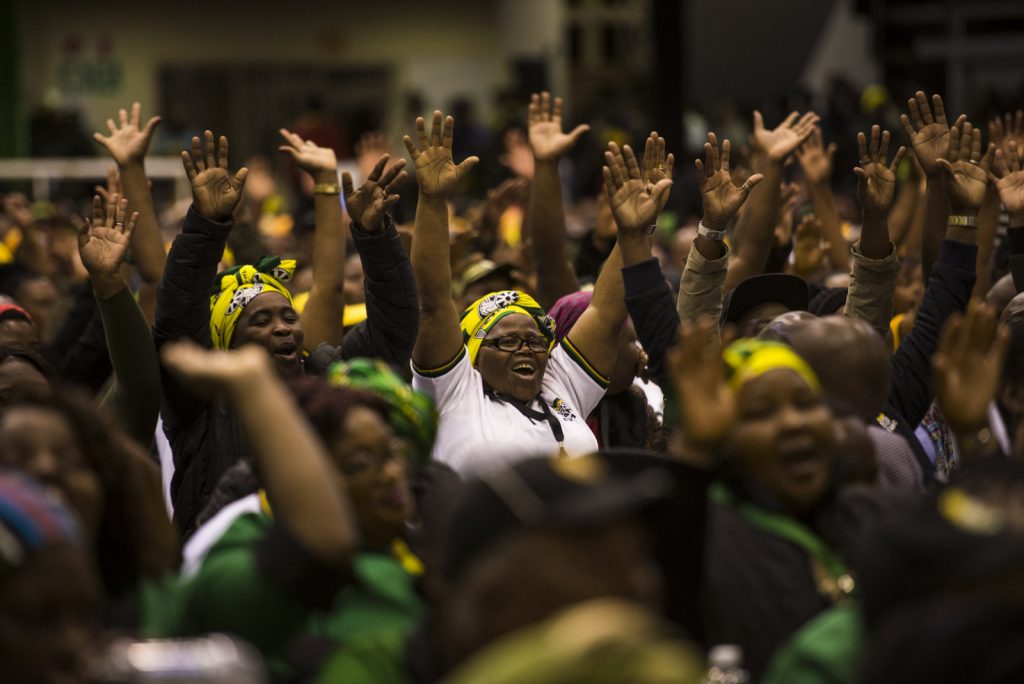 ANC delegates in KwaZulu-Natal.
The powers of the ANC integrity commission needed to be strengthened and clear rules around how it worked and the conditions under which people would be referred needed to be laid down to ensure fair, objective, internal processes, he said.
Externally, the state agencies needed to do their work fairly and without bias and would need to speed up the manner in which cases were expedited.
They also needed to “not investigate through the media” as this further inflamed suspicions of bias.
“There are investigative journalists, and we must respect their work, but it becomes political. It’s easy to politicise investigations that will be handled through the media. It clouds issues. The state organs need to act objectively within themselves, stop leaks, stop issues going to the media,” he said.
“Those are things that have undermined the fight against corruption and fraud, but for the ruling party, that has also had a negative impact because it creates and sustains the view that those who are prosecuted are being dealt with.”
The arrest of Zuma and the failure of the ANC leadership to deal with it in a “more responsive way” had “inflicted pain on members of the ANC” and had contributed not only to the riots last July but to the party’s poor performance in the province in November.
“We ended up with this situation and that affected the ANC. I would say it also contributed to the kind of election results we saw, because we went to local government elections as a movement that was trying to solidify itself, but a movement that was eating itself,” Zikalala said.
While many people would have expected the ANC in the province to have done more to prevent the backlash over Zuma’s incarceration, Covid-19 regulations and “timing” had prevented them from doing so. The party now had to ensure that “its own internal conflict does not disturb society”.
“I think that is the question we must answer going forward. We need to build a capacity to speedily handle internal conflict or internal challenges and effect that internal challenges get to a point where they affect the people,” he said.
On the possibility of another outbreak of violence should Zuma’s medical parole be revoked or should be jailed on corruption charges, Zikalala said: “We can only hope that we will not reach that point.”
Zikalala said his PEC had “laid a firm foundation” for the leadership elected at the weekend to build on. Their major tasks would be to deal with internal issues and build unity; reassert the character of the ANC through visible campaigns and work; to ensure the provincial government continued to deliver services to the public at speed and to influence the party nationally to become more propoor and pro- working class.
Zikalala declined to comment on the provincial leadership contest, in which Zungu and others have taken the unusual step of publicly declaring their intention to contest before the ANC nomination process had opened and outside the traditional ANC structures.
“There is the element of trying to liberalise the ANC, to try to bring features of liberal politics you would see in the West, where individuals would stand and campaign for themselves,” he said. “I don’t believe that is the kind of leadership that you will need in the ANC.”
[/membership]