File photo: Khaya Koko
City Power, the City of Johannesburg-owned electricity company, paid more than R93.7 million to a company tasked with refurbishing an Eldorado Park substation — but no work was done on it, the state alleges in court documents.
Absa banking details were allegedly forged by directors and employees of City Power and Setheo Investments, the company at the centre of 31 counts of fraud, theft and forgery, according to the National Prosecuting Authority (NPA).
The state claims that two City Power officials repeatedly paid Setheo and its directors after signing off that the company had done work satisfactorily when allegedly nothing had been done at the site.
Tinashe Mangwana and Nomathemba Ncube, directors of Setheo, are accused of masterminding the theft of municipal funds after the award of the 36-month contract, which began on 1 April 2015, for the construction of a new substation next to an existing one in Eldorado Park.
The city capped spending on the project at more than R143.6 million, including VAT.
In March 2021, the city announced that it would spend a further R15 million to restart the construction of the substation, which still has not been completed more than six years after the initial March 2018 deadline.
The trial began this month, almost seven years after the first arrests were made in August 2017, with Mangwana and Ncube charged alongside Brighton Chifamba, named by the state as Setheo’s project manager, as well as Godfrey Mulaudzi and Maete Thoka, former City Power employees accused of having colluded with the company.
The NPA, in its charge sheet before the Johannesburg specialised commercial crimes court, said the contract Setheo signed stipulated that the company had to provide a bank guarantee within four weeks of 26 March 2015 before City Power could advance 10% of the total project cost to it for construction to begin.
The guarantee was part of a protection mechanism for banks to reimburse the city should the company fail to complete the projects or do shoddy work.
“However, Setheo failed to provide the bank guarantee within the contractually stipulated period,” reads the charge sheet.
It added that the service provider, on 11 November 2015, “purportedly” submitted an Absa bank guarantee and, as per the terms of the contract, received an advance payment of more than R14.36 million from City Power.
When City Power began investigating the contract and asked Absa whether the guarantee was authentic, it emerged, the state alleges, that Setheo was neither a “live client” of the bank nor did it hold any accounts.
“The account number mentioned in the guarantee does not exist [and] the purported bank guarantee presented to City Power by Setheo is a fraudulent document,” Absa said in response to City Power, as quoted in the charge sheet.
“The accused, acting in the furtherance of a common purpose … knew in truth and in fact that the Absa bank guarantee was not valid and genuine but forged, and/or that Absa bank will not pay the amount of the guarantee upon demand by City Power as a result of non-performance by Setheo,” the state added.
It said City Power had terminated the contract on 28 November 2017.
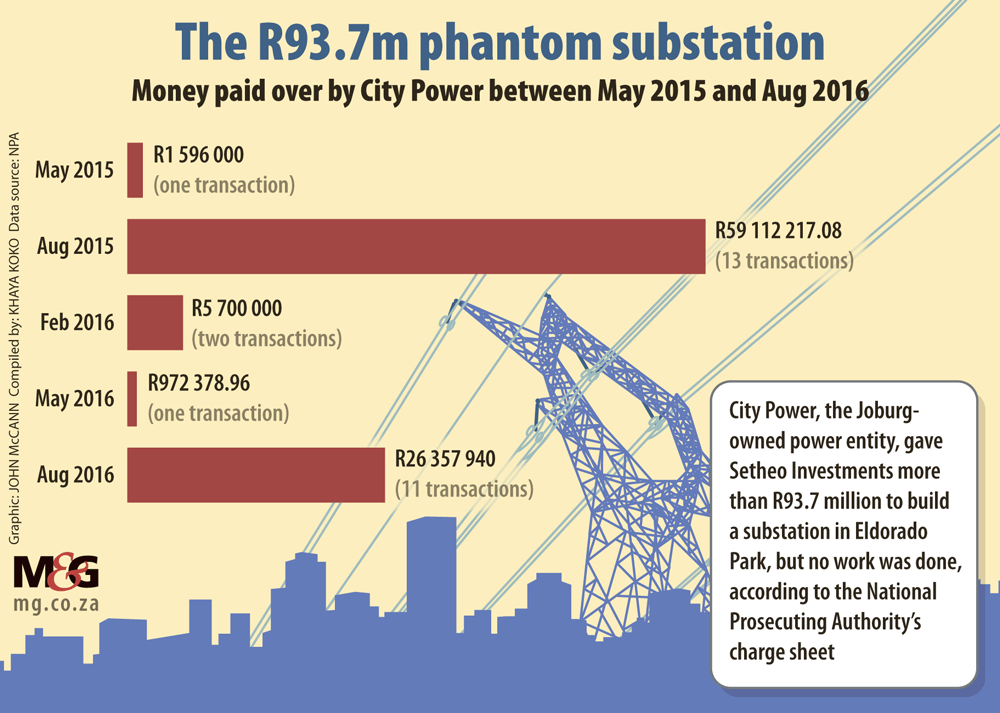 (Graphic: John McCann/M&G)
Ghost payments
But it was the 28 alleged ghost payments made by City Power that the state claims were part of fleecing the entity with the aid of its employees, Mulaudzi and Thoka.
In its case, the NPA argues the 36-month contract was performance-based with agreed deliverables and milestones, namely site establishment by June 2015, community meetings by October 2015, as well as the start of bulk civil works and control building two months later.
The state says City Power appointed an external consultancy firm, the duties of which included periodic monitoring of construction, inspection of work quality and authentication of invoiced claims through monthly payment certificates.
Mulaudzi and Thoka arranged for inspectors to visit the site, including for checking the equipment used, whereafter Setheo submitted a work completion certificate reflecting that it had invoiced for work that was to standard acceptable to City Power, the state adds. Mulaudzi and Thoka then uploaded it on the City Power finance system to process payments for Setheo.
In March 2017, after City Power’s top management received a tip-off that alleged fraud was being committed with the Eldorado Park project, the city entity requested copies of all invoices to verify whether the entity was receiving what it had paid for.
“On 13 March 2017, City Power officials, together with officials representing Setheo, visited the site to ascertain the work done.
“It was then established on site that some payments were made prior to the actual work being done on site or equipment being delivered on site,” the charge sheet stated.
“The work completion certificates on record were signed by [Mangwana and Ncube] on behalf of Setheo requesting payments, and authorised or approved by [Mulaudzi and Thoka] on behalf of City Power,” it added.
The 28 payments, according to a breakdown attached to the charge sheet, were made between May 2015 and August 2016, with the largest sum transferred being more than R51.1 million in August 2015.
The accused have pleaded not guilty and are all out on bail. They return to court in June.
Meanwhile, the site of the long-overdue new substation remains an eyesore, with no progress having been made after the project was resumed in March 2021.
At that time, City Power announced that Mpho Moerane, who was the mayoral committee member responsible for the environment and infrastructure services, would restart the project because the “continued stalling and illegal closure [would] affect the infrastructure and the provision of reliable electricity in the area”.
A background search done by the Mail & Guardian showed that Setheo was incorporated as a company in August 2015, about five months after it received the lucrative contract.
The company is undergoing deregistration due to non-compliance in filing annual returns.