The first-of-its-kind balloon is predicted to bridge the gap in atmospheric data between the West and the continent
More than 100 miniature high-tech weather balloons that monitor and predict weather are set to launch in Kenya — a first of its kind in Africa.
The balloons, backed by the Gates Foundation and San Francisco tech startup WindBorne, will launch during Kenya’s rainy season from September to November. This will provide “unprecedented accuracy when it comes to weather prediction this year”, according to WindBorne.
The company says the balloons will collect atmospheric data that can assist in tracking the evolution of hurricanes in the West.
“The West consistently finds out about incoming hurricanes weeks after they’ve already started forming — leading to a cascading set of problems that impact everyone from homeowners and insurance companies to energy grids and FEMA (Federal Emergency Management Agency),” WindBorne chief executive and and co-founder John Dean told the Mail & Guardian.
Research by the Nasa using satellite data and aircraft found that the Saharan Air Layer formed over the Sahara desert moves across Africa and the Atlantic Ocean to create the African Easterly Wave (AEW) where it occasionally initiates the development of tropical cyclones.
“Atlantic hurricanes usually start as weak tropical disturbances off the West African coast and intensify into rotating storms with weak winds, called tropical depressions,” Nasa said.
According to a World Meteorological Organisation (WMO) database, Africa has only 37 radar facilities that track weather fluctuations, rainfall and forewarnings of floods and other hazards. In comparison, 345 tracking radars cover Europe and Russia, which, combined, have a smaller land mass than Africa.
But now the wind is blowing in a new direction with a constellation of mini weather balloons soaring over the African continent, whose data will be fed into an artificial intelligence (AI) forecasting model.
Dean said this is an attempt to beat Google Deepmind’s GraphCast — an AI model for faster and more accurate global weather forecasting that delivers a 10-day weather prediction at unprecedented accuracy in under a minute — to become the most accurate in human history.
In turn, the balloons are to forecast weather conditions from hurricane in the West to weather that affects crop yield in sub-Saharan Africa.
“This data scarcity doesn’t only impact the West; it is the cause of suboptimal crop yields in Kenya and across much of Africa; inefficient water and energy usage; and inefficient agricultural processes from soil and land preparation to planting and harvesting,” said Dean.
But some analysts say WindBorne’s claim that more accurate forecasts have the potential to improve the standard of living and agricultural production in Africa” is “bold.”
“It will definitely have an impact. But much more needs to happen,” Kenyan environmentalist Esther Ngumbi told the M&G.
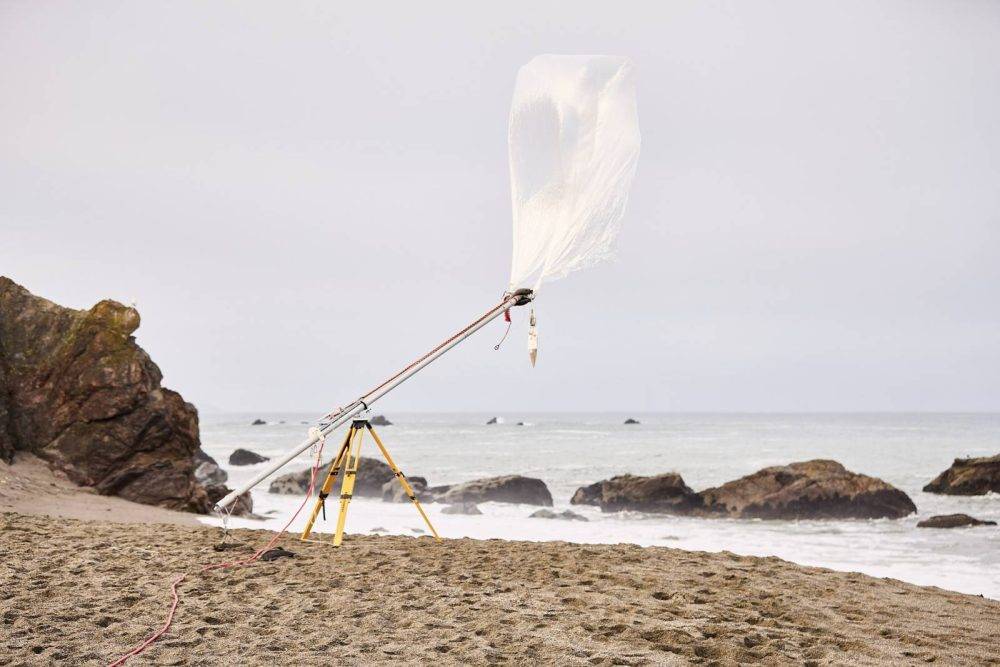
The weather balloon weighs 1.3kg and can cruise at any altitude, catch a jet stream and surf to any location on Earth.
“If they want to change course, they’ll drop some sand, ascend and catch another wind stream heading in another direction,” said WindBorne.
The balloons are equipped with proprietary sensors and a customised avionics package that enables real-time communication and navigation and can fly for about 40 days.
Each balloon operates autonomously to execute a flight plan and collects data through its onboard microcontroller — the “brain” of the balloon — which translates the flight plans into actions, such as changing altitude to catch specific wind streams.
The flight autonomy software navigates based on WindBourne’s deep learning-based weather forecast model, WeatherMesh.
The balloon’s movement is controlled by dropping sand ballast to rise in altitude and vents gas to go lower in altitude.
Once directives have been set, the flight and navigation steps happen automatically, but manual or human intervention can happen whenever desired.
“We are confident the additional in-situ measurements that our GSB [Global Sound Balloon] can collect will only complement the existing data sources in Africa,” said Dean.
Last year, a team of South African and German scientists launched a similar mission with six huge weather balloons in Beaufort West in the Karoo. The balloons measured pollutants and greenhouse gases in the atmosphere to help improve long-term weather forecasts and projections of climate change, among other things.
Gates Foundation co-founder Bill Gates, has been criticised by some environmentalists for instructing farmers on what tools they should be using to advance agriculture in Africa.
“Gates Foundation’s support for the expansion of intensive industrial-scale agriculture is deepening the humanitarian crisis,” reads an open letter from African faith leaders.
“The Bill and Melinda Gates Foundation is pushing an agribusiness model on Africa that has failed. Rather than relieving the ongoing hunger crisis, it has undercut Africans’ ability to solve their own problems, free of do-gooder philanthropists,” wrote Jan Urhahn, the programme director for food sovereignty at policy institute Rosa Luxemburg Stiftung.