The families of victims of apartheid era murder and torture have gone to the High Court to force president Cyril Ramaphosa to appoint a public commission of inquiry into the state’s failure to prosecute perpetrators identified by the Truth and Reconciliation Commission (TRC).
They believe that an inquiry into whether the failure to prosecute was orchestrated through behind the scenes discussions between the new political elite and their apartheid-era counterparts – in a bid to ensure that neither faced justice for crimes they committed – is necessary.
Papers were served on the president, the ministers of justice and police, national police commissioner General Fannie Masemola and National Director of Public Prosecutions Shamila Batohi this week by lawyers representing the families and the Foundation for Human Rights.
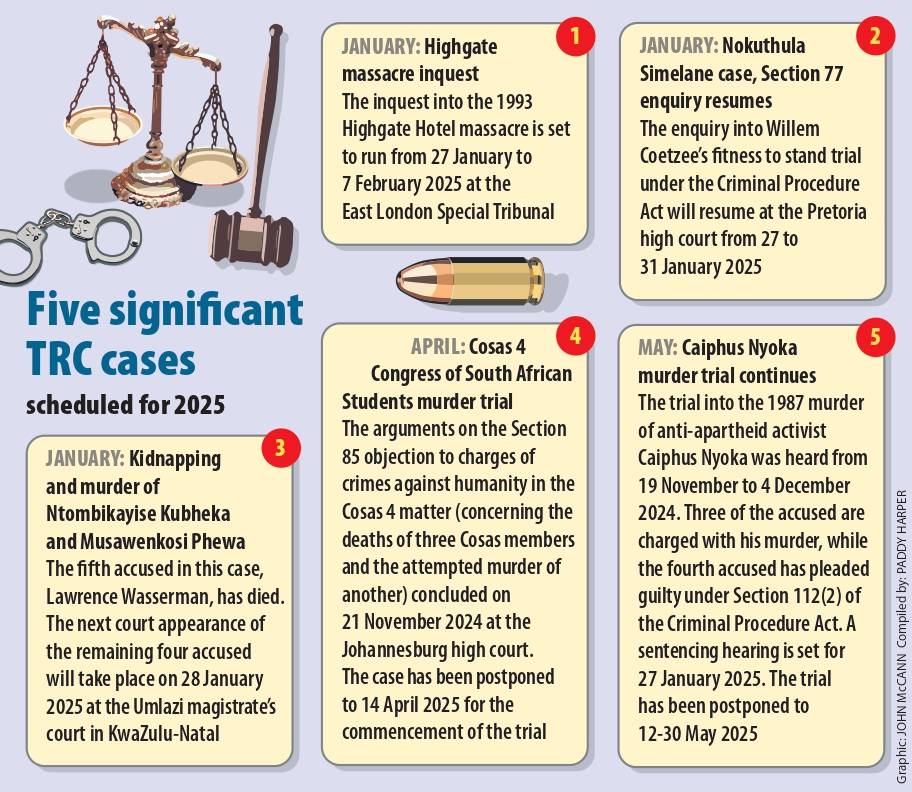
Nearly 30 years after the TRC completed its work, the majority of the perpetrators who were meant to face prosecution after failing to secure amnesty – or participate in the process – have not faced justice. A significant number have died due to the delays on the part of the National Prosecuting Authority (NPA) and the SAPS.
The applicants want the court to declare the conduct of the respondents in unlawfully failing to investigate cases referred by the TRC – or abandoning or undermining them – to be a violation of their rights and a breach of the duties and obligations of those in power.
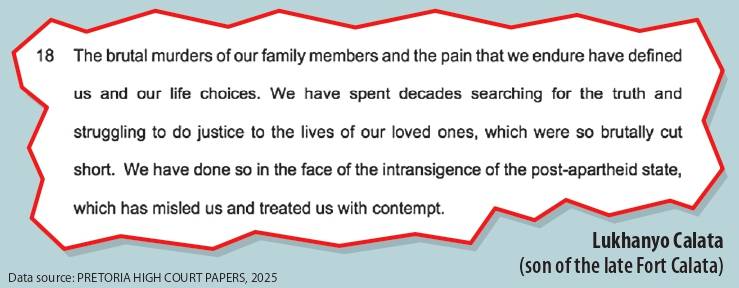
They include Lukhanyo Calata, son of Fort Calata, a United Democratic Front (UDF) activist who was abducted and murdered along with three colleagues in June 1985, and Kim Turner, daughter of murdered academic Dr Rick Turner, who was assassinated in 1978, and family members of 20 other activists who were killed by the apartheid regime.
Other applicants include Sizakele Simelane, mother of murdered ANC activist Nokuthula Simelane – and of current human settlements minister, Thembi Simelane – and Sara Bibi Lall, the sister of Dr Hoosain Haffajee, who was tortured and killed by the Security Branch at the Brighton Beach police station in 1977.
They have been joined in bringing the case to court by the Foundation for Human Rights, an activist organisation which has been pushing for those who were referred for prosecution by the TRC to finally be brought to justice.
The application comes after years of struggle by the families and survivors of human rights abuses to force the NPA and SAPS to investigate and bring prosecutions of perpetrators who had been named by the TRC.
It follows several court actions which had to be brought to force the state to carry out investigations and prosecutions in individual cases amid growing evidence of political interference to pressurise the SAPS and NPA to drop cases or ensure that they never reached their conclusion.
 (Graphic: John McCann/M&G)
On Thursday they held a media briefing in Johannesburg at which they went public on their course of action.
Calata and the other applicants have asked the court to award constitutional damages amounting to just under R160 million, for “purposes of affirming constitutional values, vindicating the rights of the applicants and families, deterring future interference” and to enable them to pursue further investigations and private prosecutions.
The order would include the creation of an independent trust to disburse the funds and damages awarded, which would also be used for educational and commemoration purposes – and to monitor the role of the police and prosecution services in pursuing TRC cases.
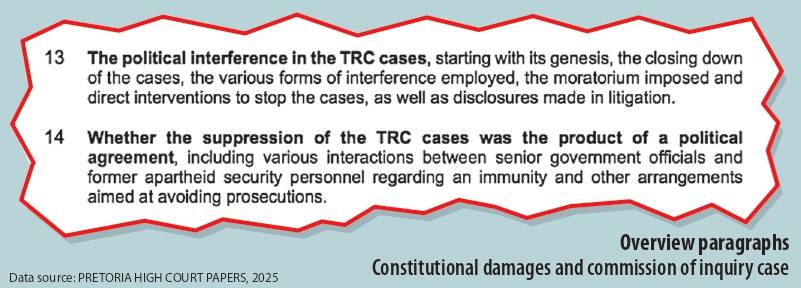
They want the court to declare the failure or refusal of the president to establish a commission of inquiry into “the suppression of the investigation and prosecution” of the TRC cases to be declared a violation of the survivors and families of victims’ right to equality, dignity and bodily integrity.
The applicants have asked the court to review and set aside the failure to appoint a commission and to order the president to do so within 30 days of the judgment being handed down.
The commission would be chaired by a sitting or retired judge designated by the Chief Justice and would inquire into whether attempts were made to “influence or pressure members of the NPA and/or the SAPS to stop investigating and/or prosecuting the TRC cases”.
The commission would investigate who had been responsible for such interference and whether any members of the NPA and SAPS “improperly colluded with such attempts to influence or pressure them”.
The commission would also make recommendations for actions to be taken by organs of the state, including prosecutions against persons who were found to have acted unlawfully in preventing prosecutions of perpetrators from taking place.
In his affidavit, Calata said they were acting in their own interests as survivors and family members of victims of apartheid-era crimes as contemplated in section 38 (a) of the Constitution; in that of all of those “whose cases were suppressed by the interference” and in the broader public interest.
He said that the TRC had concluded that the apartheid security forces had been a “law unto themselves” and that the vast majority of murders and crimes carried out by them had been covered up.
“We did not expect the apartheid police to investigate themselves or other security services. They acted entirely without restraint and without the slightest fear of having to face justice. Compliant investigating officers, prosecutors and magistrates ensured that apartheid security forces enjoyed near total impunity,” Calata said.
‘Blanket impunity’
“We did expect the post-apartheid state to pursue justice. However, a near blanket impunity for apartheid era crimes has been extended into the post-apartheid era, mainly through political interference,” he said.
While victims had accepted the “necessary and harsh compromises” of their rights to justice being compromised, they did so on the basis that there would be “a genuine follow-up of those offenders who spurned the process of truth and reconciliation and those who were refused amnesty”
“This part of South Africa’s historic pledge with victims has not been kept. Contrary to this obligation, in the aftermath of the TRC, the state chose to abandon its obligations by blocking the TRC cases,” Calata said.
Calata said that the interference did not appear to have taken place during the term of office of former president Nelson Mandela as a number of successful prosecutions of apartheid-era crimes had been secured by the Investigative Task Unit (ITU) and the team under then Gauteng attorney general Jan D’Oliviera.
This was done independently of the TRC process.
“Until the end of president Nelson Mandela’s term there did not appear to be political opposition to justice for apartheid crimes,” he said, adding that the former head of state had called for prosecution of those who failed to secure amnesty from the TRC “within a fixed time frame”.
In 1998, TRC commissioners Dumisa Ntsebeza and Yasmin Sooka had sent a list of cases which the NPA should follow up to then NDPP Bulelani Ngcuka, who appointed a human rights investigative unit the following year to look into matters referred by them.
The unit, under Advocate Vincent Saldhana, consolidated the list of cases with those which had been referred from regional offices and identified a number of categories for prosecution, including murder, torture, security force cover ups and TRC referrals. It did not however institute any prosecutions.
 (Graphic: John McCann/M&G)
In 2000 its dockets were all transferred to the then Directorate for Special Operations, (DSO), also known as the Scorpions, which established a Special National Task Unit (SNTU) under Chris Macadam, and 226 cases were identified for prosecution.
However, the NPA “devoted few resources to the SNPU” and it instituted no prosecutions during its existence, which ended in 2003.
In March 2003 the Priority Crimes Litigation Unit (PCLU) was created within the NPA by Presidential Proclamation to investigate TRC cases, which were declared “priority crimes” by Ngcuka.
A total of 459 cases were registered, 160 of which were “excluded from further consideration” and 16 of which were prioritised for prosecution. Three of these were prepared for indictment, while a decision was taken to look into the cases of 500 people who had been reported missing by the TRC.
“However, before the PCLU could get going, the political interference intervened which prevented the unit from carrying out its mandate in respect of the TRC cases. The few cases the staff managed to get off the ground were the ones that had been previously investigated with largely complete dockets,” Calata said
“It became difficult, if not impossible, for the unit to build new cases” as “not only was political support withdrawn and the PCLU denied investigators, but withering political interference was to obstruct the cases from proceeding.”
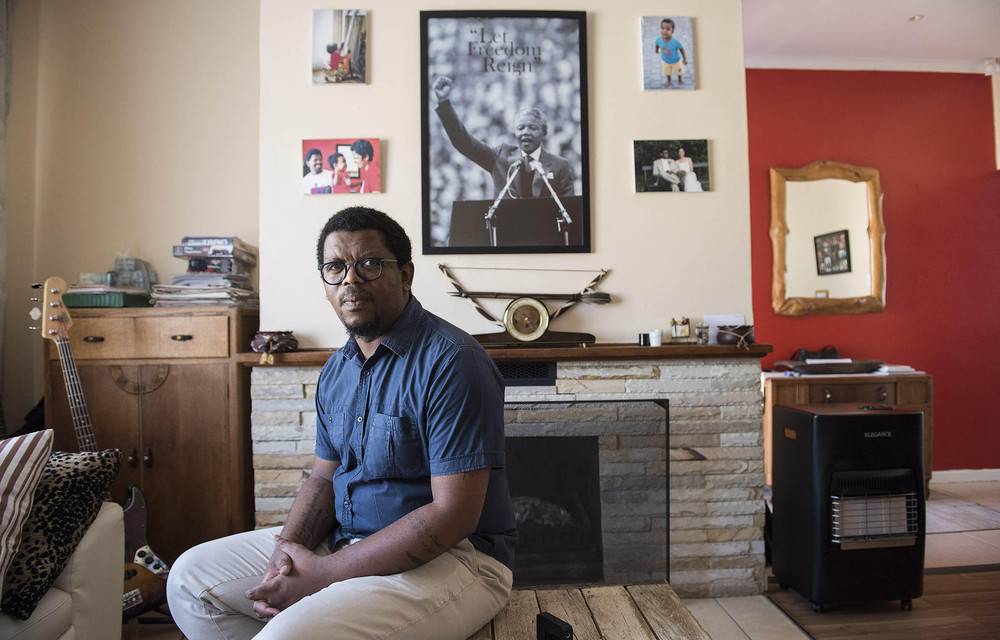 Justice: Lukhanyo Calata, son of the late Fort Calata, wants the people
responsible for his father’s death prosecuted. Photo: David Harrison
Justice: Lukhanyo Calata, son of the late Fort Calata, wants the people
responsible for his father’s death prosecuted. Photo: David Harrison
The unit secured convictions in a handful of cases, including that of former law and order minister Adriaan Vlok and other police officials for the attempted murder of anti-apartheid cleric Rev Frank Chikane. The prosecution went ahead in defiance of political instruction and was one of the factors which was to cost Vusi Pikoli his job as NDPP.
Calata said it appeared that concern that prosecuting perpetrators might open the door to the prosecuting of ANC leaders who had not applied for amnesty appeared to be one of the key factors involved in the closing down of investigations.
Calata said that the record of delivery since then was “dismal,” amounting to five inquests that had been reopened and concluded between 2017 and 2023; four plea and sentence agreements and two concluded criminal trials. Only five criminal cases were before the courts and all had been subject to significant delays.
The main reason for this had been the political interference which “effectively suppressed the pursuit of apartheid-era crimes within a few years of the closure of the TRC”.
“The TRC cases were deliberately suppressed following a plan or arrangement hatched at the highest levels of government and across multiple departments. This is the real explanation for the delay. The interference stands as a deep betrayal of those who laid down their lives for freedom in South Africa, including my father and other fallen comrades,” he said.
Calata traced this back to the announcement by then president Thabo Mbeki in 2003 that certain arrangements would have to be made to accommodate the many perpetrators who did not take part in the TRC process.
“Mbeki signalled that in relation to the TRC cases it was not going to be business as usual. Mbeki was articulating government policy that effectively said that the pursuit of justice in the TRC cases was not to be prioritised and that special arrangements were going to be put into place,” Calata said.
He said that “those wielding power and influence wasted little time in closing down the TRC cases” and prosecutors were blocked when they were refused investigative support by both the DSO and SAPS.
The NDPP was instructed to approach the president for a ruling as to who should investigate, which Calata said, indicated that “the question of investigating the TRC cases was now a purely political one, and a sensitive one at that”.
This was the beginning of two decades of policy changes, obstruction and interference which were ultimately aimed at preventing or delaying prosecutions, with an effective moratorium on TRC cases put in place by 2004.
Calata outlined other steps taken under the Mbeki administration and that of his successor, Jacob Zuma, to undermine the prosecution of TRC cases, including an attempt to push through a special amnesty.
In 2009 Zuma joined in a constitutional court bid by Afrikaner Weerstandsbeweging (AWB) member Ryan Albutt to overturn an interim interdict preventing the amnesty from going ahead.
TRC investigations were put on hold for the duration of the 2010 World Cup but there was little evidence that the cases were taken forward, while subsequent NDPPs continued to suppress investigations, preventing progress until 2017.
During subsequent court applications by the Simelane family, the NPA in 2019 admitted that the prosecution had been delayed “as a result of political interference by others. “
Mbeki has publicly denied interfering in the TRC case, but Calata said the denials were “not consistent with the brazen suppression of the TRC cases that occurred during his administration”.
Calata said that an inquiry should consider Mbeki’s denials and test their veracity.
He said that while the Supreme Court of Appeal had found that the political interference took place between 2003 and 2017, “given the ongoing delays in taking the TRC cases forward, suspicions linger that the obstruction and interference of the past have been difficult to shake off”.
While individual prosecutors had displayed great dedication in a few of the cases, the NPA and the DPCI had only concluded five inquests out of 22 cases it had undertaken to deal with by 2024.
Calata said several attempts had been made to convince the presidency, the NPA and the relevant ministries since then for both a change in prosecution strategy and an inquiry into what had taken place, along with several threats to go to court.
“We do not have evidence suggesting that the president has acted mala fide or for an ulterior purpose in not appointing a commission. However, we are concerned that since such an inquiry will have to probe the role of the government, and quite likely personalities who played leading roles in government, that political considerations may have crept into his decision,” Calata said.
“It is exceedingly difficult to shake this perception, which only grows with the ongoing refusal to get to the bottom of the suppression of the TRC cases.”
Calata said they were seeking constitutional damages and an inquiry to address the president’s improper exercise of power and the violation of their rights.
“The damage has been done. There is no way to turn back the clock. We have to look forward,” he said.
While they were not seeking compensation for personal use, it was “cruel and unjustifiable” that reparations had been “wholly inadequate” while 20 years after the TRC completed its work, R2 billion remained in the President’s Fund.
“We seek damages for the purposes of formal acknowledgement of what we have endured, meaning the vindication of our violated rights and to enforce constitutional values going forward.”
He said the damages would be used to fund 20 inquests over the next five years at a cost of around R3.8 million each; 10 criminal prosecutions (R15 million) and three private prosecutions, amounting to R23 million a year over the next 5 years.
Presidential spokesperson Vincent Magwenya said that they would respond once they had seen the court papers.
“If there is an imminent court process, all that we can do as the presidency is to respond accordingly and engage within that process once we have received the court papers,” he said.
Justice Ministry spokesperson Terence Manase acknowledged that the minister “has been cited in court papers regarding a case filed by relatives of individuals allegedly killed by apartheid security forces.”
“Our legal section is reviewing the documents and will respond accordingly, adhering to due process. “
‘We will collaborate closely with the National Prosecuting Authority and the Presidency on the matter,” Manase said.
Members of the ANC give testimony in Cape Town about human rights abuses committed during apartheid. (File photograph by Gallo Images/ Oryx Media Archive).