Visibility: Last year, a diplomatic clash between President Cyril Ramaphosa and Rwandan President Paul Kagame played out publicly on X. (Instagram/@PaulKagame)
As President Cyril Ramaphosa prepares to deliver the 2026 State of the Nation Address next Thursday, South Africa finds itself at a curious inflection point. The country has climbed to 40th place in the UN E-Government Development Index, the highest ranking in Africa. Yet the achievement contrasts sharply with lived reality.
The sixth South African Government Leaders on X (formerly Twitter) study, released by Decode last Thursday in Johannesburg, shows that many of the politicians meant to represent citizens are absent from the digital spaces where public engagement increasingly happens. This is not merely a communications failure. It reflects a widening gap in participatory democracy.
The study does not argue that governance happens on X. Instead, it observes that leadership is increasingly judged, interrogated and held accountable there, in real time.
Evidence of X’s growing political significance is not difficult to find. Last year, a diplomatic clash between Ramaphosa and Rwanda’s President Paul Kagame over the M23 conflict in the Democratic Republic of the Congo did not unfold behind closed doors. It played out publicly on X.
Ramaphosa posted that South African peacekeepers had been killed by forces, including the “Rwandan Defence Force militia”. Kagame responded on the same platform, disputing the claim and warning that Rwanda would “address the situation accordingly” if South Africa sought confrontation.
Millions of people across Africa and beyond watched the exchange unfold. It was a reminder that X has become a primary stage for international diplomacy, where
leaders stake positions instantly and unfiltered.
The study marks a significant shift. For the first time since its launch in 2020, it extends beyond national and provincial cabinet members to examine the digital presence of accounting officers, including chief executives, executive directors and commissioners, across state-owned entities (SOEs) and chapter nine institutions.
Its findings warrant urgent attention. In a country where SOEs shape daily life — from electricity and transport to telecommunications — the absence of their leadership from digital platforms represents a serious accountability gap.
There are, however, exceptions that show what is possible when leaders embrace digital engagement strategically. Mteto Nyati, Eskom’s board chair since 2023, has demonstrated how transparent and consistent communication can help rebuild public trust in even the most beleaguered institution.
Nyati and his board inherited an Eskom synonymous with a crisis: stage six load-shedding, collapsing infrastructure and public confidence at historic lows. His response included making himself visible and accessible on X, where he maintains an active presence and engages South Africans on the utility’s challenges and progress.
When Eskom achieved 148-consecutive days without load-shedding in 2024, Nyati used mainstream and social media to explain the turnaround. He pushed back against claims that the improvement was electoral manipulation or a “miracle”, choosing instead to share data and context openly.
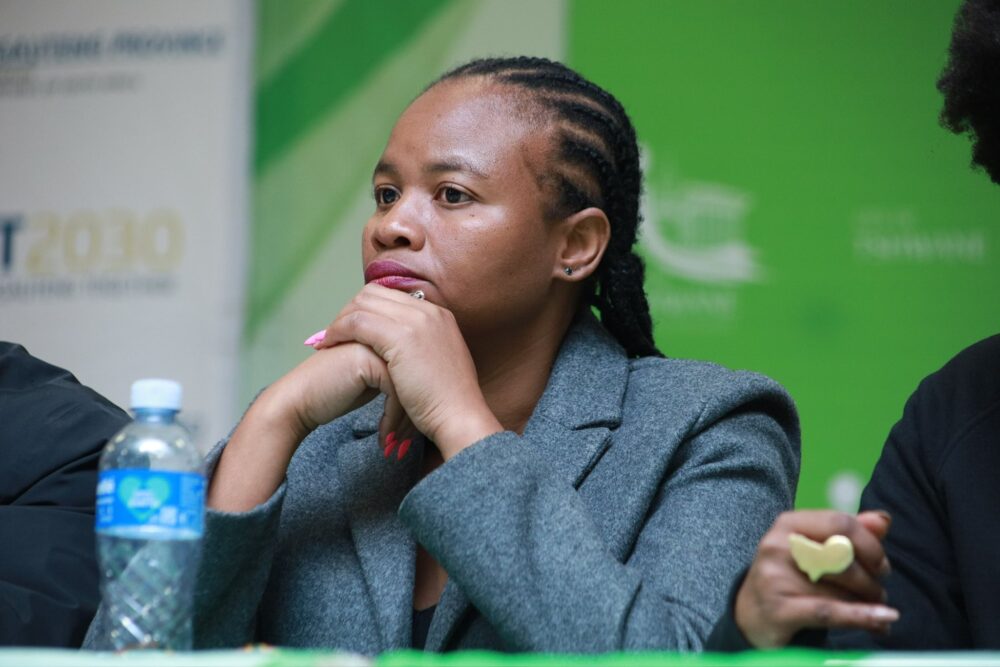 Tshwane mayor Dr Nasiphi Moya’s strong online presence signals that accessibility equals accountability. (Tshwane Metro)
The approach reflects exactly what the South African Government Leaders on X study has advocated for six years: honest, direct conversations with citizens who deserve more than announcements and ceremonial appearances. Nyati, an engineer by training, has made it clear that transparency is central to rebuilding trust and helping people understand both Eskom’s successes and its challenges as they unfold.
The contrast with other SOE leaders — many of whom maintain no digital presence, including Eskom group chief executive Dan Marokane — could not be starker. In a country where state enterprises collectively hold more than R1 trillion in assets and employ hundreds of thousands of people, such digital silence amounts to a governance failure.
At municipal level, similar exceptions underline the broader problem. Tshwane, South Africa’s administrative capital, hosts 134 embassies and 30 international organisations, making it second only to Washington DC in the concentration of diplomatic missions. The status demands governance that extends well beyond municipal boundaries.
Dr Nasiphi Moya, who became Tshwane’s executive mayor in October 2024, illustrates what meaningful digital leadership can look like. With more than 63 000 followers on X, she shares infrastructure plans, responds to service-delivery questions and brings a human presence to the mayoral office. Her approach signals a clear message: in the digital age, accessibility equals accountability.
This is the model the study has promoted for six years. Yet Moya and Nyati remain outliers. Across provinces most affected by service-delivery failures, including the Eastern Cape, Free State, North West and Northern Cape, political and administrative leaders remain largely absent from digital discourse.
The urgency of online engagement becomes even clearer when viewed against the collapse of public trust in the government.
According to a Human Sciences Research Council study on trust in the police, only 22% of South Africans trust the police, the lowest level since 1998. The 2025 Edelman Trust Barometer found that just 36% trust government overall. In a context of rising social unrest, these figures are deeply concerning.
Digital platforms offer one of the few remaining spaces to rebuild trust. Citizens want leaders to show up, respond and remain accessible. When leaders answer questions, acknowledge mistakes and explain their reasoning, they foster connections that no press release can replicate.
The traditional imbizo was rooted in direct conversation. Today, X and other platforms function as virtual imbizos. Citizens do not expect policy decisions to be made there but they do expect leaders to participate where public debate is happening.
Kenya’s experience in mid-2024 provides a cautionary example. When President William Ruto’s government introduced a contested Finance Bill, Gen Z activists mobilised on TikTok and X. They explained the bill in local languages and coordinated protests that ultimately forced the government to retreat. The campaign reached more than 750 million people globally, driven almost entirely by
social media.
It would be naïve to assume South Africa is immune to similar mobilisation. The country has a large youth population, high social media penetration and persistent frustration over service delivery. The question is not whether digital movements will emerge but whether leaders will be present when they do.
Any discussion of digital engagement must also acknowledge the broader technology landscape. Under Elon Musk’s ownership, X has rolled back policies restricting crisis misinformation and false claims about election outcomes. European Commission re-
search has found disinformation to be more prevalent on X than on other major platforms.
Paradoxically, the reality strengthens rather than weakens the case for government participation. Verified, authoritative accounts that share consistent and factual information act as anchors of credibility.
When officials are absent, information vacuums are filled by speculation and bad actors. Nyati’s example shows that sustained, evidence-based engagement helps citizens distinguish fact from noise.
The timing could hardly be more significant. With municipal elections scheduled between November 2026 and January 2027, local governance will face intense scrutiny. The registration of 27.67 million voters, with the largest group aged 30 to 39, highlights a demographic that is both digitally active and increasingly impatient with inaccessible leadership.
Municipal leaders responsible for essential services can no longer afford digital silence. As anger over water, electricity and infrastructure failures accumulates daily, absence becomes an accelerant rather than protection. Moya’s leadership in Tshwane offers a practical template. Nyati’s experience at Eskom proves that it can work even under extreme institutional pressure.
Meaningful change requires more than encouraging leaders to open social media accounts. First, digital engagement must be recognised not as a communications task but as a governance responsibility. Second, there must be investment in verification and consistency so that official accounts are recognisable and trusted. Third, leaders must accept the discomfort that comes with visibility, including real-time accountability.
The 2026 State of the Nation Address will outline ambitious policy goals. But policies implemented in digital silence — by leaders invisible in the spaces where citizens live their civic lives — will struggle to earn democratic legitimacy.
If Moya can manage a diplomatic capital while maintaining a responsive digital presence, claims of being “too busy” ring hollow. It is reasonable to expect that leaders responsible for water, sanitation and other critical services respond when residents repeatedly seek answers about crises.
The imbizo is now digital. A genuine digital imbizo requires listening as much as broadcasting. It demands leaders who respond rather than merely announce, institutions rather than personalities, and engagement on platforms citizens use. The question remains: Will our government and public sector leaders attend?
Lorato Tshenkeng is chief executive of Decode, a reputation management and advisory firm, and author of the South African Government Leaders on X report.