Scarcity in the land of plenty: It is an anomaly that in a country like ours - capable of feeding all - there are people who still go without food, especially children under five, who face
chronic malnutrition, according to Unicef’s State of the World’s Children report. Photo: Benjamin Anguandia
In South Africa, we often speak about hunger as though it were an unfortunate side effect of poverty, climate shocks or global food prices.
But this framing obscures the firm truth: widespread hunger persists not because the country cannot feed itself but because the way food is controlled, distributed and governed actively excludes millions of people.
South Africa produces ample food. Yet large numbers of households struggle to secure regular, nutritious meals.
Children continue to suffer lifelong consequences such as stunting and impaired brain development from undernutrition. These outcomes are neither mysterious nor accidental.
They are the result of policy choices, market structures and historical decisions that continue, in the present day, to shape who eats well and who does not.
The roots of this crisis run deep. Systems of land dispossession and agricultural restructuring under colonialism and apartheid dismantled local food economies and concentrated productive land in a few hands. These patterns did not disappear in 1994.
They evolved and remain entrenched.
As a society, we have become accustomed to these patterns. We speak of hunger in reports and surveys but we rarely treat it with the urgency reserved for other constitutional failures.
Today, South Africa’s highly commercialised food system prioritises export earnings, efficiency and shareholder value, while access and nutrition are treated as secondary concerns.
The result is a quiet normalisation of deprivation in a country that claims human dignity and ubuntu as founding values.
The Constitution does not permit this indifference. The right to food is neither aspirational nor an abstract concept. It is enforceable. For children, it is immediate.
Yet decades into democracy, statistics reveal a persistent triple burden facing children. Unicef’s State of the World’s Children report noted that a significant number of South African children under five years of age face chronic undernutrition (stunting and wasting), hidden hunger (anaemia) and overweight or obesity.
Where these conditions persist at scale, it signals not only poverty but a failure of governance.
This is why hunger cannot be addressed through food parcels, feeding schemes or emergency relief alone. These interventions, which are temporary, may prevent immediate starvation but they do not change the conditions that produce hunger in the first place.
In October 2025, a national World Food Day webinar hosted by the South African Human Rights Commission and the Union Against Hunger brought together government officials, civil society, academics, farmers and health professionals to reflect on this impasse.
What emerged was a shared recognition that debates about food must move beyond supply and calories towards deeper questions of control, governance, land, corporate power and public participation.
This shift matters. Food systems are not neutral. They are shaped by laws, budgets, zoning decisions, market regulation and enforcement or the absence of it.
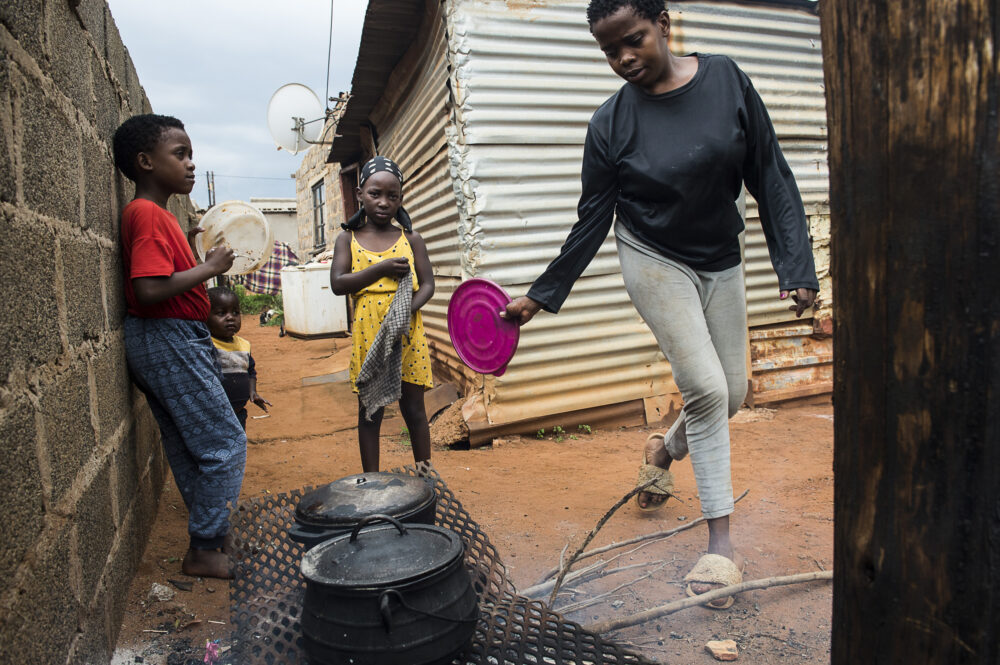 On the hearth: Hunger is not inevitable but is produced by systems that
can be changed so that families do not struggle to put food on the table.
On the hearth: Hunger is not inevitable but is produced by systems that
can be changed so that families do not struggle to put food on the table.
Local governments influence food access through spatial planning and trading rules. National policy shapes who can farm, who can sell and at what scale.
Corporations exercise enormous influence over prices, availability and dietary patterns.
When these actors operate without coordination or accountability, hunger becomes predictable.
Recent food safety failures, including reports of foodborne illness and the use of dangerous pesticides in poor communities, further expose the costs of weak oversight.
When regulation fails, it is the most vulnerable who pay the price.
This recognition informs the Commission’s intention to convene a national public inquiry into the right to food from 12 to 20 March 2026.
The significance of this public inquiry will lie not in restating what is already known but in asking questions that have too often been avoided: who bears responsibility when the right to food is not realised and what consequences follow?
An inquiry that merely listens will change little. One that clarifies duties, exposes systemic blockages and demands concrete commitments could mark a turning point.
Hunger is not inevitable. It is produced by systems that can be changed. Whether South Africa chooses to change them will be the true measure of its constitutional commitment.
The coming inquiry offers that opportunity.
The call for submissions is open until 27 February 2026.
Philile Ntuli is a commissioner of the South African Human Rights Commission. Her focal areas include land rights, the right to food and the national preventive mechanism. She is also a recipient of the M&G Power of Women 2025 award.