Jamming: Recorded live at the Bird’s Eye Jazz Club in Basel, Switzerland, Way Out Is In captures Yenana at a point of reckoning. Photo: Bram Lammer
When Andile Yenana talks about the process of recording his latest album, there is no sense of drama in his voice.
He speaks about time, patience and listening – to music, to culture and to himself. Way Out Is In, his first solo album in 20 years, feels less like a re-entry than a quiet arrival at a place he has been moving towards all along.
Recorded live at the Bird’s Eye Jazz Club in Basel, Switzerland, Way Out Is In captures Yenana at a point of reckoning.
It is a record shaped by decades of touring, teaching and collaboration, but also by withdrawal, reflection and the slow work of finding a voice that belongs fully to him.
At 57, Yenana sounds neither nostalgic nor tentative. If anything, the album reveals an artist deeply comfortable with uncertainty, improvisation and the idea that learning never really ends.
Way Out Is In was recorded across several days in June 2018, as part of a long-running cultural exchange programme that has brought South African jazz musicians to Switzerland since the early 2000s.
Yenana performed two nights at Bird’s Eye with a mixed ensemble that included long time collaborator Marcus Wyatt on trumpet, trombonist Siya Charles and Swiss musicians he had already developed a rapport with during an earlier visit.
Those first two nights were recorded in front of a live audience, followed by a third day in the same venue without an audience present.
Yenana later drew from both sessions, selecting roughly 60 percent from the live recordings and 40 percent from the closed set to complete the album. The decision to record live was central to the project. For Yenana, improvisation is not a stylistic flourish but a philosophy. “I didn’t even have charts written,” he says. “That’s how I was taught. And that’s what I did with them as well.”
That openness extended to how the music unfolded on stage. Bird’s Eye, a revered jazz venue that regularly hosts international artists, offered a listening culture very different from what Yenana was used to back home. Audiences listened intently, applauded generously and waited for pauses before responding. On the first night, he found himself slightly disoriented.
“In South Africa, people are drinking, talking, moving around,” he recalls. “If they clap, you’re thinking about how to get them back into the groove. Here, when you finish, they clap properly. I wasn’t ready for that.”
He remembers starting the next piece before the applause had settled, only to realise the audience was responding to what had already passed. By the second night, he had relaxed into the rhythm of the room. The shift mattered. For Yenana, performance is as much about sound as space. The piano, the room, the audience and the musicians form a single organism.
“I learned a lot of that from Zim,” he says, referring to the late Zim Ngqawana, one of South Africa’s most revered jazz innovators and a figure who looms large in Yenana’s life and career.
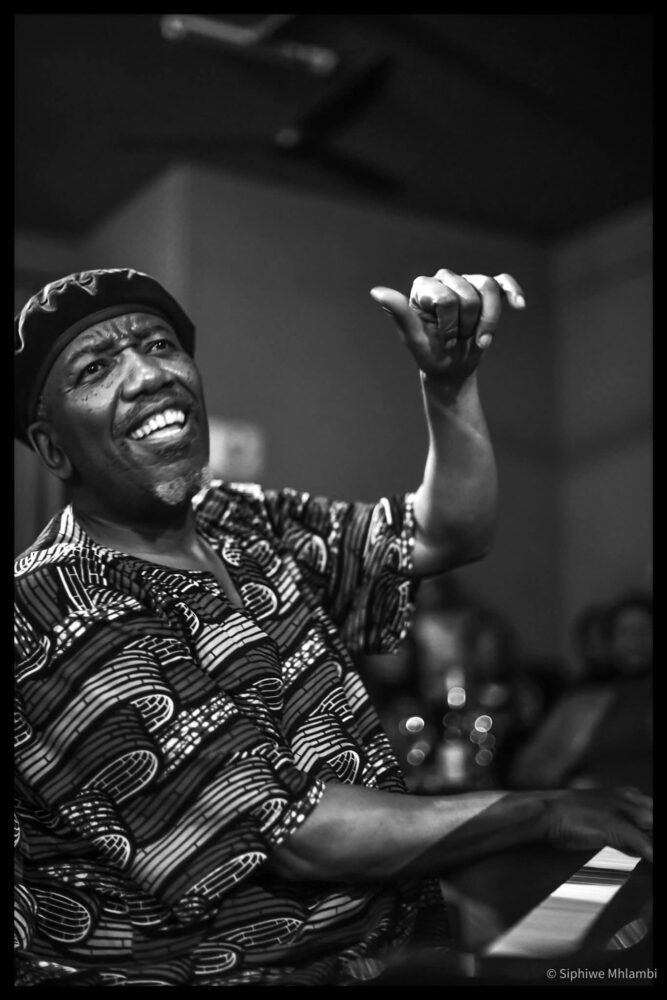 With the album now finally released, Yenana is preparing to return to Switzerland to launch it live, carrying physical copies and reconnecting with collaborators. Photo: Siphiwe Mhlambi
Yenana began working with Ngqawana at a young age and toured extensively with him across the United States, Europe, Cuba and Russia.
It was an education unlike any conservatory training. Ngqawana’s performances were spiritual, immersive and uncompromising. Incense on stage, extended improvisations and a deep engagement with sound itself were all part of the experience.
“You didn’t just play notes,” Yenana says. “You played with sound. With space. With silence.”
But that proximity to greatness came with its own complications. Touring with Ngqawana and other elders such as Winston Mankunku Ngozi, Steve Dyer and members of the exile generation meant being constantly in the presence of musicians who were clear about who they were and what they wanted to say.
“I was taken along with people who were ready to speak,” Yenana reflects. “And I was learning so much. But at some point, you have to ask yourself, what is it that I am saying?”
For years, he felt as though he was moving in the slipstream of giants. Grateful for the opportunities but unsure of where his own voice began and ended. That uncertainty contributed to the long gap between his earlier recordings and Way Out Is In.
Yenana’s debut album, We Used to Dance, released in 2002, earned a South African Music Award nomination for Best Jazz. His follow up, Who’s Got the Map?, released in 2005, received five SAMA nominations. By most measures, his trajectory was strong. Yet instead of pushing forward with more solo work, he found himself collaborating, teaching and absorbing.
“I had to get out of their shadow,” he says simply. “Not because of ego. But because I needed to understand myself.”
That understanding did not arrive all at once. It emerged through solitude, teaching and a return to foundational sounds. During periods based in Johannesburg, Yenana spent long stretches practicing alone, stripping his playing back to essentials. Later, while teaching at the University of Venda, the experience of living and working in a different cultural environment offered further perspective.
“Travelling from Joburg to another place, learning the culture, making friends, playing music, it humbles you,” he says. “It all becomes part of the arsenal.”
The title Way Out Is In reflects that inward turn. For Yenana, it speaks to the necessity of exposure, travel and challenge but also to the moment when one turns back towards oneself.
“You step out of your comfort zone to learn,” he explains. “Then you come back in and you’re ready to say something.”
That process also involved reconnecting with Xhosa folk songs he grew up with. Rather than quoting them directly, Yenana reimagines their spirit through the piano, allowing memory and improvisation to guide his interpretations.
“I had to strip away things that no longer aligned,” he says. “Old relationships. Familiar places. Certain versions of myself.”
Way Out Is In is not a record that announces itself loudly. Its power lies in its restraint, its trust in space and in collective listening. The collaboration with Swiss musicians was crucial in this regard. Having worked with them previously, Yenana arrived in Basel with a shared musical language already in place. Adding Wyatt and Charles into the mix felt organic rather than disruptive.
Marcus Wyatt, a longtime collaborator, brought a shared history and intuitive understanding. Siya Charles, then a younger voice, slotted in with ease. “She just fitted,” Yenana says. “The whole thing came together naturally.”
The absence of rigid structures allowed the musicians to meet on equal terms. Rehearsal, connection and professionalism did the rest. “Once rehearsal goes well, it’s expected of you to make something out of it,” Yenana says.
The album also reflects Yenana’s position as a jazz musician operating outside the American context. Like many South African artists of his generation, he learned jazz through records, films and fragments, shaped by apartheid era isolation and later by formal training introduced through programmes such as Darius Brubeck’s work in KwaZulu-Natal.
“Our cultural sensibilities are always present,” he says. “There are moments of clash, of negotiation. But that’s where the music lives.”
For Yenana, the encounter between South African experience and the broader jazz tradition is not a tension to resolve but a space to inhabit. Way Out Is In documents that space with clarity and confidence.
Listening back to his earliest recordings, including sessions made in Norway in the mid 1990s, Yenana is struck by how much was already there. “It’s like I covered everything back then,” he says. “I just didn’t analyse it. I played.”
Now, older and more reflective, he is wary of becoming overly cautious. The challenge, he says, is to prepare deeply without losing spontaneity. Practice, discipline and physical stamina matter but so does trusting instinct.
“I don’t want to think too much,” he says. “I just want to play.”
That balance feels hard won. Way Out Is In carries the weight of experience without sounding burdened by it. It invites listeners into unfamiliar territory, not to impress but to connect.
Yenana hopes the album offers listeners a sense of resolution or at least permission to sit with uncertainty. “It invites you to extend yourself,” he says. “Into known and unknown spaces. To find yourself.”
With the album now finally released, Yenana is preparing to return to Switzerland to launch it live, carrying physical copies and reconnecting with collaborators. Further touring is planned, alongside performances at home, where he finds renewed energy in South Africa’s jazz ecosystem.
“What surprises me is the young people,” he says. “There’s no jazz police. No fear. Just voices.”
For Yenana, that openness mirrors his own journey. After decades of searching, learning and listening, Way Out Is In feels less like a destination than a moment of alignment. An artist standing firmly on his own ground, ready, finally, to play music in his own voice.