Now in its 13th edition, the 2026 Investec Cape Town Art Fair revealed winners across five key prize categories, including the Investec Emerging Artist Award which was given to Warren Maroon on the first day of the fair.
There were also two newly introduced awards that signal an expanded understanding of where contemporary art is heading: the ORMS International Photography Prize and the Materiality Prize in partnership with Homo Faber.
Together, the honours create momentum, visibility and, in some cases, the kind of international access that can quietly recalibrate a career trajectory.
The Tomorrows/Today Prize, supported by Fiera Milano Exhibitions Africa, was awarded to multidisciplinary artist Chidirim Nwaubani, represented by Doyle Wham. The prize has long functioned as a barometer for emerging voices and Nwaubani’s practice sits squarely within its forward-looking mandate.
Based in the United Kingdom, Nwaubani works at the intersection of digital technology and cultural heritage, using immersive installation and augmented reality to probe questions of identity, memory and repatriation.
Their work has already appeared at major international platforms, including the Venice Biennale, but the recognition here underscores the growing urgency of practices that treat digital space not as novelty, but as a contested cultural terrain.
As founder of Looty, a platform advocating for the return of looted African artefacts through digital storytelling, Nwaubani’s work extends beyond the gallery into the politics of historical restitution.
If the Tomorrows/Today Prize looks toward speculative futures, the RDC Art Collection Award remains grounded in the slow work of public visibility. This year’s recipient, Mellaney Roberts of Berman Contemporary, receives not only acquisition but the promise of exhibition within one of RDC’s landmark buildings, a form of sustained exposure that outlasts the fair’s four-day intensity.
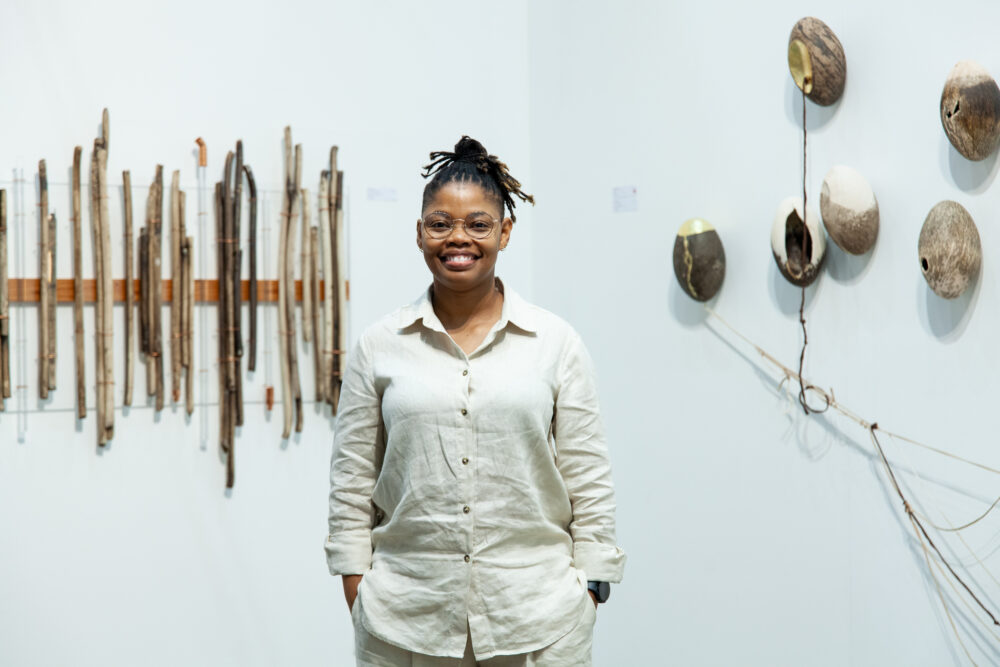
Roberts, a contemporary ceramist currently pursuing a PhD in Fine and Studio Arts at Tshwane University of Technology, framed the win as collective rather than individual.
“It’s with the community that I grew up with in Bobbejaanskloof and in a sense of identity,” she said. “So, it’s not just for me, but it’s also about taking it back to my community, showing them the appreciation and the hard work that went into excavating their memories, identity, and what land means to us.”
Her practice, rooted in both research and material process, has steadily accumulated institutional recognition, from the Nina Hole Memorial Residency Award in Denmark to repeated selection for major South African art prizes. The RDC award positions that trajectory within a more sustained public frame.
Photography, meanwhile, took a decisive step forward with the introduction of the inaugural ORMS International Photography Prize, awarded to Sibusiso Bheka, represented by Afronova. The new category arrives at a moment when the photographic image, endlessly reproduced yet increasingly contested, is being re-evaluated as both document and conceptual instrument.
Born in Katlehong and introduced to photography through the Of Soul and Joy Project in 2012, Bheka has built a practice rooted in the everyday textures of Thokoza, where he lives and works. His images function as quiet testimony, tracing the lingering imprint of South Africa’s violent past alongside the fragile intimacies of township life.
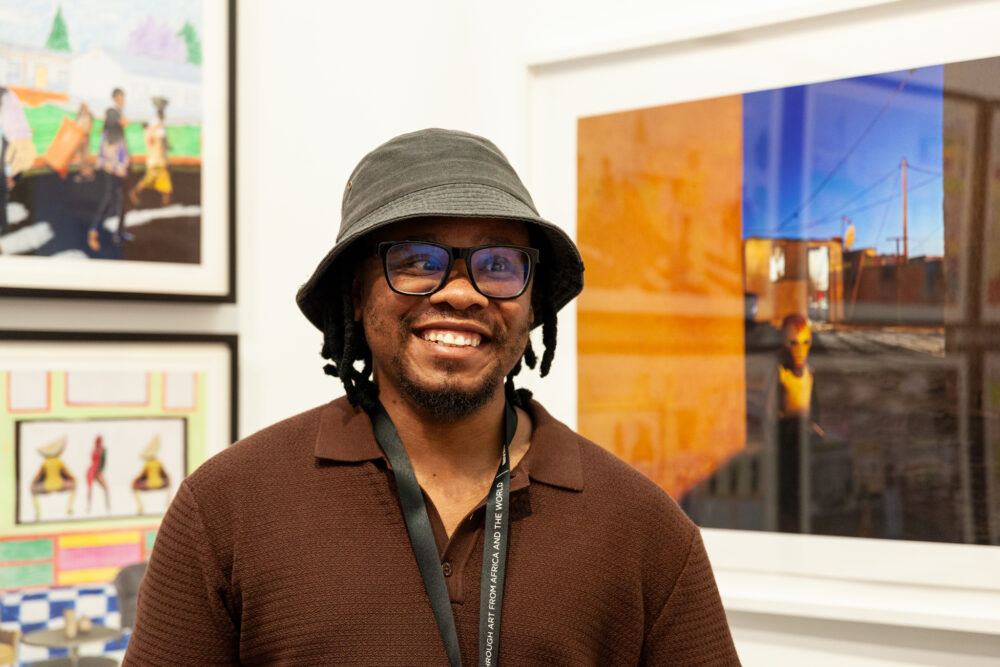
“The win for me represents hope and also patience,” Bheka noted, a characteristically understated reflection that mirrors the tonal restraint of his work. Alongside a cash prize, the award includes a Canon imagePROGRAF PRO-1100 printer, enabling the production of museum-quality archival prints and signalling the prize’s investment not only in recognition but in the material conditions of photographic practice.
Material, process and the intelligence of the hand came into sharp focus with the Materiality Prize, presented in partnership with Homo Faber. The award went to Amy Rusch of Suburbia Contemporary, whose practice treats material not simply as medium but as a site of embodied inquiry.

Rusch works across disciplines, most notably through stitched interventions into layers of found plastic bags. Her process which includes cutting, heating, binding and layering unfolds with a deliberately uneven rhythm, moving between slow accumulation and sudden gesture.
The resulting works sit in a charged space between craft, environmental critique and tactile abstraction. “The process is about sitting with the remnants of man-made materials,” Rusch explains. “Human time in contrast to the elemental and deep time.”
The prize includes an all-expenses-paid invitation to the Homo Faber Fellowship Masterclass in Venice, an eight-month international programme that bridges artisanal knowledge across generations and geographies.
In a moment when the art world is increasingly attentive to tactility and process, the award positions Rusch within a global conversation about what it means, and what it costs, to make by hand.