There’s a moment I see regularly in clinic. A man sits down, pulls out his phone, and shows me a photograph, usually a screenshot from a video call, sometimes a LinkedIn profile picture someone else has taken, occasionally a candid from a family event.
He looks at it the way you’d look at a stranger. “Is that really what I look like?” he asks. It is. And that’s precisely why he’s here.
The Screen That Changed Everything
Video conferencing didn’t just change how we work, it changed how men see themselves. Before Zoom, before Microsoft Teams, before the proliferation of front-facing cameras and high-definition screens, most men moved through life with a relatively untested image of their own face.
The bathroom mirror is forgiving. It’s static, it’s familiar, and crucially, you’re not watching yourself talk, frown, and listen in real time.
The pandemic changed that in a matter of weeks. Suddenly, men
were spending hours a day watching themselves on screen in morning stand-ups, client pitches, board meetings, and virtual drinks with friends.
The camera renders everything: the shadow under the eye, the loosening of the jawline, the texture of the skin under harsh ring-light. It’s less a reflection and more a document.
Social media compounded this. A LinkedIn profile photo is no longer just a headshot, it’s a first impression delivered to hundreds of potential clients, employers, or collaborators before a single word is exchanged. Dating app profiles run on a logic that is purely visual, and unforgiving.
And as male celebrities from athletes to actors to executives became more visibly invested in their appearance, openly discussing skincare, skin treatments, and the work they’d had done the cultural permission structure shifted.
The result? Men are now walking into aesthetic medicine clinics in significantly greater numbers than they were five years ago
What’s changed isn’t vanity. It’s awareness.
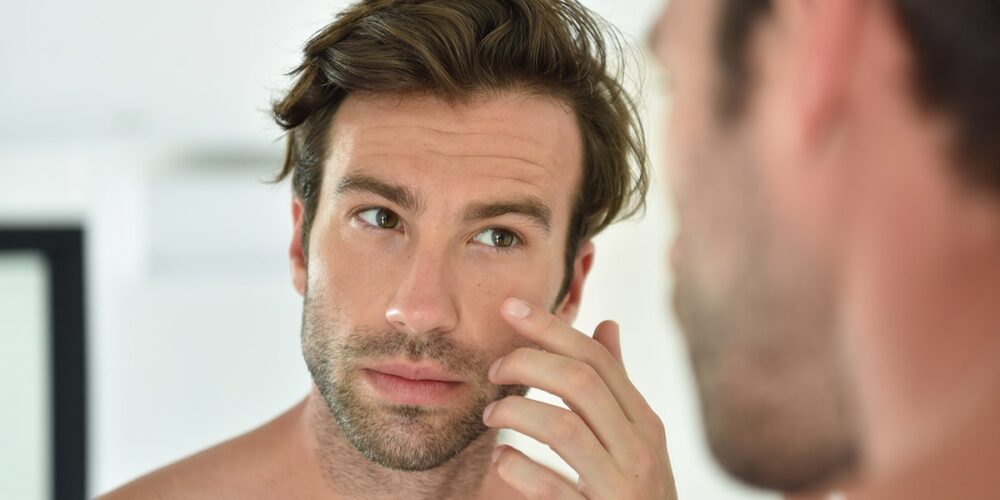
What the HD Effect Reveals
The language I use in clinic when speaking to male patients is specific: I talk about the HD effect. High definition cameras, particularly at close range during video calls, reveal things that weren’t previously visible or noticeable in everyday life.
They show what happens when collagen thins and the skin loses its structural scaffolding. They highlight under-eye hollowing that tired, slightly sunken quality that can make a well-rested man look chronically fatigued on screen. They catch the early descent of the jawline, the softening that turns a defined edge into something less decisive.
Men who come to see me aren’t chasing a different face. They’re managing a gap. The gap between how they feel internally and what is now, thanks to modern technology, being broadcast back to them in high resolution.
The concerns are remarkably consistent:
• skin laxity and the early stages of jowling,
• under-eye hollowing,
• skin texture and tone that looks dull or uneven on camera,
• Fine lines and wrinkles, particularly around the forehead and the corners of the eyes, • and for many men, hair thinning that has become more apparent now that they’re looking at the top of their own heads on video calls more than ever before.
These are structural and physiological changes. Treating them is problem-solving. What Men Are Doing About It
The treatments men are choosing tend to reflect their preference for efficiency and results.
Injectables – both neuromodulators for dynamic lines and dermal fillers for structure, remain among the most requested.
Skin tightening and resurfacing treatments address texture and laxity especially now with the advent of the GLP 1 face
Platelet-rich plasma therapy and targeted hair restoration protocols have seen a notable surge in male patients, as have medical-grade skin programmes that deliver measurable change in pigmentation, clarity, and firmness.
What’s notable is not the treatments themselves, many of these have existed for years but the purposefulness with which male patients are now approaching them.
Men arrive having done research, They know what they want addressed, they ask about mechanisms and downtime with the same diligence they’d bring to a business decision, and they want to understand the return on their investment. Because that’s exactly how they frame it: an investment. In that sense, the conversation in clinic has shifted. We’re not selling anything. We’re consulting.
The Normalisation That’s Already Happened
The idea that men caring about their appearance is somehow novel or culturally marginal is, at this point, demonstrably outdated.
Male grooming has been a multi-billion-dollar global industry for years.
The skincare category alone has seen sustained double-digit growth in male consumer spending. Luxury brands have built dedicated men’s skincare lines. Barbershops have evolved into full grooming experiences.
The infrastructure of male self-investment has existed for a generation. Aesthetic medicine is simply the next logical extension of it.
What’s new is the conversation.
Men are talking to each other about this about what they’ve had done, what they’d consider, what they’ve noticed about themselves on camera. The discretion that once characterised male aesthetic patients is giving way to something more pragmatic: if it works, why wouldn’t you?
The Practitioner’s Perspective
I see this shift daily. The demographic of male patients coming through the door at Skin Renewal has changed. Not just in numbers, but in attitude. Less apologetic, more precise. Older men who have decided that looking as capable as they feel is not an indulgence. Younger men in their thirties who are thinking proactively, wanting to maintain rather than correct.
The camera doesn’t lie. But it also doesn’t have to be an adversary. With the right intervention, at the right time, it can simply confirm what you already know, that you’re looking as sharp as you think you are. If you’ve found yourself in that moment, phone in hand, questioning the face on your screen, it might be worth a conversation. That’s all it takes to start.
Skin Renewal offers comprehensive consultations for men. To book, visit skinrenewal.co.za for the branches nearest you or contact the Live chat team on the website