Mandy Johnston's latest exhibition uses burning steel wool sculptures and ash paintings to explore ritual, transformation and the transitions that shape our lives
If you have been to the supermarket lately and found shelves mysteriously missing steel wool, I can explain. It was Mandy Johnston. She bought every roll of steel wool. To burn it.
Okay, okay, maybe I am exaggerating a bit.
Let me rewind. Johnston is a South African artist. She has an exhibition, titled Gatherer, on at the Berman Contemporary All Women Art Gallery, V&A Waterfront, in Cape Town.
Where does the steel wool fit in?
“Steel wool, for me, is like a commentary on the fact that we construct these man-made things that seem so strong and so formalised. Steel is one of the hardest substances on Earth but in another form it’s so fragile and can burn,” said Johnston, a few days before the exhibition’s opening on Thursday, 28 May.
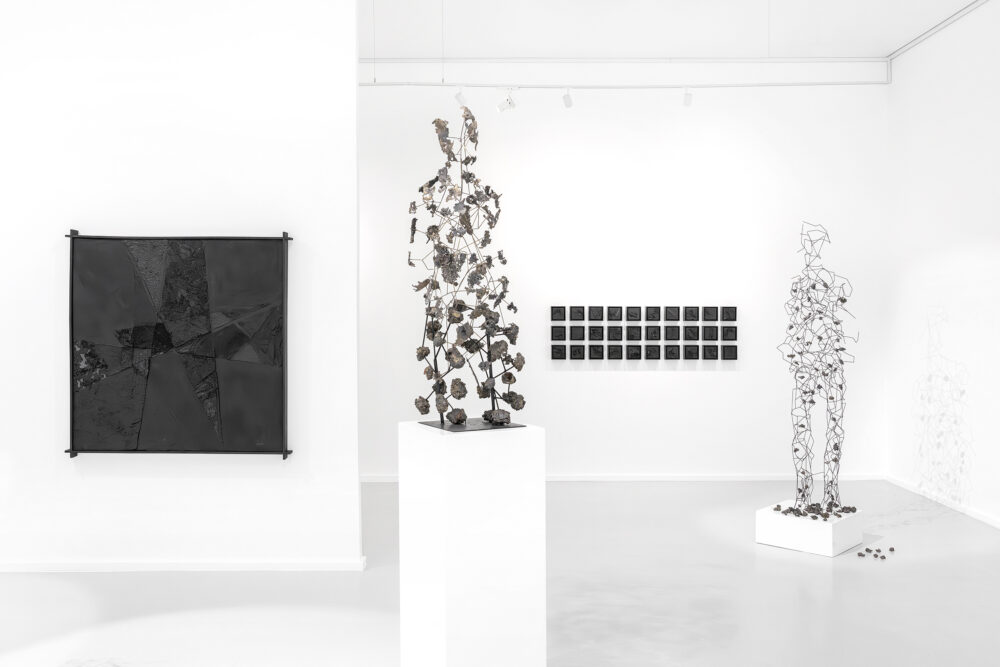
At the opening, selected human-form wireframe sculptures, including dog sculptures, were set alight, their steel wool surfaces erupted into orange sparks before collapsing to the floor. It was beautiful to watch the one-off component of the exhibition. I am not sure if Johnston will be recasting the sculptures in steel wool to reburn them for another audience. When I asked, it was a firm “no”. Videos of the burn do exist. Art buyers then buy the burnt remaining frames/sculptures.
Aside, I knew Johnston’s work and it hit me that her first work I encountered was at this year’s Cape Town Art Fair, where I called her beautiful burnt wood sculpture an anorexic Jackson Hlongwane sculpture. I have been a fan ever since. Those who have been to AfrikaBurn might have seen her Burning Man Sculpture too. These are works of art to admire, really.
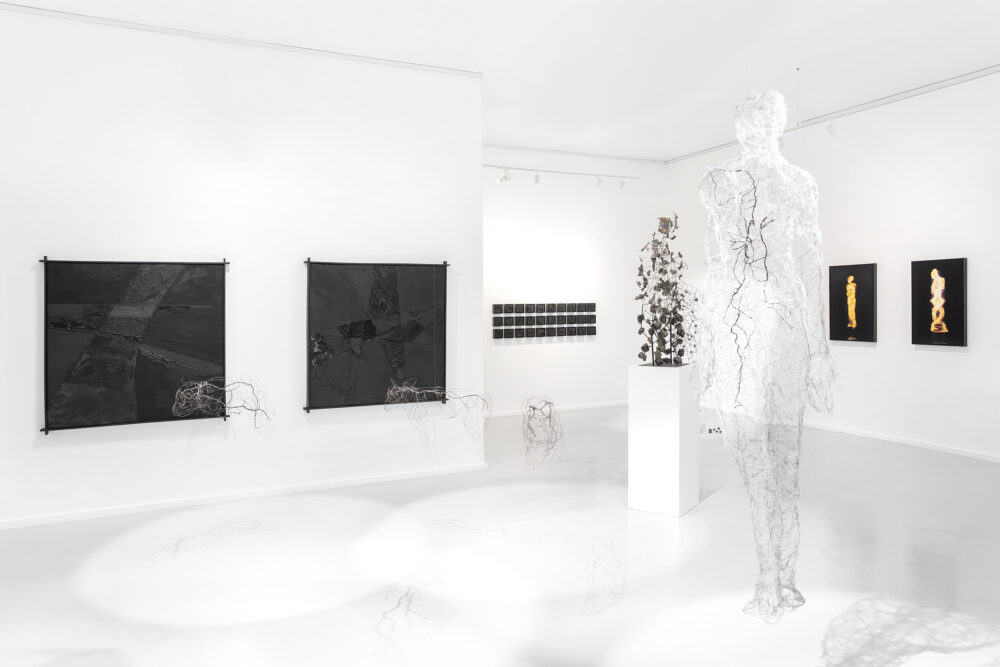
Along the walls of the new exhibition are some visually appealing black landscape paintings. I later learnt that they were not paintings in the traditional sense of the word but rather ash from the sculpture burns. The remnants have been reincorporated into paintings and titled Earth Meets Ash. The surfaces are smoky and mineral-rich, suspended somewhere between landscape and memory. They resemble scarred fields viewed from above or weather systems gathering over exhausted terrain.The exhibition, which has technically been unfolding since 9 May this year, has been open for some time before the official opening.
Johnston spent three weeks inside the gallery building her work in situ; inviting strangers, friends and passing tourists into the making of it. People wandered in while she stitched steel wool onto wire dog sculptures and spread out ash on canvasses.
The cleaning ladies outside quipped and called the gallery “la ndawo ineziporho ngaphakathi!” [the place with ghosts inside] owing to the appearance of the wireframe sculptures with steel wool. I envy whichever collector gets the artworks.
There is something deeply Johannesburg about Johnston. Not merely because she was born and raised there, or because she studied Fine Art at Wits under Walter Oltmann, Karel Nel, Penny Siopis and more art luminaries, but because her work carries the psychic architecture of the city of Johannesburg: its unease, improvisation, violence, tenderness and constant becoming. “Johannesburg teaches people to build while things are breaking,” she said.
Johnston speaks in long, searching thoughts, as though she is discovering ideas while articulating them. At one point she recalled a two-week Wits seminar unpacking the word “tradition” with Colin Richards; an experience that has remained etched in her thinking ever since.
“If you look at tradition and the different ways we understand it, you realise it can both preserve culture and hold it back. Accepting something simply because ‘that’s how it has always been done’ is not necessarily healthy. This tension feeds into a lot of my thinking.”
And here our chat went as far as the Xhosa custom of ulwaluko; where boys become men. Calls for the banning of ulwaluko fall slap-bang into Johnston’s thinking on transitions and how we, as humans, are failing to handle changes.
“We have lost a lot of ceremonies and ways of dealing with transitions. The problem with doing away with customs like ulwaluko is what about all the other things that go along with it? What about the teachings from the elders? It is not just only that moment when there is a medical issue to attend to. It is not only that. Yes, some traditions do need to be let go of. But consider everything that goes away with that going.”
Gatherer is not interested in dismissing ritual. Quite the opposite. The exhibition aches for its absence.
“My work at the moment is around transitions in our lives and looking at ways in which we can support one another through transitions. The burn is a moment in time that represents that transition because we all go through these things.”
She speaks about childbirth, mental-health diagnoses, grief and political rupture. She speaks about growing up during apartheid’s collapse and the strange dissonance of inheriting freedom alongside trauma. She speaks about communal rites that contemporary society rejects wholesale, sometimes rightly, but without replacing the structures of care and collective meaning that once accompanied them.
Johnston’s own life has had several acts of transitions. Straight out of university she built corporate sculptures, taught art at schools and even ran a nightclub called The Songwriter’s Club in the Old Mill building near Carfax in Johannesburg.
Eventually she realised all the auxiliary identities were obscuring her main identity and went back to her first love. Art.
Today she also runs Mothership studios in Fishhoek where she supports women in the arts who are caregivers or mothers. The idea was born out of what she calls “the high fall-out rate of women artists once they give birth to children”, they struggle to go back to being artists.
That said, this is an artist one would like to meet and listen to. An artist who is moving consciously through a world in which we are seemingly no longer paying attention to the many things we are losing. Gatherer moved me. You want to stand in the middle of the white-cube space and marvel at the beauty.
The exhibition is on until 28 June and then it moves to Johannesburg where it opens at 223 Jan Smuts Ave, Rosebank on Thursday 30 July 2026.