Wide selection: South Africa’s car park remains diverse, the author says, from entry-level hatchbacks to family crossovers, like this BMW X3. Photo:
BMW SA
Greetings, goodwill and good wishes to the motoring fraternity — from everyday motorists and fleet operators to vehicle manufacturers, logistics players and transport workers — as South Africa embarks on another year on the roads in 2026.
This week, I am back behind the steering wheel — a comeback columnist on all matters motoring, mobility and the political economy of transport.
For those who remember the days when newspapers were read cover to cover, I was among the original Top Gear motoring writers, when print journalism was still the premium showroom for ideas, analysis and aspiration.
Those years behind the wheel of brand-new vehicles — what locals affectionately called “brand new from the box”, invariably referred to cars as she — remain etched in memory. Under the original byline By Top Gear in the print media, motoring was not merely a beat; it was a passion.
The smell of new leather, the precision of engineering and the rigours of off-the-beaten-track testing lingered long after the just-off-the-production-line cars had been returned to their makers.
From Assembly Line to Open Road: Durban, at the time, was a dead-end street for many matriculants. CVs disappeared into File 13. My own entry into the industrial side of motoring came via an internship on the Toyota SA assembly line in Prospecton, counting and auditing body parts and accessories — a grounding in how cars are actually made before they are marketed, sold and romanticised.
Then came an advert for a cub reporter at Argus Printing and Publishing Company. On a rain-swept Saturday, I emerged from dozens of applicants.
An editor soon suggested a motoring column — partly editorial, partly to support the newspaper’s formidable vehicle advertising pages. Paging through a handful of motoring magazines later, I was firmly behind the wheel, driving into an exciting new beat.
From open coastal roads to Kyalami’s demanding tarmac, test drives ranged across Alfa Romeo, Fiat, Toyota, Volkswagen, Ford, Chevrolet, Valiant — and an endless parade of bakkies.
The rest, as they say, is history.
A Sector in Overdrive: Returning now, the world of motoring has shifted dramatically — not just into top gear, but into an entirely new transmission.
Imagine sitting in a self-driving car, guided by state-of-the-art artificial intelligence. Imagine factories staffed by humanoid robots assembling vehicles around the clock. Hyundai Motor Group has already announced plans to deploy human-like “Atlas” robots in its factories globally from 2028, working alongside human employees to handle dangerous and physically demanding tasks.
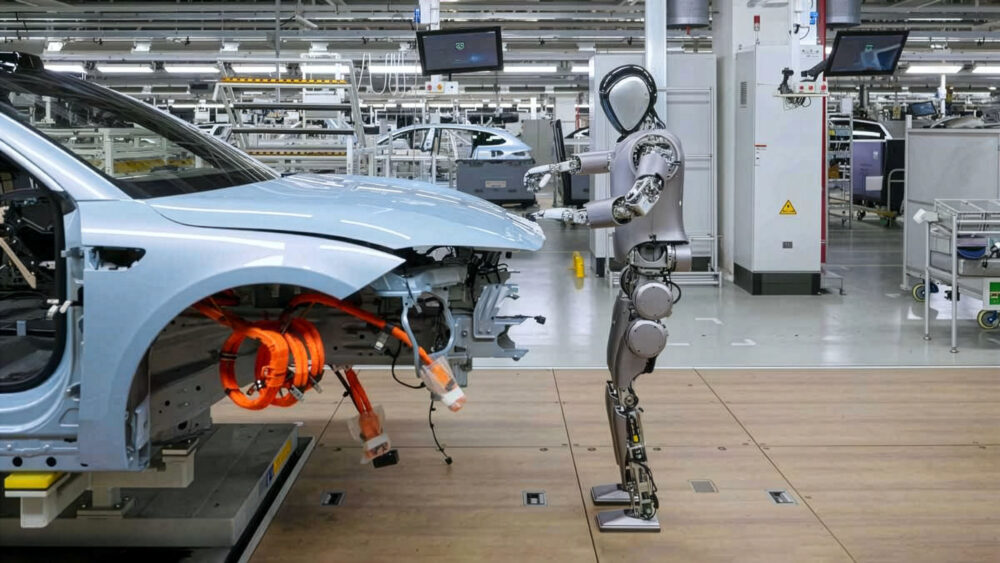 From men to machine: A humanoid robot of UBTech Robotics works at an automobile factory in Hefei, Anhui province. Photo China Daily
The questions are no longer speculative. What happens to blue-collar employment? What does a labour organisation look like in a partially automated industry? How do unions, policymakers and manufacturers respond to a future where robots neither strike nor clock wage cards?
These are not distant hypotheticals — they are pressing realities.
The Politics of Wheels: Motoring has never existed outside politics. From patriotic Mercedes-Benz workers assembling Nelson Mandela’s luxury sedan without clocking overtime, to how a discounted ML320 dimmed Tony Yengeni’s political star, cars have long been instruments of power, patronage and symbolism.
In KwaZulu-Natal, ululating minibus taxi owners once lavished transport MECs with luxury vehicles — the infamous amabenzi — while senior politicians quietly accepted “gifts” for college – going children. The road economy has always mirrored the moral economy of the state.
The Good, the Bad and the Ugly: The good news for 2026 is felt immediately at the pumps. Petrol and diesel prices, a gift at the pumps, have been cut, driven by a stronger rand and softer international oil prices.
Petrol dropped by up to 66c a litre, while diesel fell by as much as R1.50 — meaningful post-festive season relief for millions of private motorists, taxi operators, logistics firms and freight corridors already under pressure.
There is also light at the end of the tunnel at licensing centres. South Africans are set to bid farewell to five-year driving licences, with the Department of Transport confirming a shift to eight-year validity — although bureaucratic delays mean implementation remains some distance away.
The bad news comes in the form of large-scale vehicle recalls. Stellantis has issued a stop-drive recall affecting 26 vehicle models in South Africa, spanning Citroën, Jeep, Opel, Chrysler, DS and legacy Chevrolet vehicles sold between 2004 and 2019.
Faulty Takata airbag inflators — linked globally to deaths and severe injuries — remain a serious safety risk, with thousands of motorists yet to respond to recall notices.
The ugly is South Africa’s persistent road carnage. Thousands of drunk drivers were arrested over the festive season, alongside more than 16 000 criminal offenders. Reckless driving remains endemic, with minibus taxis once again topping the charts for lane-weaving lawlessness.
Worse still is the entrenched culture of violence and assassinations within parts of the taxi industry — a parallel transport economy at war with itself.
Mobility Disrupted: E-hailing platforms have already rewritten the rules of urban transport, accelerating the decline of metered taxis — much as Uber did to New York’s yellow cabs and London’s black carriers. Autonomous vehicles and AI-driven logistics will only deepen this disruption.
By the end of this decade, humanoid robots may not only be building our vehicles — they may be packaging and dispatching them too.
The Cost of Ownership: Owning a vehicle is no longer a Sunday drive. Depending on credit scores and finance terms, would-be owners may need to earn anything from R20 000 a month to well over R1.5 million to access the cheapest and most expensive cars on the market.
South Africa’s car park remains diverse — from entry-level hatchbacks to family crossovers, double-cab bakkies, luxury sedans and ultra-exclusive supercars. Ferrari still commands the highest official price tags, while Rolls-Royce continues with its discreet “price on request” protocol.
For many car-owning households, balloon payments remain a financial trap — a lesson I learned firsthand. But sometimes, clearing the debt and turning a vehicle into a vintage asset is its own quiet victory.
Eyes on the Road: For motorists, the advice for early 2026 is simple: enjoy the lower fuel bills, tighten financial belts, buckle up and plan responsibly for the Easter long weekend.
And one message bears repeating: don’t drink and drive. As SAB now rightly says, it’s no longer “one for the road” — it’s none for the road.
As I return to this beat — on the highways, the factory floors and the policy lanes — this column will keep its eyes firmly on the good, the bad and the ugly of motoring, mobility and the roads that bind South Africa together.
Marlan Padayachee is a veteran political, foreign and diplomatic correspondent from the transition to democracy, freelance journalist, photographer and researcher.