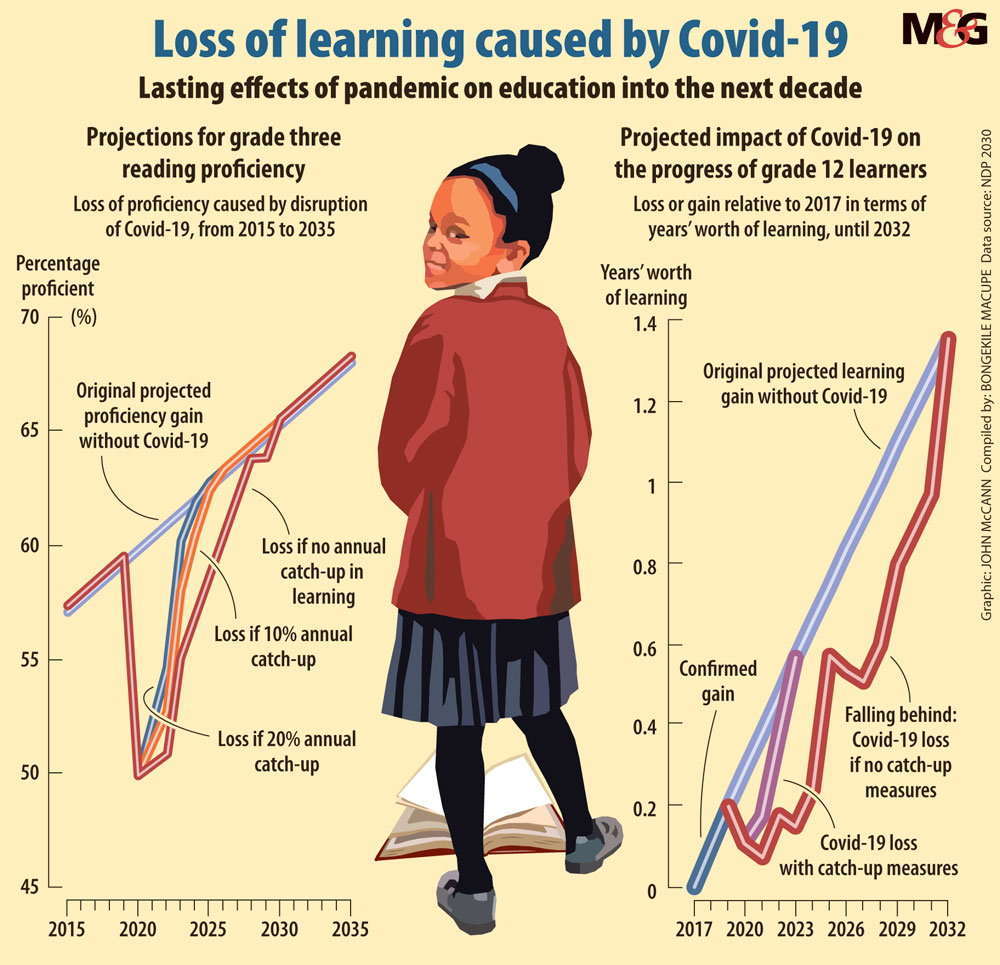
It may take up to eight years to recover from the learning losses resulting from the disruption caused by the global Covid-19 pandemic in the schooling system.
According to the department of basic education’s research reports, it is only learners entering grade three in 2030 who will get the right standard of education. But this will depend on the success of catch-up programmes.
More than 13-million young people missed almost five months of classes last year. And just as schools prepared to catch up the work, the second Covid-19 wave hit, forcing another halt to their education.
Last week the department told the parliamentary portfolio committee on basic education that the disruptions would be difficult to recover from any time soon.
Two pandemic-induced scenarios were generated in the department’s research report on how the pandemic affects educational quality in South Africa: one where learning losses remain unchanged for the rest of each learner’s schooling, and the second where learners catch up to the pre-pandemic trajectory after three years.
“Without catching up, the skills of grade 12 graduates would be lower than in the no-pandemic scenario up to 2031. In contrast, the catching up scenario takes the quality of graduates back to the no-pandemic trend in 2023,” reads the report.
“Even this is a worrying loss, but clearly much better than negative pandemic-related quality impacts.”
This means the catch-up efforts driven by policy, schools and individual teachers are vital.
“In 2021, one can expect learners who experienced the pandemic while in grade three to enter grade four. In grades one to three, estimated time lost is 24% of the school year, as these grades resume schooling before grade four. Hence for 2021, the expected level of performance in grade four would be 24% below what was expected,” reads the report.
Stellenbosch University’s Professor Martin Gustafsson, who co-wrote the report, said: “If we are really good and fast at catching up by 2023 we will be back on track. But that means we must really have good interventions in all grades because it is a loss of learning across the entire system.”
Last week, the Mail & Guardian spoke to foundation phase teachers who raised fears that some learners could still not write their names or read.
Educationist Mary Metcalfe said this week that although it is a concern that the foundation phase learners might have lost out on learning, they still have many years to catch up — but this will not be the case for grade 12 learners.
“For grade 12, this is a very big issue. If you imagine this is a balloon moving from year to year; if you are in grade one, two, three, four, five the bubble can go on for another seven or eight years. But for grade 12s the bubble hits a brick wall,” she said.
In its presentation, the department projects that only learners entering grade 12 in 2025 would not be affected by the pandemic without a catch-up plan. This is because these learners were in grade 7 in 2020 and did not miss too many classes.
Metcalfe added it was a “serious mistake” that grade 11 was not prioritised to return earlier to school last year. This year they will not only have to catch up on work they should have done in 2020 but are expected to do the full content of grade 12 because matric cannot become “softer” to accommodate what they had not covered.
To ensure that the 2020 academic year was completed the department decided to trim the curriculum for all grades except grade 12.
The department’s director general, Mathanzima Mweli, told the portfolio committee that he was concerned about this year’s matric class because they did not do the full grade 11 curriculum last year.
“The further delay in this year places a huge burden on the system not only to catch up for the grade 12 content, but we still have to catch up on the grade 11 content which was lost last year. So it is going to be extremely difficult for the system to be able to recover the learning losses.”
The M&G reported recently that provincial education departments had presented their catch-up strategies to the portfolio committee. These plans include weekend classes, earlier school starting times and even boot camps to cover what schoolchildren should have learnt in 2020.
Metcalfe said that catching up on the curriculum will require teachers to make adjustments in every grade, which will be a substantial professional responsibility.
“So, going forward into 2021, teachers have to work out what was not taught in 2020 that they have to include in 2021, which then takes [up] the 2021 time,” she said.
“So if we get it [Covid-19] under control this year, by the middle of the year we are back to full-time teaching [and] maybe in 2023 we would have caught up with the displaced content.”
[/membership]