Up in smoke: Thousands of unique items in the University of Cape Town’s world-renowned Jagger Library collections were destroyed by the fire that ravaged several buildings on the
campus this week. Some of printed items were digitised, but the extent of the loss is not yet quantified.
When autumn paints the ivy-lined buildings a deep green colour on the University of Cape Town (UCT) campus into a reddish-orange or brownish-red, students are reminded the academic year is well underway. If one does not seriously start to focus on academic matters, one might struggle over the year ahead.
But this year, the ivy won’t be looked at in the same way. The risk the now dry ivy-lined walls pose to the spread of a fire is part of an investigation to determine the cause of the recent Rhodes Memorial Fire, says UCT spokesperson Elijah Moholola.
During a walkabout on the campus a day after the fire, as dense smoke lingered in the air, UCT registrar Royston Pillay noted that the possibility of the ivy-lined walls playing a role in spreading the fire was being discussed.
Though acknowledging the ivy as an important part of the institution’s identity, Pillay said the potential risk it posed would need to be evaluated.
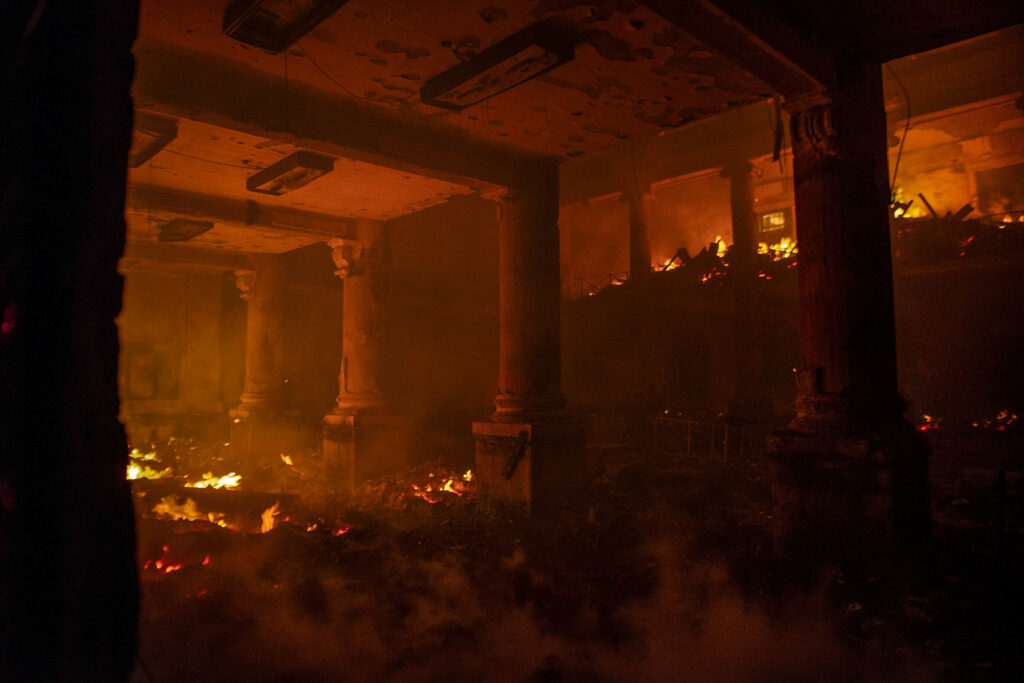 A massive fire on Table Mountain that started near Rhodes Memorial on Sunday morning raged out of control & spread onto the UCT upper campus, destroying the Jagger library building. (David Harrison/M&G)
The things that burned
The Rhodes Memorial fire started its destructive descent along the slopes of Devil’s Peak towards Rhodes Memorial and UCT’s upper campus on Sunday 18 April. Firefighting crews battled the blazes for almost three days.
On the fourth day, the fire was largely contained, and a thick veil of smoke finally dissipated over the Mother City.
As you walk around the UCT campus, you can visualise students’ panicked movements as they run to evacuate the campus.
Marang Keebine, a first-year BSc environmental and geographical sciences student from Gauteng, was working on campus when she received a message requesting all residential students to close their windows because of smoke. On her return to her residence on upper campus, students were already evacuating.
“Everyone was in a state of panic. It being an actual fire with smoke and not a drill was scary,” said Keebine, who is one of 4 000 students who had to evacuate from their residences.
“I took my ID, bank card, medical card and clothes, I already had my laptop, and I took my teddy bears as I didn’t want them to burn,” recalls Keebine, who was fortunate to escape with her laptop — several students did not.
“I didn’t think it would affect me,” says Babalwa Mshume, a second-year BA theatre and performance student.
She was one of the many who were suddenly told to vacate “because the fire is coming closer and we had to leave. I didn’t have time to take my clothing or school things. I just ran outside with my student card.”
On Tuesday, she was still in the same clothes she was wearing while running away from her Forest Hill residence on Sunday.
Another student who didn’t manage to take any clothing with him is Werner Leicher. He recalls receiving an SMS to be ready for evacuation. “And then, two minutes later, we were told to evacuate immediately. We only took our laptops. The smoke was so bad that some of our mentors’ eyes were burning, and they couldn’t breathe,” he says.
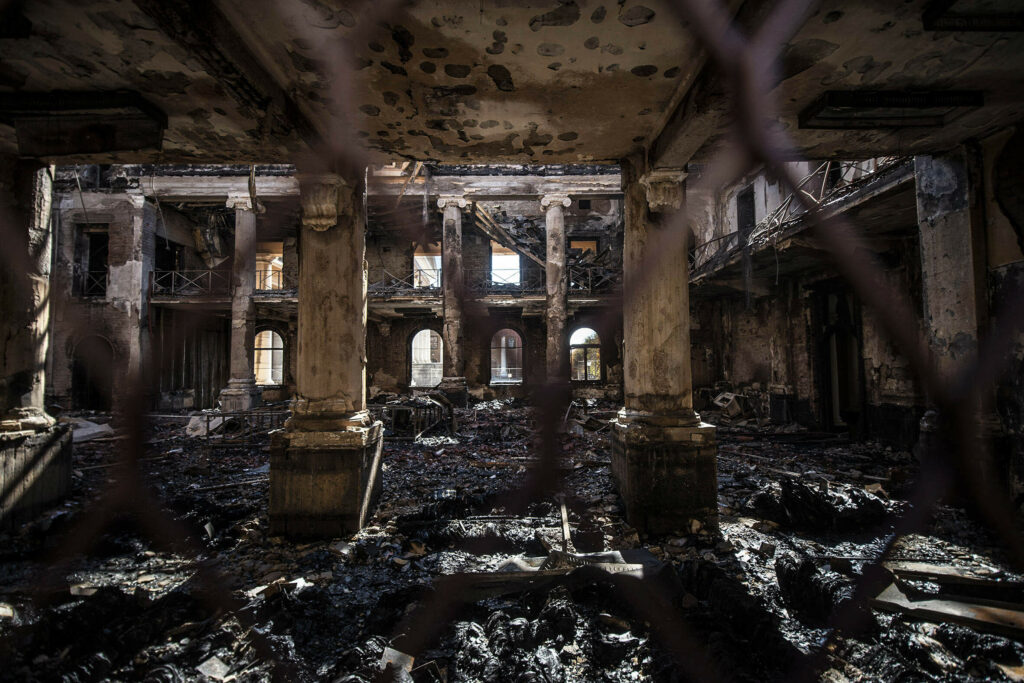 The completely destroyed Jagger library reading room on Tuesday morning. UCT mops up after a devastaing fire destroyed the Jagger Library reading room & damaged other buildings on Sunday. (David Harrison/M&G)
African films destroyed
On the same day, the blaze found its way to the university’s treasured African Studies Library, engulfing the Jagger Reading Room in flames. Although several other buildings were damaged, the burning of the Jagger Reading Room meant thousands of unique and irreplaceable documents destroyed.
When the M&G visited the reading room on Tuesday, the executive director of UCT’s Libraries, Ujala Satgoor, sat outside the reading room on a bench, as staff put in every effort to recover what they could before the 1930s building became a construction site.
Satgoor describes the scene in front of her as heart-wrenching.
“The Jagger Library holds lots of memories for many people. Students [and] people working at UCT who are alumni speak very fondly of it. We have researchers from around the world coming here,” says Satgoor.
Writer and alumnus Carina Stander recalls her visits as a student to the library. “There I discovered Yehuda Amichai en Pablo Neruda. I did the research for my first novel [Wildvreemd] by reading treatises on the impact of fire on nature — valuable old texts that are most likely not digitally available,” she says.
Stander describes walking past the red photo reading “African Studies” to reach “Rare Books”. There she would befriend the librarian before she was entrusted with the texts she wanted to read — handwritten journals from the 1800s.
The roof of the Jagger Reading Room is gutted; its galleries and adjacent offices were destroyed in the flames. So are thousands of items destroyed, including the vast majority of the African Studies published print collection, more than 3 500 unique African films, and the government publication documents.
“We have a government publications segment that was in storage in the galleries because we renovated the government publications library. It is all gone,” Satgoor says.
“In addition, we had materials that staff were working on during the lockdown. We were offering a scan and email service because people couldn’t access the reading room [during the Covid-19 lockdown]. So you had materials that were brought from off-site storage, [that were]scanned, emailed and [were] waiting to be returned,” Satgoor says.
“Then we have some personal manuscript collections that people have gifted to the libraries. We were in the process of finalising and digitising all the agreements so that we had a digital repository.”
The only hope now remains to salvage items from the basement, which is a race against time as water used to contain the fire is now seeping through the roof into the basement.
The Jagger Reading Room was home to the African Studies collection, “a unique Africana collection which is a compilation of print, monographs and books, which is more than 75 000 items,” says Satgoor.
Satgoor notes that the reading room represented a study collection, research collection and academic collection. “But it also represented the dedication and vision of staff that worked here,” she adds.
“At the moment, the human cost is huge. People who gifted their materials and trusted the materials to UCT and UCT libraries for prosperity — I can only imagine their pain,” Satgar says.
“My staff are struggling with this as well, because they’ve been working on the collections. And there’s a huge sense of guilt as well. But the human cost — the emotional and psychological cost — I think is going to be with us for a very, very long time.”
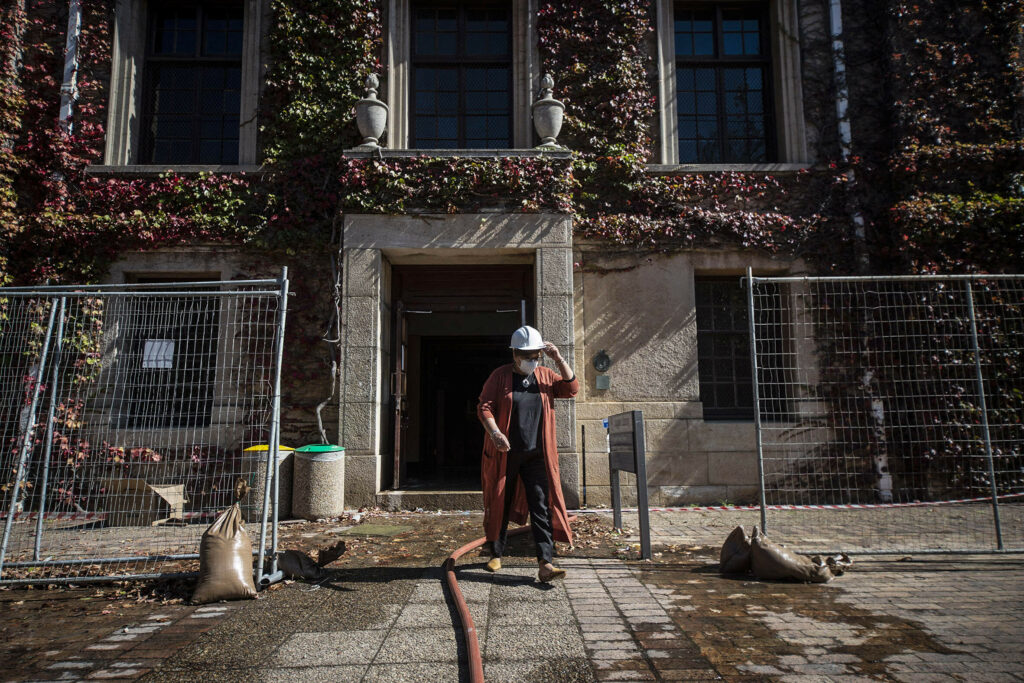 April 20 2021 – UCT executive library director Ujala Satgoor leaving the Jagger library on Tuesday. UCT mops up after a devastaing fire destroyed the Jagger Library reading room & damaged other buildings on Sunday. (David Harrison/M&G)
Digital preservation
For some years already, the UCT libraries have invested in sophisticated equipment to digitise their wide range of materials.
“We have a Zeutschel Scan Studio, which can digitise all sizes and all kinds of materials. And so we’ve invested in a digital preservation platform and the digital showcase platform,” Satgoor says.
“While in some cases we may have lost certain materials; thankfully, [in others] we have the digital versions, but we cannot say exactly what the extent [of the loss] is, or how much it is.”
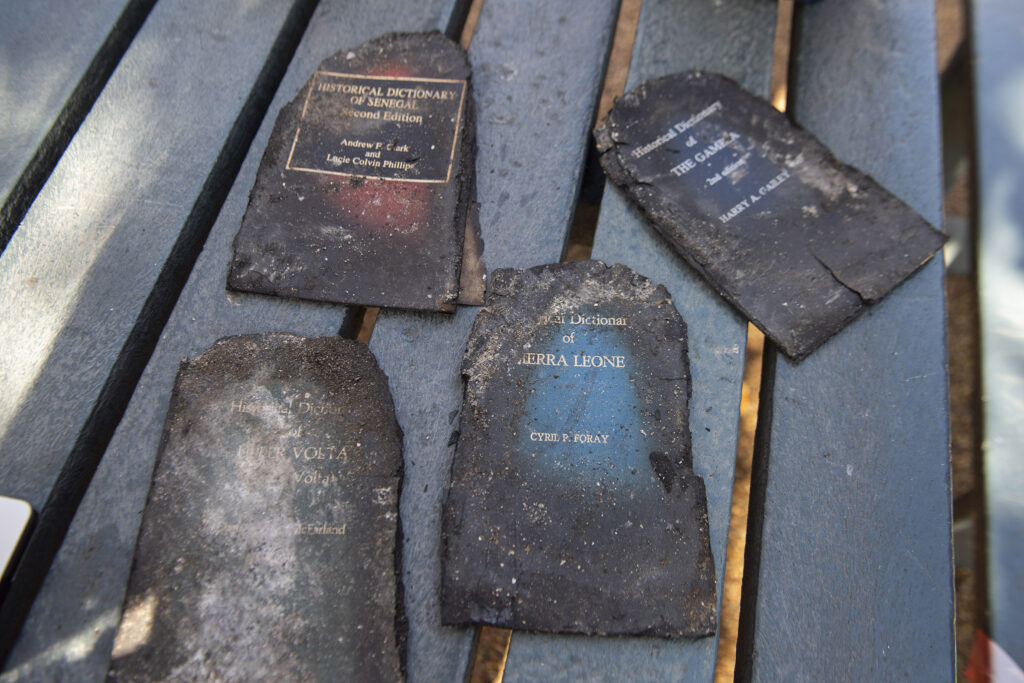 Burned dictionary covers from a special collection recovered from the burned Jagger library. UCT mops up after a devastaing fire destroyed the Jagger Library reading room & damaged other buildings on Sunday. (David Harrison/M&G)
With the UCT libraries already embracing new, modern ways of archiving academic materials, Satgoor believes in balance when moving forward. “I think we go forward based on cognition. One cannot put a financial value on this. Human value outweighs the financial value,” Satgoor says. So it becomes our responsibility now to say, ‘How do we replace this, and how do we add to it? How do we embrace digital technologies while preserving history as well?’ So there should be synchronicity between that without decrying the value of one over the other. I think there has to be a symbiosis.”
As we sit on the bench with the Jagger Reading Room behind us, my own words are lost as I try to grasp the calamity of the thousands of words that are lost forever.
[/membership]