After battling a fire at Table View in Cape Town for some days, the city’s fire and rescue teams have been able to stand down after rains helped get the blaze under control. (David Harrison/M&G)
When the world-renowned Jagger Library at the University of Cape Town (UCT), with its priceless collection of African literature, went up in flames on Sunday, the South African Air Force had only one of its powerful Oryx helicopters available for fire duties. And only for two hours.
To save what possibly could have been saved depended on the water drops performed by four Huey helicopters belonging to Working on Fire (WOF) and more than 200 firefighters on the ground. James Styan, the spokesperson for the Western Cape department of local government, confirmed the South African National Defence Force (SANDF) was approached for aerial assistance on Sunday.
When only one Oryx was available, it was “saved” for possible emergency rescues of hikers or runners trapped on the mountain, while WOF continued with the water-bombing.
According to Trevor Abrahams, director of WOF, the Hueys dropped 30 loads of water on the UCT buildings alone. That amounts to 27 000 litres of water, but it did not save the library nor the other historical buildings in the path of the runaway fire. A total of 456 loads were dropped on Sunday until nightfall made it impossible to continue flying.
The Western Cape government in a statement said an Oryx — being a stronger machine — has the capacity of dropping 2 000 litres at a time — more than double that of a Huey.
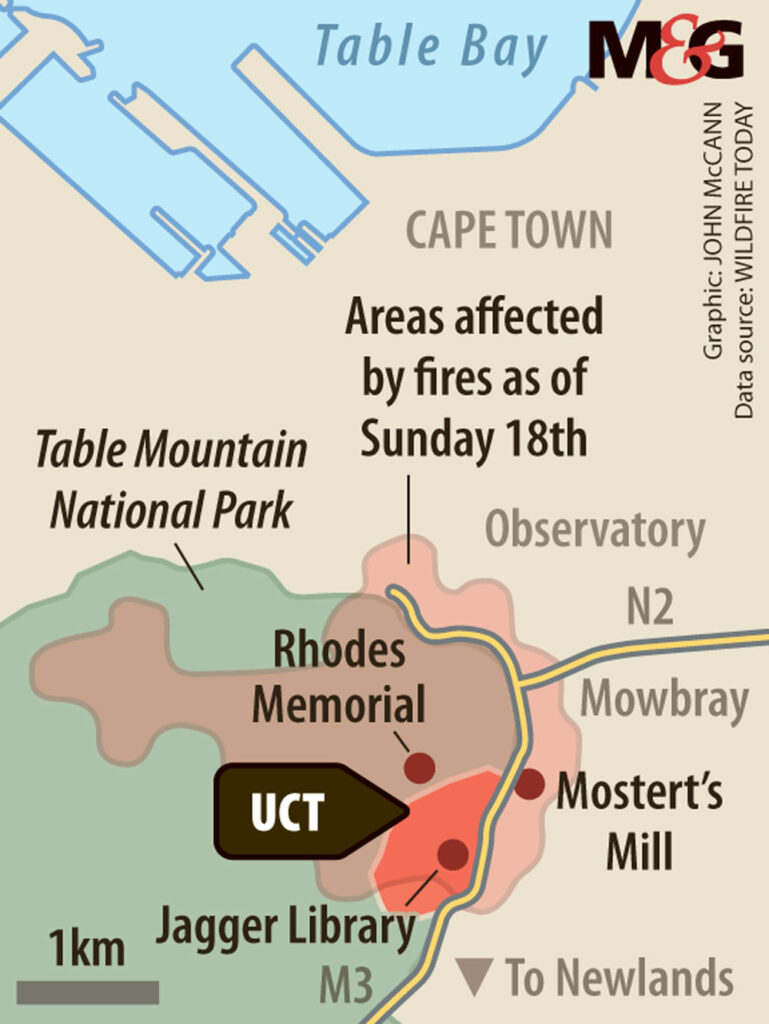
The restaurant at the Rhodes Memorial was largely gutted and Mostert’s Mill, South Africa’s oldest working windmill, built in 1796, also went up in flames.
According to Abrahams, WOF was alerted about the fire at about 9.00am on Sunday morning, when it started close to the M3 highway that connects downtown Cape Town to the southern suburbs.
A strong northeaster of 40km/h per hour caused the fire to spread and cross the M3 highway.
“One of the contributors to the rapid rate of spread was the very old pine trees and their debris,” South African National Parks (SANParks) said in a statement.
Abrahams said WOF’s four helicopters started fire-bombing runs at 10.15am. A spotter plane was also deployed. The spotter’s crew were in contact with the fire chief on the ground to direct the helicopter to the hotspots at which the drops of 900 litres at a time were needed most.
When Newlands seemed to be in the path of the fire just before noon on Sunday, plans were underway for the emergency services to begin evacuating people from this area. But things changed quickly when the wind changed direction to a full-blown southeaster. “That is why UCT was engulfed so fast,” said Abrahams. Students were evacuated with only what they could grab and carry from the residences closest to the fire.
Thick eucalyptus and pine trees on the mountain slopes close to the university fuelled the fire even faster. Residents have resisted the cutting down of the trees in the past, which has added to the devastation wreaked over days of smouldering timbers. The heat of the fire causes the trees’ crowns to pop, spreading burning embers in all directions, said SANParks fire manager Philip Prins.
Monday began with the southeaster raging much more forcefully than on Sunday. The Mail & Guardian understands from air force sources that its mechanics worked through the night to have two Oryx helicopters ready to fly the next day.
The Western Cape government said in a statement that “The SANDF has put its available air resources in Cape Town on standby for assistance with the ongoing wildfire on Table Mountain National Park.”
The air force gave the assurance that the two Oryxs would be able to provide 25 flying hours for fire duties, but then the unpredictable “Cape Doctor” had other plans. One of the Oryxs tested the winds where the fire, by Monday morning, was approaching Vredehoek and Woodstock.
 (John McCann/M&G)
“The biggest problem battling a fire along the curves and bends of the mountain slopes was not the wind itself, but the varying downdrafts. It was clear that none of the aircraft would be flying on Monday before the wind calmed down,” Abrahams said. The exhausted ground teams working around the clock were the last line of defence between the fire and properties.
“The wind also affects the direction of the water being dropped. The drafts take the water everywhere, except to the hotspot that needs to be drenched,” Abrahams said. Only by Tuesday were the Hueys and Oryxs working in tandem to douse the fire where it was still flaring up.
Ironically, the fire started just a week after the Western Cape provincial government announced that all 30 of its municipalities were preparing and reviewing their disaster management plans for flooding, mudslides and other calamities associated with the province’s typical winter weather.
In January 2000 — when wildfires torched more than 8 000 hectares of the Cape Peninsula and swept through the Table Mountain National Park destroying houses and property in its wake — the air force was at the forefront, with six Oryx-helicopters dropping one water load after the other.
Since 2000, the SANDF’s budget had been cut “beyond the bone” as Defence Minister Nosiviwe Mapisa-Nqakula told parliament during her 2020 budget speech.
She warned that it wouldn’t be long before the SANDF could not fulfil its constitutional mandate, given the unrealistic budget cuts. In February 2021, in reaction to Finance Minister Tito Mboweni’s budget speech, SANDF budget cuts as a “full-blown crisis”.
The SANDF referred in response only to Tuesday, when two Oryxs were dispatched to assist with the fire.
[/membership]