Armed community members gather around a fire to keep warm at a road block set up in Phoenix Township, North Durban, on July 15, 2021 to prevent looters from reaching the community. - Armed community members and vigilante groups have stepped in to tackle unrest in South Africa, taking matters into their own hands and sometimes stoking violence as security forces struggle to restore order.
Understaffed and heavily reliant on private security companies, the police was rapidly overwhelmed when riots and looting first flared last week in the southeastern province of KwaZulu-Natal (KZN), sparked by the jailing of graft-accused former president Jacob Zuma. (Photo by GUILLEM SARTORIO / AFP)
As racial tensions continue in Phoenix, northwest of Durban, in the wake of last week’s unrest and looting, supporters of former president Jacob Zuma are staging a series of marches and motorcades protesting against the alleged killing of black residents and calling for his release.
At least 22 people died in Phoenix, where residents had set up roadblocks in response to the wave of looting and arson attacks in the area, in clashes with looters and alleged racist attacks on black people residing in neighbouring areas.
The ANC in KwaZulu-Natal has distanced itself from the new protests, which started with a cavalcade of clergy on Wednesday and a motorcade to the party’s provincial office on Thursday, believing that they may inflame tensions.
A third cavalcade to Phoenix, called under the Zuma banner, is expected to leave the Durban city hall on Friday.
The renewed mobilisation comes after a week of tension and violence in Phoenix, where 35 inquest dockets have been opened.
On Wednesday, the acting minister in the presidency, Khumbudzo Ntshavheni, said that claims of more than 300 bodies lying at the Phoenix mortuary were untrue. “According to the department of health in KwaZulu-Natal, 128 bodies are being processed at Phoenix Medico-Legal Mortuary. These may not necessarily be linked to the unrest as the facility caters for the greater eThekwini area.”
Ntshavheni said the bodies of 35 people at the mortuary had not been identified by their next of kin.
Police Minister Bheki Cele spent several days in the area after the outcry over the alleged killing of black residents of nearby suburbs, including Bhambhayi, Zwelisha and Amaoti, who had gone to Phoenix in search of supplies as shops in their areas had been looted.
On Wednesday, KwaZulu-Natal Premier Sihle Zikalala visited the families of several of the victims
ANC KwaZulu-Natal spokesperson Nhlakanipho Ntombela said on Thursday that the marches were not sanctioned by any of its structures or the province.
“We don’t know who organised them. They are not organisational programmes instituted by any structure in the province or the region,” Ntombela said. “We are not even sure they have permits for such activities.”
Expressing concern that the protests might cause further tension or violence in the area, which is still highly volatile, Ntombela said they were “hopeful” that the police would “act timeously” to prevent any further escalation around Phoenix.
Bishop Vusi Dube, an ANC MPL who was among the religious leaders who marched to the Phoenix police station on Wednesday, said he had done so to try to get the police to act on the alleged murders of innocent black people by Indians last week.
Dube is a close ally of Zuma and a key figure in the protests supporting him since 2006. “There is a very racial thing that is happening there. One of these challenges we face as a country is that we haven’t dealt with racism … that is why we saw what we saw,” Dube said.
Unless those responsible for the killings were arrested or handed themselves in to the police — or were given up by “the community” — the likelihood of the friends and families of those who were killed seeking revenge in the future was “very strong”, Dube said.
The police should also act “quickly” against people who had posted pictures and videos of themselves shooting black people to defuse tensions.
“I visited the family of a person who was lost in the violence. The atmosphere is very tense. I believe that if the police don’t do something soon, we are going to see a lot of revenge attacks in the future.
“The community needs to stand up and assist by identifying the people they saw killing black people in the streets. If not, they are going to be seen as condoning the killings.”
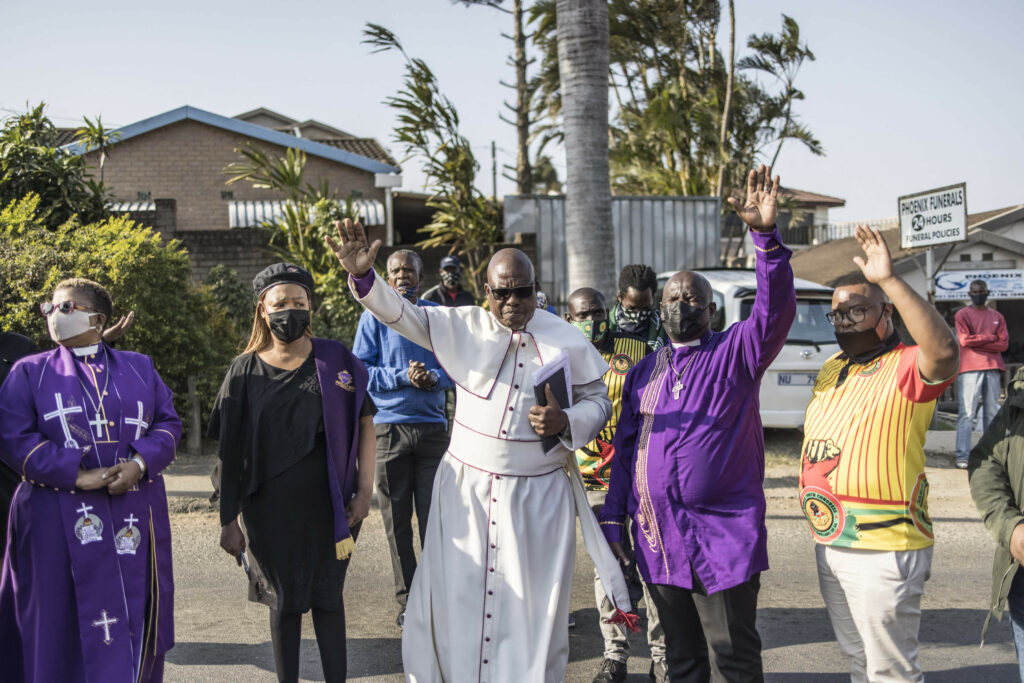 Bishop Vusi Dube (C) leads a delegation of interfaith leaders to the Phoenix police station in Durban, on July 21, 2021 to demand the police to investigate the killing of over 20 Black South African allegedly at the hands of vigilante groups. – Phoenix is flashpoint town between black South Africans and counterparts of Indian origin where at least 20 people died in the recent wave of violence. Like communities across South Africa, residents of the predominantly ethnic Indian town set up their own protection squads in response to pillaging and arson that broke out days after the jailing of ex-president Jacob Zuma on July 8th — overwhelming security forces. (Photo by MARCO LONGARI / AFP)
Dube said the series of cavalcades — set to continue until Friday — were “a very clear cry” and were not aimed at inciting further violence.
A source close to Zuma claimed that there had been plans to burn buses in Phoenix but that, at his inner circle’s insistence, these were called off.
“They were going to burn buses. But we said you can’t do that, innocent people and children were going to die. He does not want anybody to die.”
There have been 42 deaths in Gauteng; 17 cases of murder are being investigated and 25 are at the inquest stage.
[/membership]