Former health minister Dr Zweli Mkhize. (Photo by Darren Stewart/Gallo Images via Getty Images)
There is evidence that the suspended minister of health, Zweli Mkhize, has directly and indirectly received gratifications from Digital Vibes.
This is contained in court papers the Special Investigative Unit (SIU) placed on Thursday before the Special Tribunal, which has a statutory mandate to recover public funds syphoned from the fiscus through corruption, fraud and illicit money flows.
President Cyril Ramaphosa was confronted with questions about a possible cabinet reshuffle and his plans for Mkhize during a tour of Covid-19 vaccination sites on Thursday, but left journalists still guessing about what he would do.
Ramaphosa has largely been silent about the SIU report handed to him on 30 June, which should shed light on Mkhize’s role in a R150-million communications contract being awarded to Digital Vibes, a company associated with his former spokesperson.
Ramaphosa placed Mkhize on special leave in June.
Money from the contract was allegedly used to buy a vehicle for Mkhize’s son and to carry out repairs to a house in Johannesburg owned by the Mkhize family. The health minister has denied any wrongdoing.
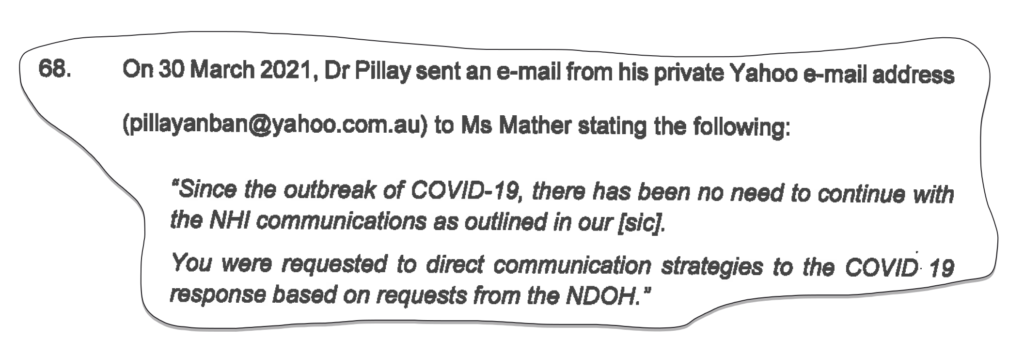
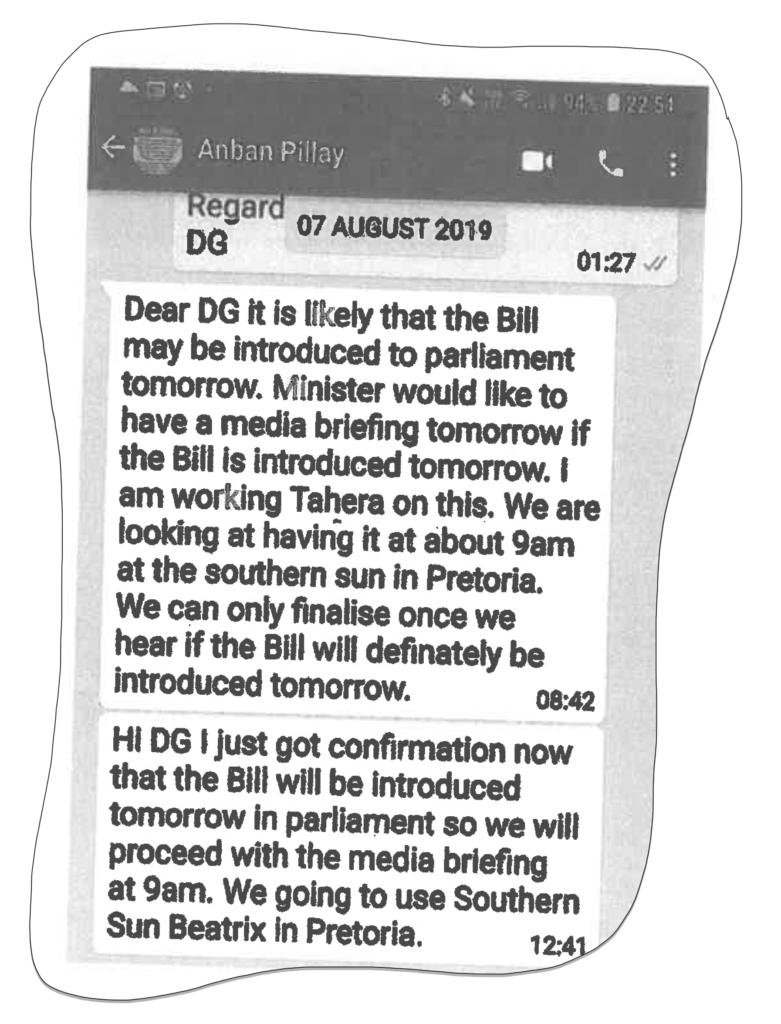
The SIU has found evidence linking Mkhize, his son Dedani Mkhize and top officials, including the department’s deputy director, Anban Pillay, to payments from Digital Vibes. There is also evidence that Mkhize and Pillay directed other department officials to ensure that Digital Vibes got the contract. This includes WhatsApp messages and emails from personal accounts, including from Mkhize and witness statements.
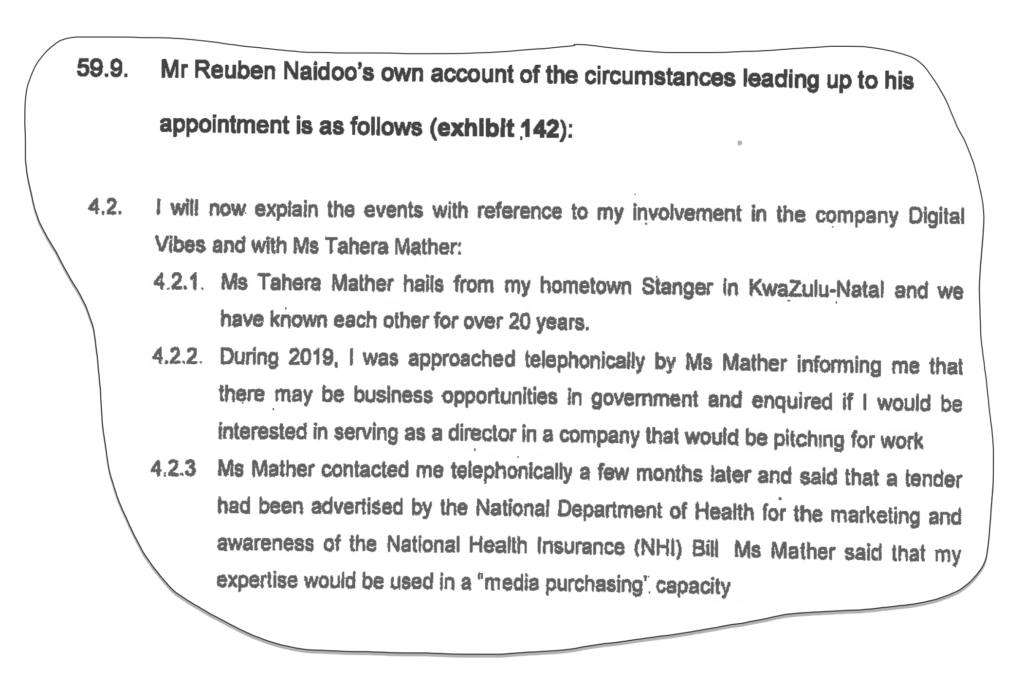
There is also evidence that shows Mkhize’s long-standing relationship with Tahera Mather and Naadira Mitha was central to millions being syphoned out of the department of health for work that had little to no benefit for the state.
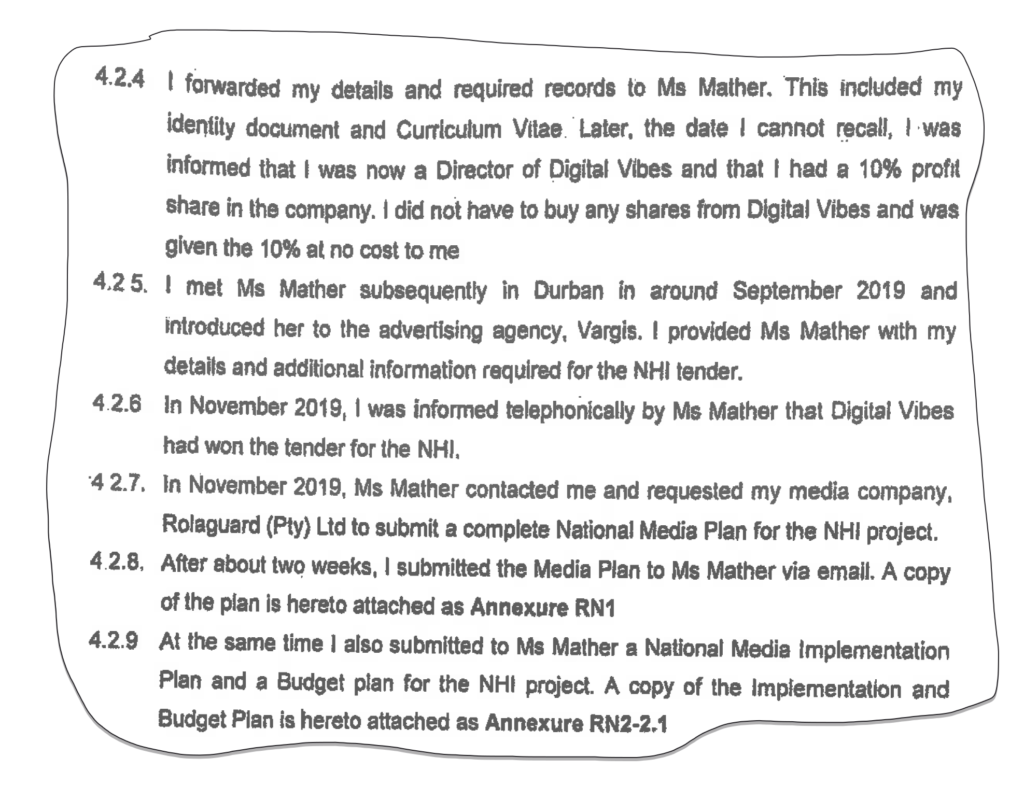
The SIU has asked the Special Tribunal to declare the R150-million that Digital Vibes received invalid and to set aside the health department’s decision to appoint the communications services company.
In nearly 100 pages, the SIU lays bare the evidence it has amassed while investigating the contract and payments made to Digital Vibes.
The SIU says it has evidence showing that:
- Digital Vibes paid 4-Way Maintenance Services R6 720 for repairs to one of Mkhize’s properties. Mkhize told the SIU he had not requested these services. He also said the contact details on the invoices the SIU had did not belong to him. But on the eNatis records the cell numbers are linked to vehicles registered in Mkhize’s name. Mkhize attributed the payments to a worker on his property, also named Mkhize.
- In May last year, Mather’s company transferred R300 000 to the company of Mkhize’s son. Mkhize told the SIU that this money was a gift to his son from Mather, as was a second-hand car.
- Witnesses have told the SIU how “parcels” with cash were given to Mkhize’s son. He, Mather and Mitha would collect the boxes at a garage in Stanger.
On 17 June, the SIU obtained an interim interdict from the Special Tribunal for R22-million held in several accounts. This application was brought in terms of the previous order. The latest order wants all the money forfeited to the state.
“The amount of some R150-million received by Digital Vibes was unlawfully received. To remedy the flagrant abuse of public resources that has occurred, the SIU seeks an order that is just and equitable that this amount (minus the amount currently interdicted and subject to be forfeited in terms of the order …) must be repaid to the state by Digital Vibes and or the individuals that are controlling minds and or participated in the fraudulent and unlawful scheme,” the papers read.
The SIU argues that there was no procurement or contractual basis for most of the payments made to Digital Vibes. It said the company received these payments based on fraudulent misrepresentation made in its bid documents, and officials of the department fraudulently manipulated the procurement process.
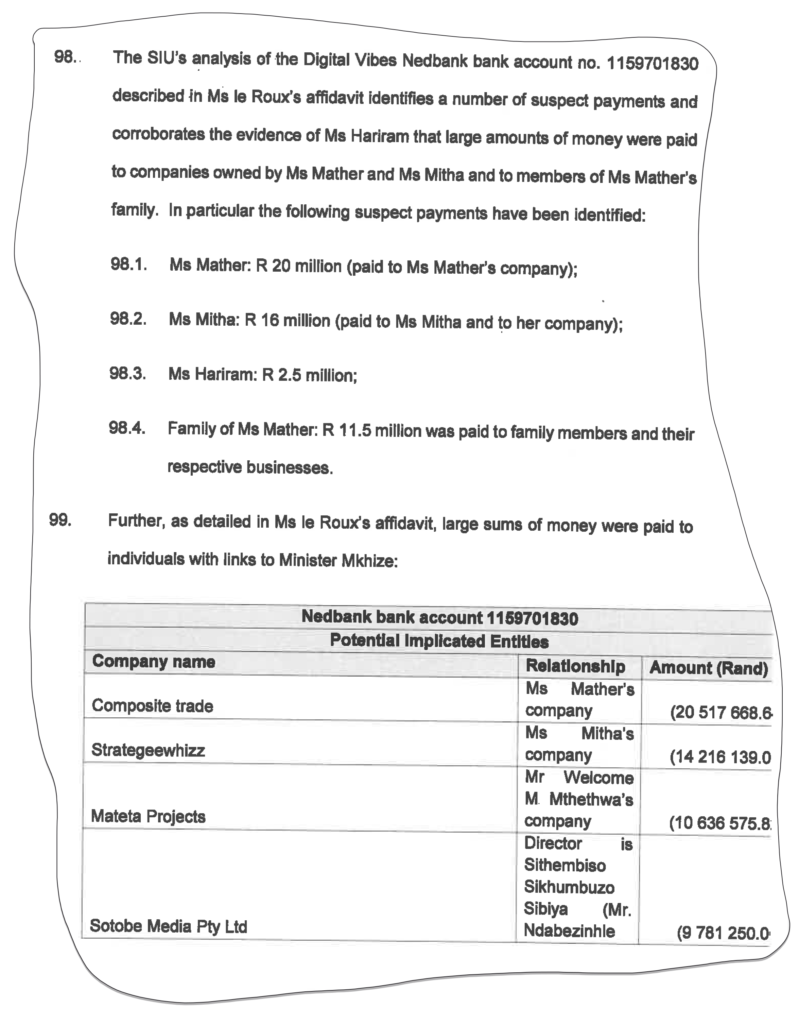
The evidence the SIU has received thus far indicates that the department received little or no value for money regarding services provided. Instead, tens of millions of rand paid to Digital Vibes by the department has been paid to companies controlled by Mitha and Mather and her family.
The SIU says about R90-million of the R150-million appears to be suspicious expenditure. It has requested supplier invoices and supporting documents in relation to the payments made by Digital Vibes, but has received nothing.
The SIU’s investigation indicates that transactions took place in circumstances constituting the commission of offences relating to the prevention and combating of corrupt activities. The unit says Mkhize and his son Dedani have committed these offences.
“This evidence has been referred to the National Prosecuting Authority (NPA),” it says.
The SIU says the Mkhizes have an interest in the application and the unit is seeking relief against them.
The SIU further indicated to the court that the transactions also amounted to Pillay contravening the Public Finance Management Act. This has also been referred to the NPA. The unit is asking the court to hold Pillay responsible for any loss or damages suffered by the health department.
The SIU is also asking the court for the banks that hold the money from these transactions to be barred from allowing any transactions on the funds.
“The sixteenth respondent to the twenty-ninth respondent are all persons and entities who received funds or payments or benefits that were directly or indirectly made or given to them by Digital Vibes as part of undue gratification or for purposes of money laundering or as the proceeds of unlawful activities,” the SIU argues.
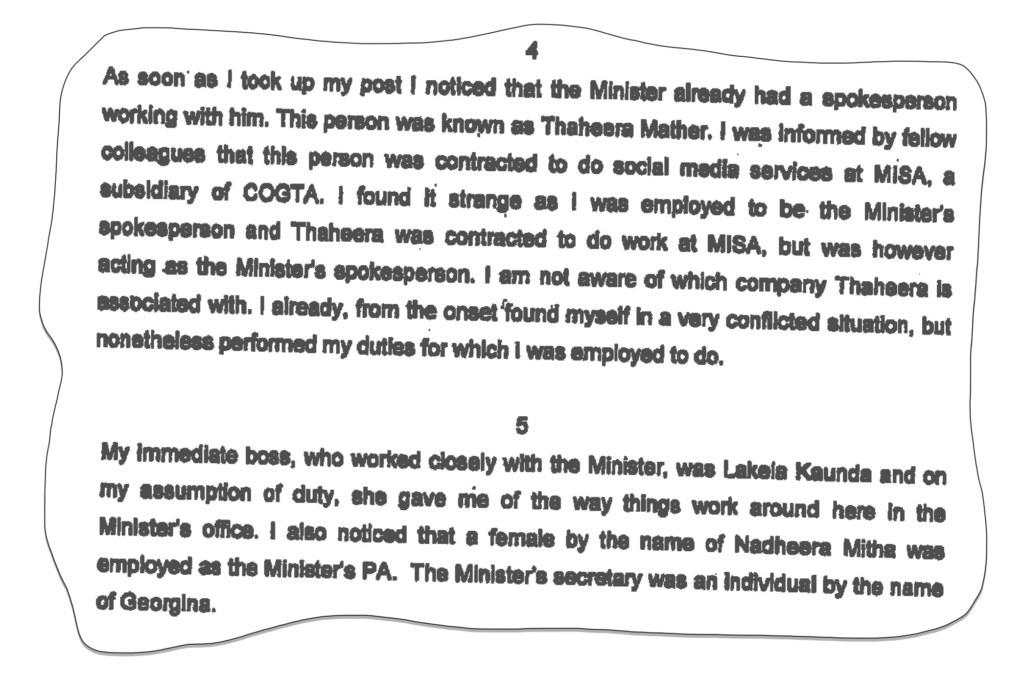
Mkhize’s relationship with Digital Vibes during his time as the minister of cooperative governance and traditional affairs was also questioned. During the investigation, the SIU ascertained that Digital Vibes signed an agreement with the Municipal Infrastructure Support Agent (MISA) in 2018 for R3.9-million. The MISA falls under the department of cooperative governance and traditional affairs. At the time, Mkhize was the minister and Mather was his private spokesperson.
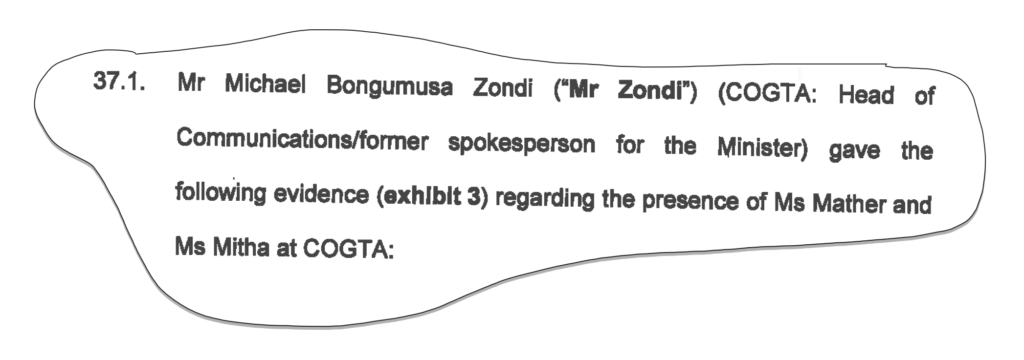
Michael Zondi, head of communications at the cooperative governance department, told the SIU that Mkhize already had a spokesperson as soon as he took on the post. “I found it strange as I was employed to be the minister’s spokesperson and Tahera [Mather] was contracted to do work at MISA … I also noticed that a female by the name of Naadira Mitha was employed as the minister’s PA.”
According to the SIU, Digital Vibes was registered in 2014 by Radha Mariram, a former bank employee who became the manager of a petrol station in Stanger. She has provided the SIU with details of how she was used to front for Mather and Mitha and how Mather told her that she had found work for Digital Vibes — the contract for the MISA. Mariram has now opened a case of fraud and embezzlement against Mather and Mitha, who she alleges embezzled R80-million from Digital Vibes.
After the appointment of Mkhize as health minister, Mather and Mitha followed him to the department. Former director general Precious Matsoso told the SIU of how she was introduced to Mather and Mitha and, in a few days, began receiving messages from Mather.
According to Matsoso, she was instructed by the minister to “sort out the contractual arrangements” for National Health Insurance (NHI) communication to be handled by Mather.
“Ms Matsoso’s evidence further confirms that long prior to the actual appointment of Digitial Vibes, Ms Mather was already working with Dr Pillay and the Minister on NHI matters,” the SIU said.
In the court documents the SIU mentions a whistleblower who did not want to be named. The whistleblower told the SIU they were instructed not to appoint any service provider but were provided with Mather’s name in an email from Pillay and Matsoso. But this was not successful.
“Thereafter, according to the whistleblower, Dr Pillay then provided the name of a company called Digital Vibes,” read the documents.
On 15 July, Mkhize sent a WhatsApp message to Matsoso: “Hi DG. Kindly sort out the contractual arrangement. Please ask for the preliminary NHI implementation plan and draft communication plan by Friday from each individual as discussed.”
The SIU argues that it was apparent from the contents of the message that Mkhize was giving instructions to the director general. “At best this conduct on the part of the minister was improper and, at worst, the conduct of the minister’s was unlawful as it constituted an interference by the executive authority in the affairs of the administrative authority of the NDOH [national department of health].”
On 2 July last year, the newly appointed director general, Sandile Buthelezi, sent a letter to the chief financial officer stating that the director general’s office would immediately manage all communication contracts. The financial officer was requested to hand over to the director general all the documentation relating to the Digital Vibes contracts. More than R60-million was paid to the company from 2 July 2020, according to the unit.
The health department appointed Digital Vibes on 15 November 2019 as a communication service provider for a year, renewable annually for a maximum of three years and a total value of R144-million.
Then, on March 6, Digital Vibes was asked to provide a quotation. Mather, representing the company, sent it stating that it would produce “20 million A5 pamphlets 4 billboards near major airports, airtime voucher advertising, television slots over two weeks” on the Covid-19 pandemic.
The quotation was sent on the same day for an amount of R35-million. Pillay accepted the quote, saying to Mather in an email, “your proposal is approved”.
SIU Digital Vibes founding affidavit by Mail and Guardian on Scribd
[/membership]