Fossil finds: Lynne Quick and her team extract sediment to analyse pollen grains to assess changes in plant communities to establish vegetation histories. (Photo: Emil Von Maltitz)
Ancient pollen grains found in sediment cores and dating back thousands of years are helping scientists shed light on the Earth’s past and future climates.
These pollen fossils are “much more than pesky pollen and fungal spores that wreak havoc on those with allergies”, said Lynne Quick, a palynologist at Nelson Mandela University.
A multidisciplinary team at the University of Cape Town is also examining the fluctuating pollen levels and the subsequent effects on the human body.
Pollen levels are expected to increase in the coming decades, according to Jonny Peter, head of the division of allergology and immunology at the university.
“From a nationwide public health perspective, increasing awareness on the impacts of climate change on air quality is important,” he said.
Pollen monitoring has largely focused on the health risks associated with pollen concentrations in the atmosphere, but now palynologists are using it to study climatic changes in specific landscapes. The past 20 years of pollen monitoring in the Western Cape have provided answers about the rate and extent to which climate change is occurring.
“Pollen is distinct in two ways. It has a unique shape, depending on what plant it comes from, and its outer layer is made of sporopollenin, which is chemically very stable and resistant to microbial decay,” Quick said.
“In fact, it’s one of the most chemically inert organic compounds found on Earth and is known as the ‘diamond of the plant world’. Sporopollenin preserves pollen grains in ancient deposits and sediments when almost all other organic materials are reduced to unrecognisable components.”
Pollen helps scientists determine what other vegetation grew in a landscape centuries and millennia earlier — and it is this that is helping researchers make inferences on the climate at the time.
“Fossil pollen leaves an important fingerprint that can help us uncover how our climate has changed over millennia and what it may look like in the future,” said Quick.
Through these “vegetation histories” researchers can structure climate models as baselines for past changes, which Quick said could also aid in environmental conservation management initiatives.
Academics are focused on key regions — fynbos (Western Cape and Eastern Cape), the Drakensberg (KwaZulu-Natal), grasslands (high central plateau and inland areas of KwaZulu-Natal and the Eastern Cape) and savanna biomes (Free State, North West and Gauteng).
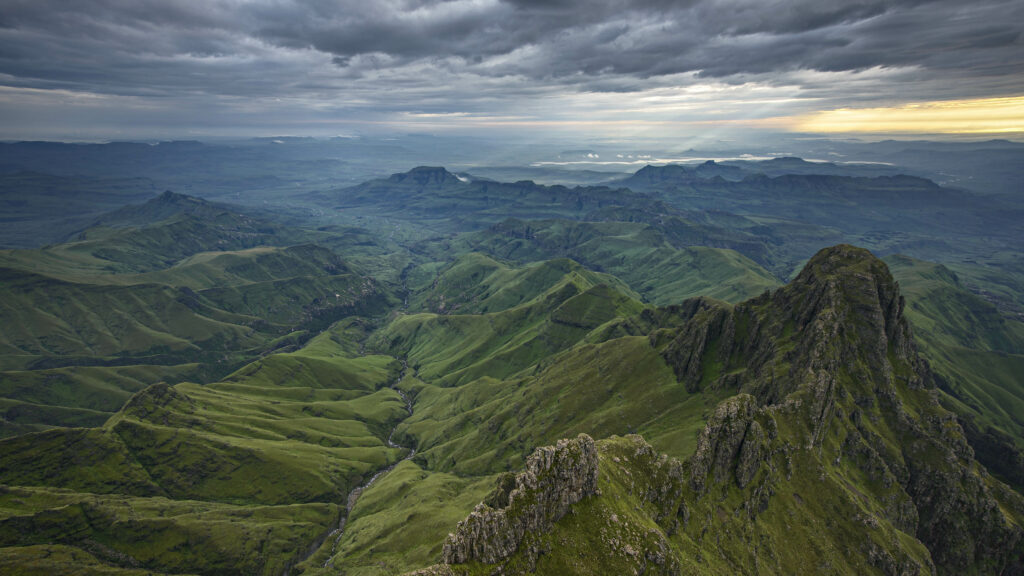 Researchers are looking into various regions including the Drakensberg (above).
Photo (above): Emil Von Maltitz
Researchers are looking into various regions including the Drakensberg (above).
Photo (above): Emil Von Maltitz
Researchers said 10 000 years ago, the Cape fynbos region was abundant with fynbos and forest, indicating plenty of rainfall.
“It is expected that the extent of forest areas will be reduced to isolated patches where conditions remain favourable, along with potential reductions in the extent of the fynbos biome,” Quick noted.
“In addition to the threat of climate change, ongoing habitat transformations as a result of agricultural, coastal resort and urban development and the spread of alien vegetation, makes the region particularly vulnerable to significant reductions in biodiversity. To limit the impact, the conservation of the coastal lowlands of the fynbos biome should be prioritised.”
In the Drakensberg, Jemma Finch and Trevor Hill, of the University of KwaZulu-Natal, are reconstructing long-term vegetation and changes to the climate. Their research indicates that grasslands in the area, which were previously viewed as secondary features of the mountainous terrain, is actually an ancient primary vegetation type.
“Pollen records from the Drakensberg and surrounds reveal that grasslands remained relatively stable over the past 5 000 years, whereas forests were restricted in their distribution, likely occupying fire protected valleys and kloofs as seen in the present-day grassland-forest mosaic,” Quick said.
The long-term perspective provided by this pollen research highlighted the conservation value of grasslands in this watershed.
“As the climate continues to warm through the 21st century, there are concerns that montane grassland species may be forced to respond by migrating upslope, altering the composition of these important grasslands, and impacting species that may not be able to keep pace with the current rate of environmental change,” said Quick.
The data shows varying changes in rainfall and warmer periods that have influenced vegetation changes in the past 6 000 years, researchers studying ancient pollen grains and analysing pollen in soil from Southern African savannas said.
Scientists say these landscapes might be compromised by the effects of carbon dioxide fertilisation, which will increase the growth rate of trees, allowing more rapid access to water in deep soil layers to the detriment of grasses.
Wildlife poaching has a role to play in all of this. The scientists said the problem is being aggravated by escalating illegal hunting of the white rhino, historically important in keeping tree canopies open.
The findings have prompted researchers to caution against rapid aforestation to increase carbon sinks to mitigate climate change in South Africa’s savannas and grassland.
“Through this deep-time ecological lens we can see that grasslands are not degraded forms of landscapes. Therefore, we should carefully consider the implications of planting trees and expanding forests as these efforts may undermine the provision of valuable ecosystem goods and services associated with grasslands,” Quick said.
Tunicia Phillips is a climate and economic justice reporting fellow, funded by the Open Society Foundation for South Africa
[/membership]