Whiffs of totalitarianism: Declassified documents show that the SAPS’s crime intelligence bought spy equipment to track and monitor #FeesMustFall students, and, what’s more, vastly overpaid for it. (Madelen Cronjé)
High-ranking police generals will be rounded up in imminent arrests for crime intelligence corruption of R100-million related to alleged procurement fraud for spying operations on students protesting under the Fees Must Fall banner as well as the ANC.
It has also emerged that the company involved in the R100-million procurement saga could still be doing business with the state.
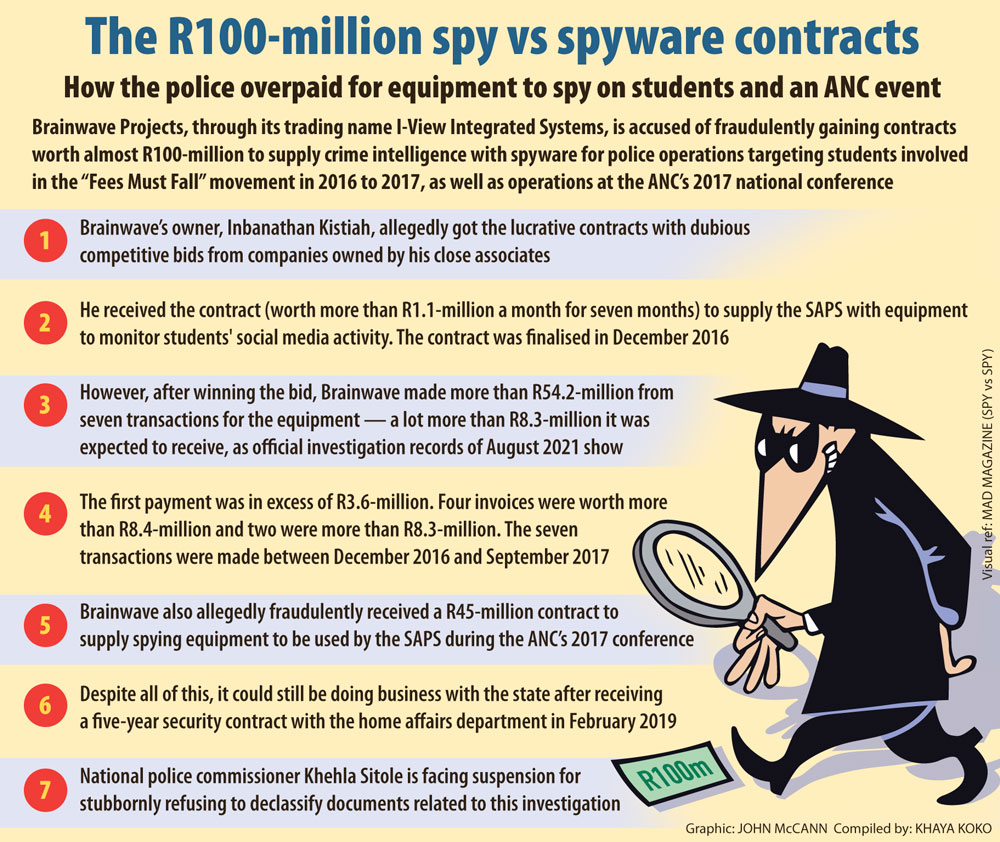
Brainwave Projects, which trades as I-View Integrated Systems, received a five-year security contract with the home affairs department that began in February 2019, despite recently declassified South African Police Services (SAPS) documents showing how the company allegedly scored fraudulent payments from December 2016 to September 2017.
Despite official home affairs records showing that Brainwave was one of five service providers appointed in 2019, the company said it neither tendered a bid, nor has it ever received a contract with the department.
Home affairs, for its part, acknowledged that Brainwave had provided a bid for the department’s security systems upgrade, but said the contract was never concluded, despite the department’s records showing that Brainwave was appointed.
Meanwhile, the allegedly fraudulent payments by the SAPS’s crime intelligence unit relate to spying equipment bought to conduct operations on higher education students, who were demanding free quality education in 2016, as well as to spy on the ANC’s 2017 elective national conference.
The Mail & Guardian understands that an arrest blitz of police generals, who were allegedly complicit in the blatant procurement fraud, is imminent following October’s supreme court of appeal (SCA) order that the SAPS declassify documents related to the investigation.
The names of the suspects are known to the M&G, but will not be published until after the expected arrests. The officers, however, belong to the top echelons of the SAPS hierarchy.
The M&G has also established that a team of investigators already has a charge sheet, and that the state will be ready to begin prosecutions immediately after the expected arrests are made.
Spying on students
Documents that form part of the probe show how Brainwave, its sole director Inbanathan Kistiah and senior police generals allegedly created a dubious bidding war to supply social media monitoring systems for police to spy on and disrupt the activities of the student movement for free tertiary education. In December 2016, Brainwave received a more than R1.1-million-a-month contract to supply the spyware for seven months.
But, according to an investigative document dated August 2021, Brainwave ended up pocketing more than R54.2-million from just seven invoices; the lowest of which was for more than R3.6-million, and the highest for more than R8.4-million.
An internal crime intelligence proposal said the SAPS’s resources “were overstretched” in 2016 when the countrywide student movement began to demand free higher education, and the police asked for devices to track down and monitor protests and protestors.
“The required platform will provide a complete user profile with all the links and a list of role players on a specific matter, and identified user profiles can be further tapped into in order to get personal information, pictures and physical location of the user. All [this] information will be compiled in real time,” reads the internal proposal.
Investigative reports, however, show how Kistiah allegedly co-opted a company belonging to his employee’s spouse to create what investigators claimed was a false bidding war.
Crime intelligence bid documents reveal that Kistiah’s I-View set a price of about R33.8-million for the equipment, while the other company had set its price at more than R45.7-million.
“The wording, format and pricings of the two entities were similar in several material respects despite the fact that there were no specifications for the software that the SAPS sought to procure. The two entities colluded and thereby deprived the state of a transparent and competitive bidding [process] that would have resulted in the award of the contract to a company that would have offered a cost-effective price for the software,” reads part of the investigative reports.
I-View then reduced its tendered price and received an almost R1.2‑million-a-month contract, which would have amounted to nearly R8.4‑million over seven months. Instead, the company ended up raking in more than R54.2-million, according to financial records seen by the M&G.
 (John McCann/M&G)
Spying on the ANC
In a separate matter, I-View is embroiled in a R45-million procurement fraud probe for the alleged inflated purchasing of grabber equipment, which was to be used to intercept phone calls and text messages at the ANC’s 2017 national elective conference in Nasrec, Johannesburg.
The Independent Police Investigative Directorate (Ipid) finally received court orders to receive declassified documents from the SAPS related to the purchase of the grabber equipment. The latest order was issued in October by the SCA, which dismissed an SAPS appeal to keep the documents classified. National commissioner General Khehla Sitole was one of the applicants in the appeal.
The M&G reported in October that Ipid had confirmed the investigation into the crime intelligence unit.
Ipid’s investigation stemmed from whistleblower Brigadier Tiyani Hlungwani, a crime intelligence officer who supplied an affidavit alleging that Sitole agitated for the R45-million price tag, when the grabbers, Hlungwani stated, retailed at less than R10-million.
Hlungwani said he had cautioned both Sitole and then-crime intelligence head Major General King Ngcobo against the exorbitant procurement. “I told [Ngcobo] that he was handing himself over to the people that have been sabotaging his efforts to clean crime intelligence and that he [would] go to jail because purchasing a grabber of R45-million from I-View was illegal and was not in compliance with the Public Finance Management Act,” Hlungwani’s affidavit reads.
He works in the finance section of crime intelligence.
President Cyril Ramaphosa sent Sitole a letter in September asking the commissioner to provide reasons why he should not be removed as the top cop.
This followed a scathing February Pretoria high court judgment that chastised Sitole and the SAPS for classifying documents related to alleged fraud.
In a statement, Ramaphosa’s office said: “The president has, in terms of Section 9 of the South African Police Services Act of 1995 … deemed it appropriate at this stage to institute a board of inquiry into the national commissioner’s alleged misconduct and fitness to hold the office of national commissioner of police.”
The presidency added that the inquiry into Sitole’s alleged misconduct was “merited by the public interest in the integrity of the office of the national commissioner”.
Brainwave responds
Kistiah rejected claims that he had received any money for the grabbers, saying that he had supplied “a proposal [to crime intelligence]; it was never a transaction”.
Kistiah did acknowledge that I-View received money for the #FeesMustFall operations, adding that the payment was for services rendered.
“Remember, I am not [part of] the SAPS; I provide services. How they [SAPS] use those services has got nothing to do with me,” Kistiah asserted.
He said he would maintain his innocence and, if he had the money, he would fight the investigation against him because it had “destroyed” his life.
Kistiah had initially denied that he had a contract with the department of home affairs.
When the M&G showed him the departmental information that listed Brainwave as a service provider, Kistiah said he had deregistered his company “a long time ago” — without supplying an exact date — and said he did not know how he was contracted with the home affairs department.
“This [contract] must be some weird thing because I deregistered my company a long time ago. So, there is no way [Brainwave] can have any contract with home affairs because that thing doesn’t even operate — it’s gone,” Kistiah said.
When the M&G informed him that a search was conducted on Brainwave, which showed that the company was still operational and that he was the sole active director, Kistiah emphasised that his company was deregistered and had no contracts with the department of home affairs.
The M&G provided the department of home affairs with the appointment record for Brainwave. Despite this, the department continued to deny that Brainwave had ever received a contract with it.
“The department did not award any bid for the installation and maintenance of an alarm system and monitoring with armed reaction, for a period of five years. A bid number … had been published in 2019 and Brainwave Projects was one of the bidders that responded.
“However, this bid was not concluded but cancelled,” said Siya Qoza, spokesperson for Home Affairs Minister Aaron Motsoaledi.
Kistiah disputed this, saying Brainwave had last traded around 2016 or 2017.
[/membership]