A Gauteng township association, which forcefully removed foreign shopkeepers, disagrees with two economists and wants the government to protect the informal sector
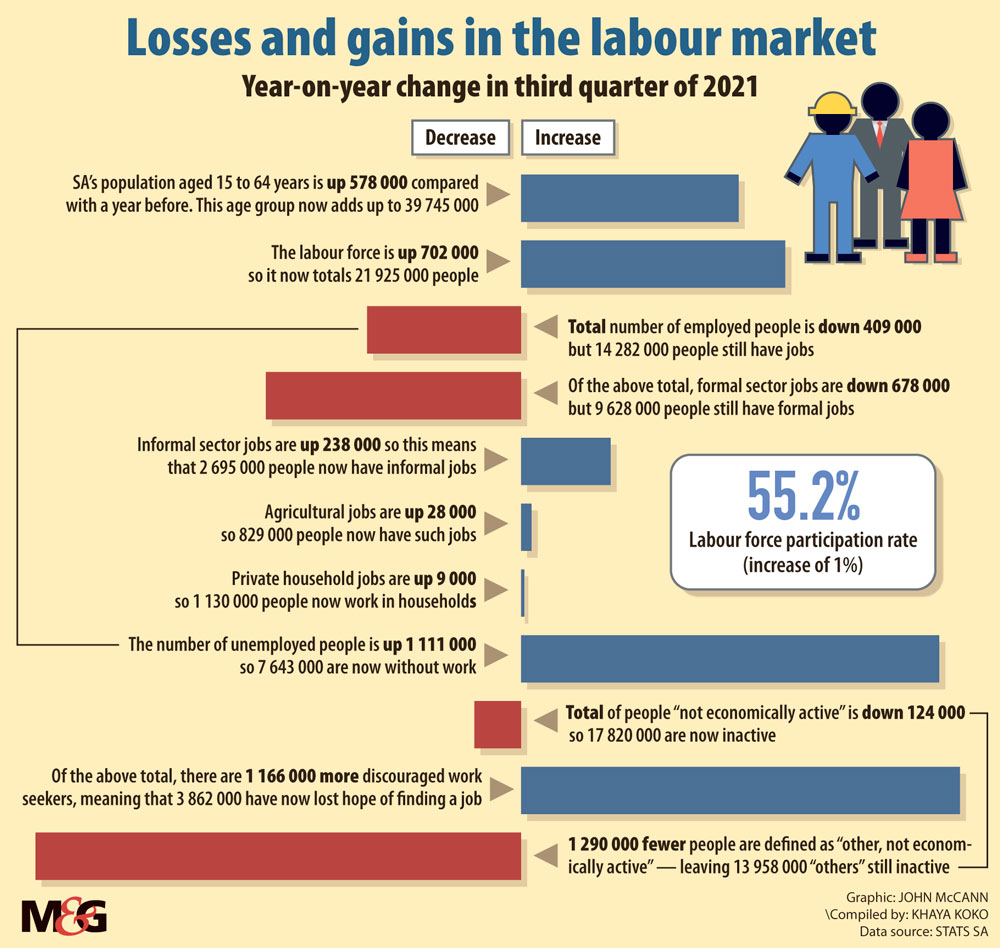
The unrelenting drive to force immigrants out of South Africa’s informal sector, which employs almost 2.7-million people, will stymie economic growth and prevent competition and innovation in the country, economists have warned.
But the Kathorus Shop Owners Association, which has about 3 000 members comprising small business owners, has rejected the views of economists, and insists that the informal sector should be protected by the state on behalf of South Africans.
The association admits to having forced more than 1 000 foreign shopkeepers out of the township in Gauteng’s Ekurhuleni municipality.
Themba Tozo, spokesperson for Kathorus — a portmanteau of the Ekurhuleni townships of Katlehong, Thokoza and Vosloorus — argued that the reason for the 2019 formation of his organisation was the view that informal businesses, such as spaza shops and street vending, were not critical skills and should be reserved for South Africans.
“Previously, we were an economic forum that was set up to benefit from the 30% set aside for small businesses in government contracts [worth more than R30-million], but decided to set up an association in 2019 to formalise small business ownership in the townships of Katlehong, Thokoza and Vosloorus.
“A decision was taken to force foreign shop owners out of the area because of the realisation that they did not bring anything new to the South African market; South Africans were running shops long before the competition from outside came in,” said Tozo.
“It took about a year for the majority of the shops in the township to be owned by South Africans because there was a lot of resistance from the foreign business owners, as can be expected. It became a real war because six of our members were shot dead in what we believe to be planned hits from foreign shop owners because of our stance.
“But we had to enforce the eviction so that the people of this country can benefit from its informal economy,” Tozo added.
The formation of the association followed the last spate of looting and xenophobic attacks on foreign-owned shops and shopkeepers in September 2019, which Police Minister Bheki Cele said at the time led to 12 people in Gauteng dying during the week-long violence and destruction.
Walking through the township of Katlehong today, it is evident that shops previously owned by foreigners are now owned by South Africans.
The shops are not as fully stacked as those that were run by foreigners, but Tozo said “the new businesses needed to crawl before they walked”, and that many owners had to relearn the skill of small business ownership after years of what he termed foreign dominance.
Tozo said that although association members experienced “violent retaliation” for the forced removal of foreign business people in the Ekurhuleni region, there were examples of peaceful legislation by African governments to protect the informal markets of their countries.
He mentioned the Ghana Investment Promotion Centre Act, or the GIPC Act, which was promulgated in 2013 and calls for a minimum equity capital of $1-million in cash or capital goods relevant to the investment for all trading business that are wholly owned by a non-Ghanaian.
In a joint venture with at least 10% Ghanaian participation, the GIPC Act stipulates that the foreign partner should contribute $200 000 in either cash or capital goods relevant to the investment.
Tozo said his association was working with the provincial government to ensure there was greater South African ownership of businesses in townships.
“Each and every country has a responsibility to take care of its citizens. Other countries such as Ghana have been able to do so, and there is no reason why we cannot do so here in South Africa.
“Township businesses cannot compete in the macroeconomic sector due to mainly historical, repressive laws that prevented the business development of black people. So the township economy should be reserved for us as black South Africans.
We cannot be spectators in our own economy.”
Tozo was alluding to the various movements that are gaining momentum in the country, such as Operation Dudula, which aims to forcefully remove foreign small traders in mainly township and urban areas.
But his assertions have been slammed by Isaah Mhlanga, Alexander Forbes’s chief economist, who said it was too late for the government to introduce protectionist policies in the informal business sector.
“Our informal economy is very small compared to our peers in the rest of Africa because, in the main, we might not see them as proper jobs. There is also little data available on foreign ownership in the informal sector for the government to even think about introducing legislation that protects the informal market on behalf of South Africans,” Mhlanga said.
“State intervention could help to improve the creation of new South African small businesses and protect existing ones, but that cannot be permanent. Competition should be brought in to encourage innovation because innovation is driven by greater competition.
“I don’t favour protectionism, because when the economy is dynamic, that is when growth and innovation come in. We need to attract more entrepreneurs into the economy, regardless of whether they are foreign or local.”
Mhlanga’s views were supported by Dawie Roodt, the Efficient Group’s chief economist, who stressed that the basics of economics was that individuals should be able to trade freely among themselves.
“It is not possible to trade without private property rights. And if there is no private property certainty that people [cannot] just take away your property illegally, people cannot trade and create wealth.
“So, forcing foreigners from the informal market is very wrong because if you remove one person from trading, then we, as a country, will be all the more poorer for it,” Roodt said.
According to Statistics South Africa, as of the third quarter of 2021, the informal economy contributed to just under 2.7-million jobs. Figures for the last quarter of 2021 have not yet been released by Stats SA, which said in February that it would release the numbers later than usual because of “quality checks”.
[/membership]