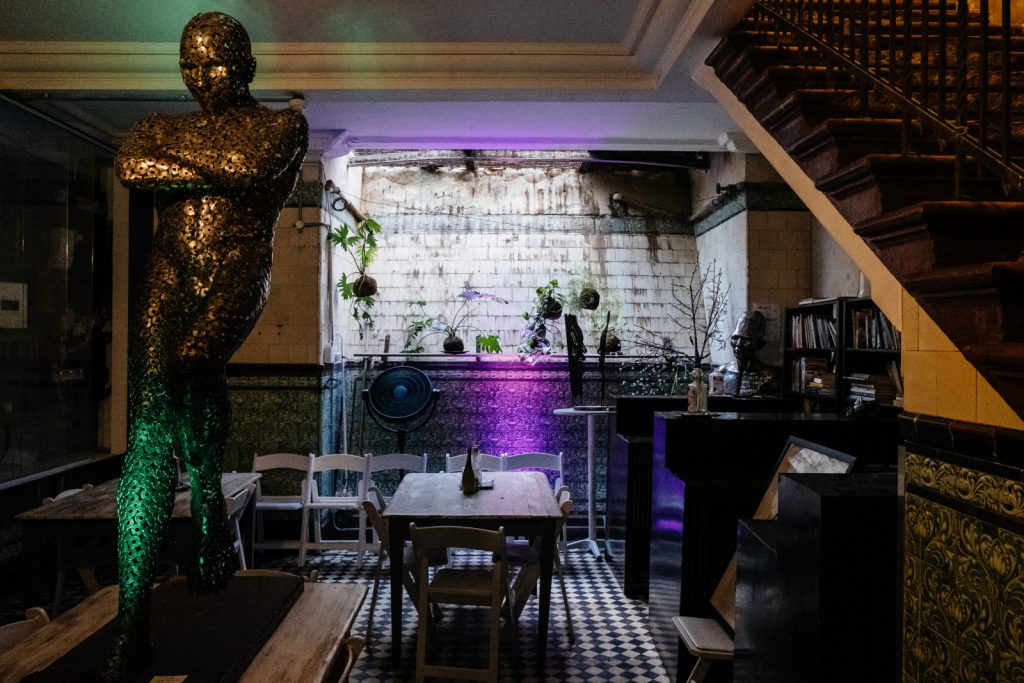
Interior of the Rand Club in the Johannesburg CBD. Photograph: James Puttick.
The Rand Club in Johannesburg’s central business district has not been spared the ferocity of the autumn downpour. The damp spots on the club’s grand ceilings threaten to bloom. One of the club’s members collects 15 litres of water, which trickles down to the historic building’s lower level — the result of a creaking gutter system not fit to endure the unexpected change in climate.
When the club was founded in 1887, a year after Johannesburg was established, the randlords had not yet gone about turning the city into one of the world’s largest man-made urban forests. The stretch of veld and farmland where the Rand Club was erected was windswept and largely treeless.
A lot has changed since then. Women can enter the club through the front door and mining magnates no longer ramble around the inner city like they own the place.
The city built on mining has also recently lost some of its most esteemed tenants: In 2020, Anglo American left its Marshall street headquarters for the more suburban comforts of Rosebank. Earlier this month, the Minerals Council South Africa announced it would also be decamping to the northern outpost.
The flight of the mining bosses may signal that the bottom has finally fallen out of the CBD, which has gained a reputation for being hostile to new company — so much so that “stay safe” is a common refrain by Uber drivers dropping off their clients.
But some insist that, even without its corporate lodgers, the city’s centre will hold.
The wild west
When the Minerals Council’s departure from the CBD was first announced, its chief executive Roger Baxter said the institution “is synonymous with Johannesburg”.
The old headquarters, home to what was then known as the Chamber of Mines, was constructed in 1921. The first board meeting held at the building was on 27 March 1922. “We have promoted and protected our members’ interests, while being mindful of the country’s imperatives, for 132 years, mostly from our graceful, history-filled building in central Johannesburg,” Baxter said.
“But the time has come to move to premises that are better suited to serving our members in a modern, easily accessible, and efficient environment.”
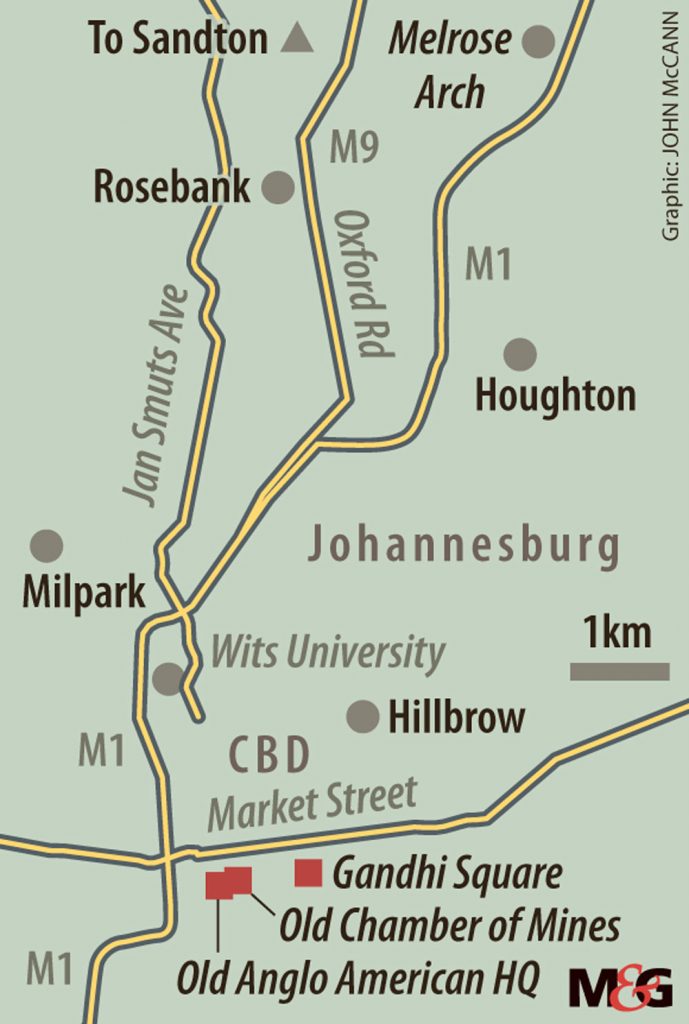
The Minerals Council took occupancy at Rosebank Towers, which is a two-minute walk from Anglo American’s new headquarters, earlier this month.
According to the statement announcing the council’s new home, the old building was too large and impractical for its vastly reduced staff complement, many of whom still work from home even as the Covid-19 pandemic’s two-year grip loosens.
The Mineral Council’s workforce has dropped to just 49 full-time employees. In its heyday, the then Chamber of Mines, which before the 1990s provided a number of now outsourced services, employed about 7 500 staff members.
Jeanette Hofsajer, the Mineral Council’s head of administration and its longest-serving current employee, said working in the CBD had its ups and downs. “When I started working there in the 1990s, along Main Street there were about five or six banks and there would be a bank robbery or a major shootout at least once a month,” she tells the Mail & Guardian.
“The banks wisened up and now they target the cash-in-transit trucks. So at its worst, the CBD was like the wild west.”
Little islands
In the latter half of the 1990s, however, the work of city improvement districts started to take shape.
Hofsajer explained: “We have our own security in the area. All the security firms work together. And that pushed a lot of the crime and grime out … So our area is literally a little island. It’s very nice. It’s lovely. It’s got coffee shops. There are trees and fountains and art. So it’s a very nice little island. The problem is that literally within a kilometre in either direction there’s absolute squalor.”
The Johannesburg Central police station has one of the highest number of community-reported serious crimes in the country. The station tops the lists of those dealing with the highest number of contact crimes, robberies with aggravating circumstances and robberies at non-residential premises.
The city’s ugly underbelly was exposed to its corporate interlopers when the M2 highway, one of the city’s main road networks, was closed in 2019.
“All that traffic was pushed back into the inner city. And people who have never understood how bad it was around us, including our staff, had to drive through those areas and they were horrified,” Hofsajer says.
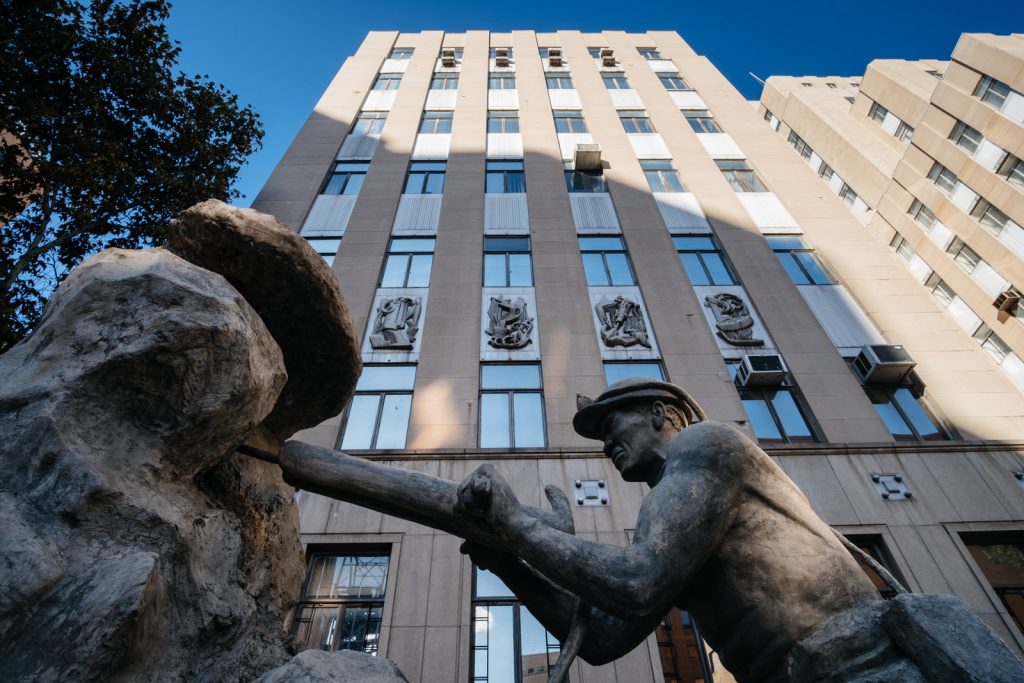 The Chamber of Mines Building at the intersection of Main and Sauer Streets in the Johannesburg CBD. The Minerals Council of South Africa has recently moved from these premises to Rosebank. Photograph: James Puttick.
“One of our staff members saw a trolley full of cow heads and was actually traumatised by that. You shouldn’t be able to see things like that in a city.”
Though it is sad to leave the old building behind, the Minerals Council’s departure from the CBD is the inevitable expression of an ever-changing city, Hofsajer said. “I love the way it used to be. It has definitely changed, but any city changes over time. The demographics have changed,” she adds.
“The large businesses have moved out, with the exception of three major banks … But it is just changing. It has become a lot more housing-oriented. There are a lot more smaller businesses and small legal firms. So it’s a different grouping of people that are finding a home there and taking it on and taking it forward.”
Outside Gerald Olitzki’s office hangs a framed Star poster with the headline: “Business returns to the CBD”.
Light filters into the lawyer-turned-property developer’s office. The room is a far cry from the street below, where the crush of pedestrians moves hurriedly to their respective destinations. Olitzki pioneered the development of Gandhi Square, the CBD’s main bus terminal.
“I had a tiny office that faced what was called Van der Bijl Square in those days. I watched the deterioration of the city, you know? And for me this was a shame … The reality was that there was this mindless flight from the inner-city. They all fled to the north and to me that was unconscionable,” Olitzki says, his brow furrowing.
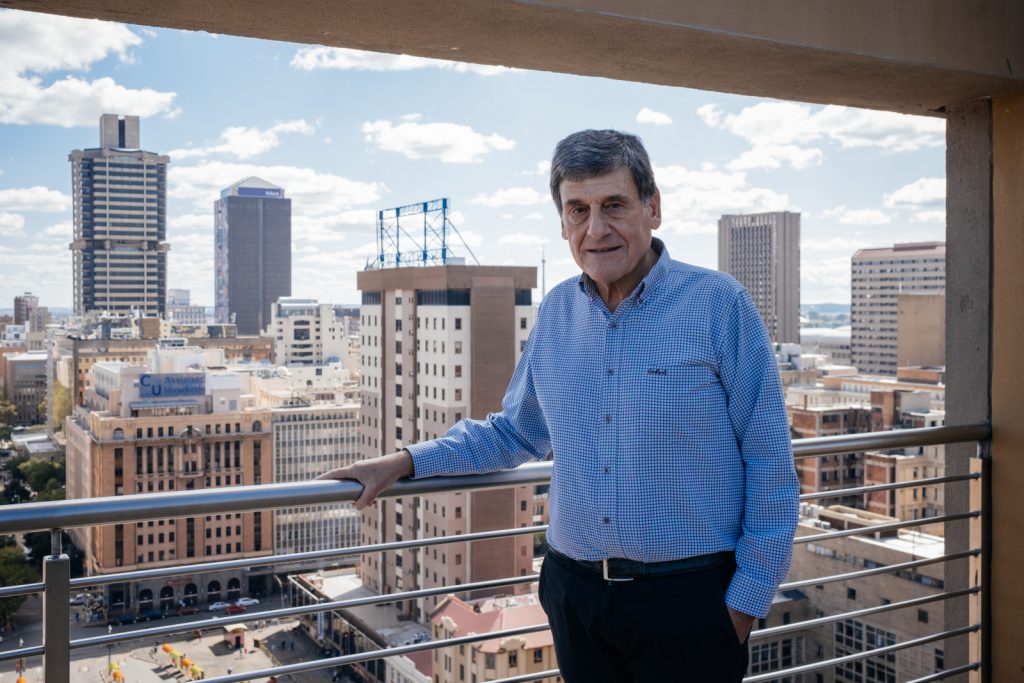 Executive Chairman of Olitzki Property Holdings, Gerald Olitzki, at the company’s offices overlooking Ghandi Square in Marshalltown in the Johannesburg CBD. Photograph: James Puttick.
Square pegs, round hole
The flight of the corporates, and later some of the lawyers and accountants, caused a vacuum that allowed the urban decay to spread, he explains. “I thought, ‘This is absolute nonsense. How can you allow this to occur?’ And at the end of the day, they were sitting in Sandton and Rosebank saying ‘We told you so.’ But they actually created the problem. So something had to be done to reverse this.”
The Gandhi Square development, which was completed in 2002, was the impetus for the revival of the area around the bus terminal — spanning from Commissioner Street to Marshall Street.
The roof of the Olitzki Property Holdings headquarters looks down on the square, which is flanked by a McDonalds, a Capitec, a florist, an Adidas and other retailers. People, who from Olitzki’s perch are just anonymous characters in a Where’s Wally illustration, wait casually for their buses.
Speaking on the departures of big businesses from the inner city, Olitzki says: “Businesses that essentially employ the northern suburbs types and cater for the northern suburbs type of clientele will always be in Sandton or Rosebank. That is their place. But businesses that employ from the broader spectrum of Johannesburg and cater for the broader spectrum of Johannesburg, will be in Johannesburg.”
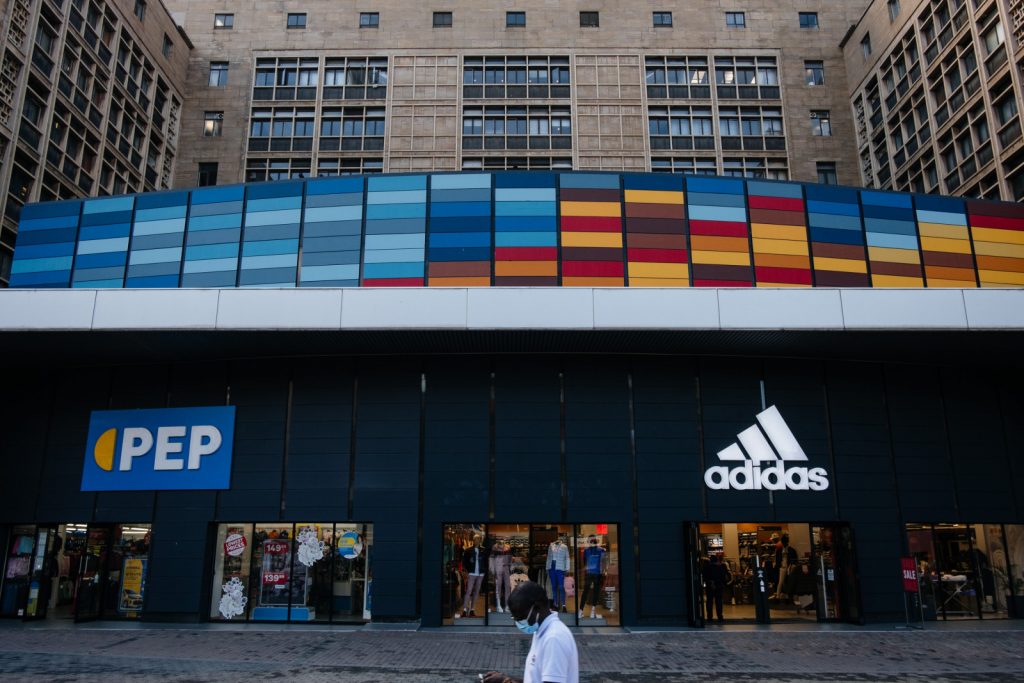 Adidas and PEP flagship stores located in a newly refurbished building on Ghandi Square in Marshalltown in the Johannesburg CBD. Photograph: James Puttick.
Anglo and the Minerals Council, Olitzki says, “were essentially a square peg in a round hole. They fit the category of the northern suburb types. So I am just surprised that it took them so long to leave. It’s no disappointment.”
Inner city developers should not be labouring to woo back those businesses, but be open to the opportunities their flight represents, Olitzki says. “They occupied a tiny percentage of those big buildings. Once they are gone, whether it be me or some other developer, those buildings will be taken and filled with people,” he adds.
“That is so much more vibrant, so much more meaningful, than having 20 people sitting in a building of a hundred square metres. So, on the contrary, their departure is a plus for us.”
Change is gonna come
Alicia Thompson is the new chair of the Rand Club, which until 1993 did not accept women as members. When Thompson and her husband joined the club in 2012, the city felt like it was — as she puts it — “on an upward trajectory”.
“Things were looking up for the city. However, the club was going through a very bad patch. The club was losing members. We were really struggling with members coming into the city from the North.”
In 2015 the Rand Club, which at the time was haemorrhaging money, was forced to close down.
When it reopened in 2016, the club also opened its doors to what its general committee recognised was a crowd vastly different from its stuffy former demographic. “What we had to do was actually change the essence of the club,” Thompson says.
“And we had to change the perception of the club. So we have made a lot of effort to, first of all, shed that image of the club as this elitist space, because it actually isn’t. It’s a Joburg space.”
 Charlie and Gerald’s Town Treasure is a restaurant situated in an old bank vault in the basement of a recently refurbished building on Fox Street in the johannesburg CBD. Photograph: James Puttick.
For Thompson, the big business exodus is not the CBD’s death knell. “The city is still full of people who want to make the city work … Jo’burg is still a young city. It is only 136 years old. The city will go through cycles.”
The city may appear moth-eaten in parts, “but there is still a vibrant energy”, Thompson adds. “People are just going about their days, living their lives in the city. The businesses that are there are just trying to stay in business.”
[/membership]