File photo: Madelene Cronjé/M&G
Corporal punishment remains a problem in the country’s schools, according to the South African Council for Educators (Sace), which received 169 complaints in the 2020-21 fiscal year.
Of the complaints, only two teachers “were removed indefinitely for severe assault on learners,” while 23 were found guilty and paid a fine.
The number of complaints for 2021-22 are yet to be finalised, the council told the Mail & Guardian.
The use of corporal punishment remains most prevalent in rural areas, according to Basil Manuel, the executive director of the National Professional Teachers’ Organisation of South Africa (Naptosa).
“In rural contexts [you] are far more likely to see corporal punishment still practised, maybe not to the same extent as it was before, but I don’t believe there’s been a significant change in those contexts,” he said.
But, he added, corporal punishment “has become completely unknown in many schools, which is what we wanted, of course.”
Corporal punishment in schools was banned in 1996, but cases of such still make it to the headlines, as with the most recent legal battle between the council and Section27, which represented parents and the Child Law Centre against SACE and argued that fines imposed on the offenders in two separate incidents were inadequate.
After the first hearing in the Johannesburg high court in late April, the case was postponed because of legal technicalities. A new court date is yet to be set.
The incidents involve grade two and grade five learners whose assaulters were fined R10 000 each and were handed suspended sentences of having their names removed from the teacher’s roll for 10 years, but only should they be found guilty of misconduct in the future.
“This essentially allows the teachers to return to the classroom without any proper intervention to address their violent behaviour,” said Mila Harding, a legal researcher at Section27.
The law centre represents the Centre for Child Law and the parents of the two learners and has challenged the council to reconsider its judgment. In addition, Section27 will argue to have the council revise its Mandatory Sanctions on Contraventions of the Code of Professional Ethics, the guideline used when sanctioning educators for misconduct.
Harding contends that the council’s Mandatory Sanctions document “is unconstitutional and irrational because it fails to consider necessary factors such as the rights of children or the severity of the instances of assault”.
“The teachers in the case committed severe acts of assault against very young learners, which has left the learners emotionally and physically traumatised.”
In turn, the council — which is responsible for maintaining and protecting ethical and professional standards for educators -— argued, according to Harding, that “it could not impose different sanctions because the sanctions that were imposed were based on the Mandatory Sanctions document that Sace itself formulated”.
Harding said Section27 will challenge the council to “reformulate its Mandatory Sanctions document to be constitutionally compliant and reflect the seriousness of corporal punishment”.
The two separate cases clearly differ in severity, yet both teachers received the same sentences after pleading guilty. The cases date back to 2020.
In the first case, a Gauteng teacher hit a grade two learner over the head with a plastic pipe, causing “severe emotional distress and physical trauma”, according to Harding.
In the separate incident in Limpopo, a teacher struck a grade five learner against the head, causing the child’s ear to bleed. The learner repeated the academic year because of “emotional trauma” and having to visit doctors.
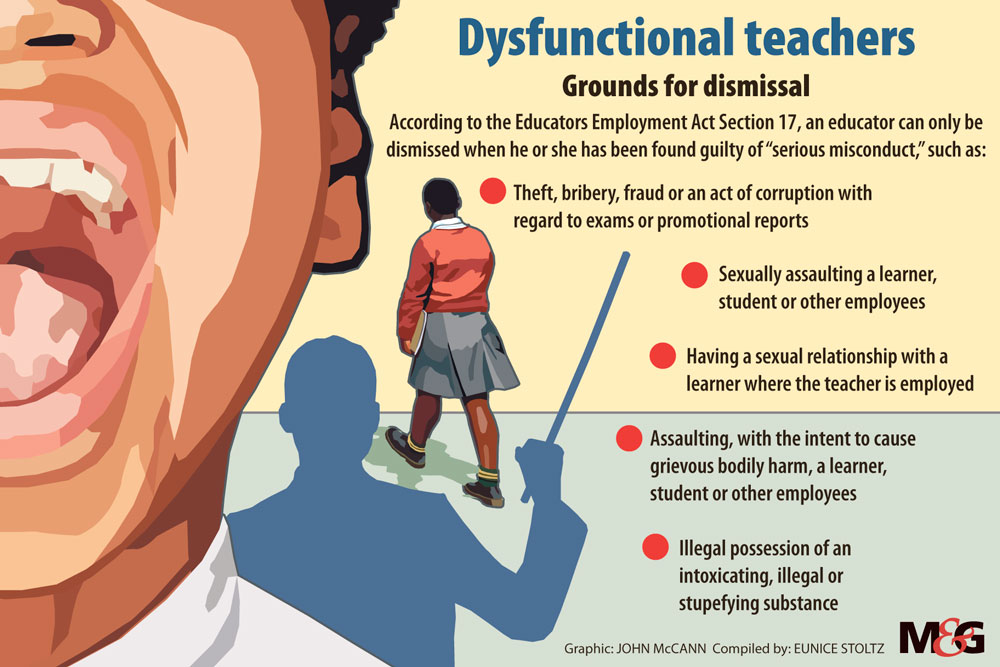
But, as per the Educators Employment Act, not all offences lead to dismissal.
The South African Human Rights Commission was told in 2021 that some educators found guilty of corporal punishment were fined anything between R1 000 and R5 000 and were suspended for a month or more without pay, while the more serious cases led to dismissal.
An educator can only be dismissed when found guilty of “serious misconduct”. In the case of corporal punishment, the educator must be found guilty of administering corporal punishment with the intention to cause grievous bodily harm.
Naidoo argues that a fine “is not a deterrent” to stop teachers from administering corporal punishment. Further to this is of educators that corporal punishment is effective in disciplining learners.
Ella Mokgalane, chief executive of Sace, said: “It is a fact that corporal punishment remains the most reported type of a complaint in the country annually. It remains the biggest challenge in our schools to date.” Not all cases are reported to the council, which is a requirement.
Divya Naidoo, the child protection programme manager at Save the Children South Africa, said that after years of monitoring complaints of corporal punishment, she found an increase in the number of complaints — not necessarily because incidents increased, but because of awareness and learners being encouraged to make incidents known.
There remained a “major gap in our system to teach new [discipline] skills”, said Naidoo. Teachers were not taught alternative disciplinary methods.
Manuel emphasises that teachers also find themselves in a “difficult environment” where “discipline is a major issue in our schools … I’m not trying to legitimise corporal punishment but there are contextual factors that must be taken into account.”
He argues that instead of isolating the council’s disciplinary function, “we must look at the entire cohort of people involved”.
He agrees that multi-component approaches are needed to address corporal punishment, such as parents helping to discipline their child and the department of basic education seeing to it that “teachers are equipped, trained and have the necessary resources for every context they may find themselves in”.
[/membership]