Expansion: Reserves at Tendele Coal Mine near Somkhele village and Mutabatuba will run out by June and now it wants to open a new mine, arguing that the court ruling did not prevent this. Photo: Oupa Nkosi
Local activists opposing a multibillion-rand coal mine in Zululand have threatened to interdict operations if Tendele Coal attempts to start new mining in contravention of a recent high court judgment.
Tensions are high in the rural areas around Mtubatuba and Hluhluwe in KwaZulu-Natal since Pretoria high court Judge Noluntu Bam’s 4 May ruling.
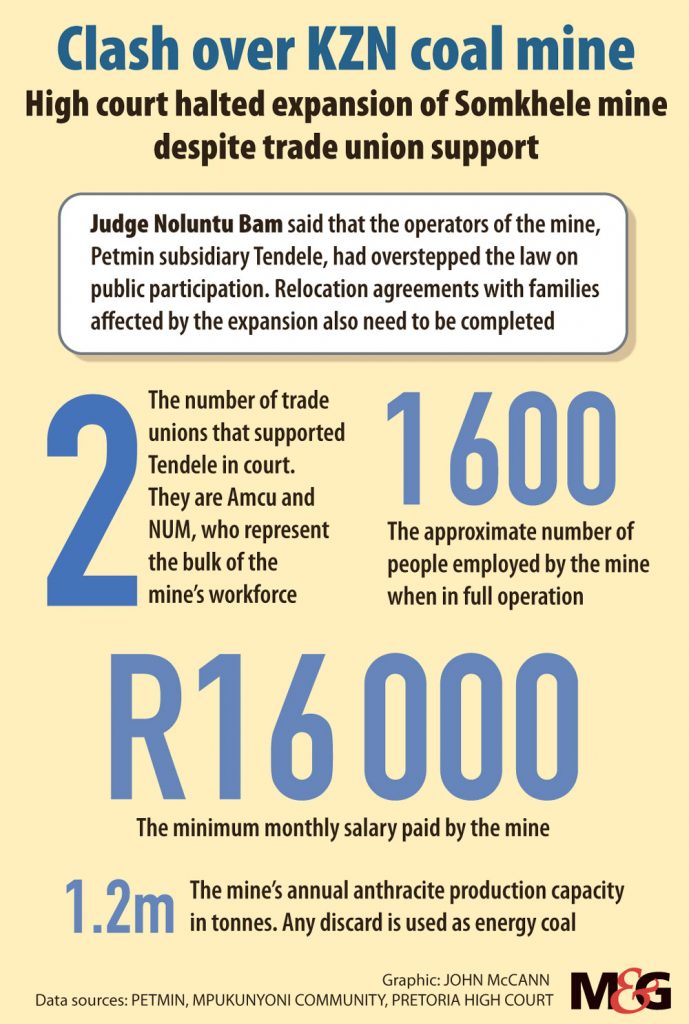
Tendele’s owner, Petmin Somkhele, says it employs 1 500 people and in its 16 years of operation has paid R1.5-billion in salaries.
As one of the country’s major anthracite suppliers, it says if its operations were to stop, the local market would be “wiped out”, with a knock-on effect in the ferrochrome industry that employs 20 000 people.
This week, the mining company released a statement on the back of Bam’s ruling that appears to be an attempt to pacify the markets.
The ruling and subsequent statements have raised tensions in an area divided by those for and those against the mine, with different interpretations of Bam’s judgment.
Tendele said this week that Bam’s ruling meant that “on the clear basis” its existing mining right remained in force pending a determination by the minister of mineral resources and energy.
“The reason for the court making this determination was to ensure the mine’s ultimate survival” because anthracite reserves at Tendele’s current site will be depleted by 30 June this year, leaving no alternative but to retrench employees and cancel contracts.
But this is nonsense, according to lawyer Kirsten Youens, whose clients are a coalition of local residents and environmentalist groups.
“The judgment clearly says that the mining right was unlawfully granted. So how can the mine say they are authorised to start in the new areas? If they start mining, contrary to the findings of the judgment, we will have no choice but to interdict them from doing so,” she said.
Youens said Bam’s judgment was an indictment of Tendele and “outrightly declared” the state’s decision to award Tendele its mining right to be invalid.
In her 48-page ruling, Bam said Tendele’s licence to extend the activities of the mine was invalid.
The judge nullified the approval by the KwaZulu-Natal regional manager of the mineral resources department for Tendele to mine a further 212 square kilometres.
The entire licence, the judge ordered, had to be reconsidered by the department’s minister, who was also ordered to revisit an appeal lodged by various organisations, in accordance with the findings of her judgment.
The judge’s ruling followed four years of legal action initiated by the Mfolozi Community Environmental Justice Organisation and its partners.
Bam ordered Tendele to pay costs and said the mine conceded that it could not defend its position on several issues, including its “imperfect” public participation process.
Bam said the “wheels had come off” during Tendele’s scoping process, which was “offensive” and had scant regard for public participation.
The judge said the case called for “pragmatism” and required the “correct balance of various competing interests”, which she ordered the minister to keep in mind when considering the issue in accordance with the findings of her judgment.
Approached for comment, Tendele’s Craig Harrison said the judgment applied to new mining and did not affect current mining, although immediate coal supply will be exhausted in June.
Harrison said that in essence, the judgment reopened an appeal process before the minister, who had to consider any new information placed before him by interested and affected parties.
“For example, we have done 26 additional environmental studies since 2016 [when the mining right was awarded] and abandoned 92% of the mining right area.”
 (John McCann/M&G)
The mine had to ensure public participation and was in the process of drafting notice to this effect. Harrison said a lobby sought to close the mine, which would affect many poverty-stricken people.
“Fortunately, with the judgment, the mine now has a chance to survive, allowing the continued employment of 1 200 people, local entrepreneurs continuing to operate and material benefits flowing to the local community.
“This area, and South Africa, can’t allow a mine with a 10-year life to close as it will have a devastating impact on the community and will send a terrible message to foreign investors during a time that South Africa is desperate to attract more investment.”
In the statement released earlier in the week, Tendele made reference to the economic effect of the mine. It said unemployment in the area was 70% and that in the course of Tendele’s history, it had contributed R2.7-billion in direct benefits to 40 000 people, including the R1.5‑billion paid in salaries.
This week, the Association of Mineworkers and Construction Union and the National Union of Mineworkers put out a statement slamming anti-mining activists, saying it was imperative that mining jobs be saved because 15 000 people directly depend on the mine for their livelihoods.
The Mail & Guardian this week had sight of a letter dated 4 May to the Industrial Development Corporation by anti-mining groups, which references an attempt by Tendele to secure a “substantial loan in excess of R100-million” to continue its operations, suggesting Tendele is pressed for cash.
It is unlikely that the mine will be able to fulfil the public participation process demanded by the judge before 30 June, when supply at its current sites is exhausted.
Youens said Tendele was the author of its own misfortune.
“Had they complied with the law back in 2013 when this mining application process began, none of this would have been necessary. The court has made it clear that the people of the land must be seen, must be heard, and must be consulted when their rights are going to be so fundamentally affected. The fact that the department and Tendele ignored the law and the people for so long is the reason my clients were forced to go to court. It was a long road, but finally their rights have been recognised.”
The battle over Tendele’s future has been marked by harassment and even murder.
In October 2020, three gunmen shot dead anti-mining activist Fikile Ntshangase.
At the time a joint statement from the Global Environmental Trust said the mine caused “untold destruction” and had adversely affected lives.
It has also created huge tensions among residents of the area, at times pitting family members against one another, because some are determined to protect their land and the environment, while others are desperate for work.
Youens said it was disingenuous to make arguments about the mine’s economic effect when the mining right was illegally granted.
“We understand there are jobs at stake, but these should not be at the expense of thousands of people being impacted by mining operations, long term devastation, intergenerational loss and psychological trauma. The land will be sterilised forever. What about the impact of that?”
Community member Khetiwe Sangweni, a nurse who has lived in the area most of her life, said: “I’m very worried about all this. The community is very divided. People who benefit from the mine with jobs and contracts there don’t want it to stop and are angry with people who are opposing the mine. It is very scary. People say if the mine stops there will be a fight.”
Sangweni, who is opposed to mining, says tribal leaders made agreements with the miners without a mandate. This led to families being relocated and graves moved.
Sangweni lives next door to the mine and her family lives with constant noise and dust.
[/membership]