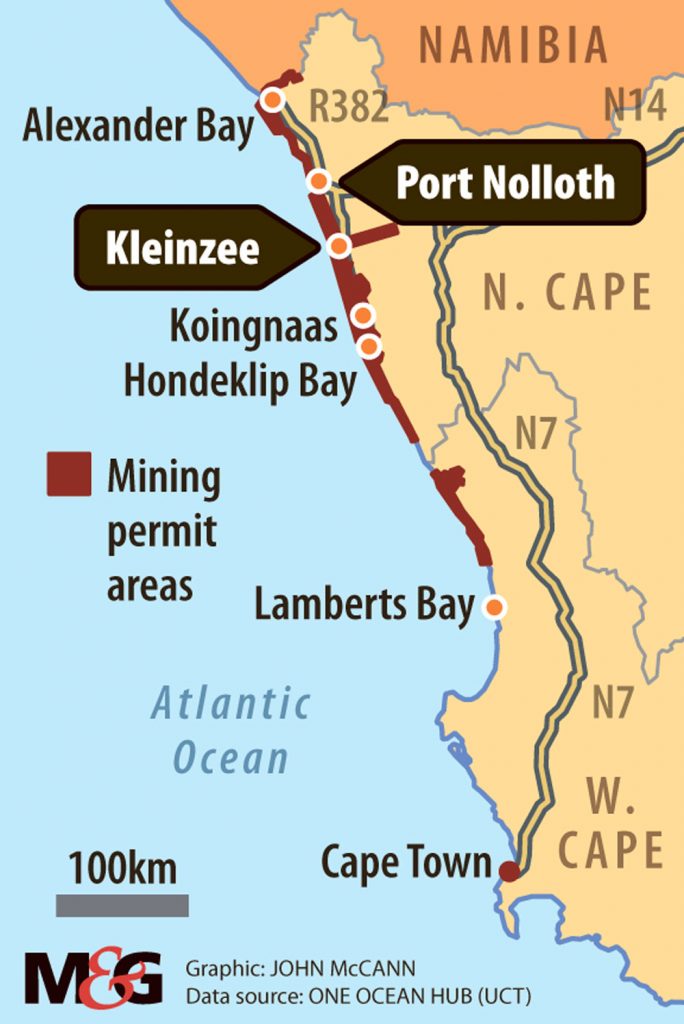
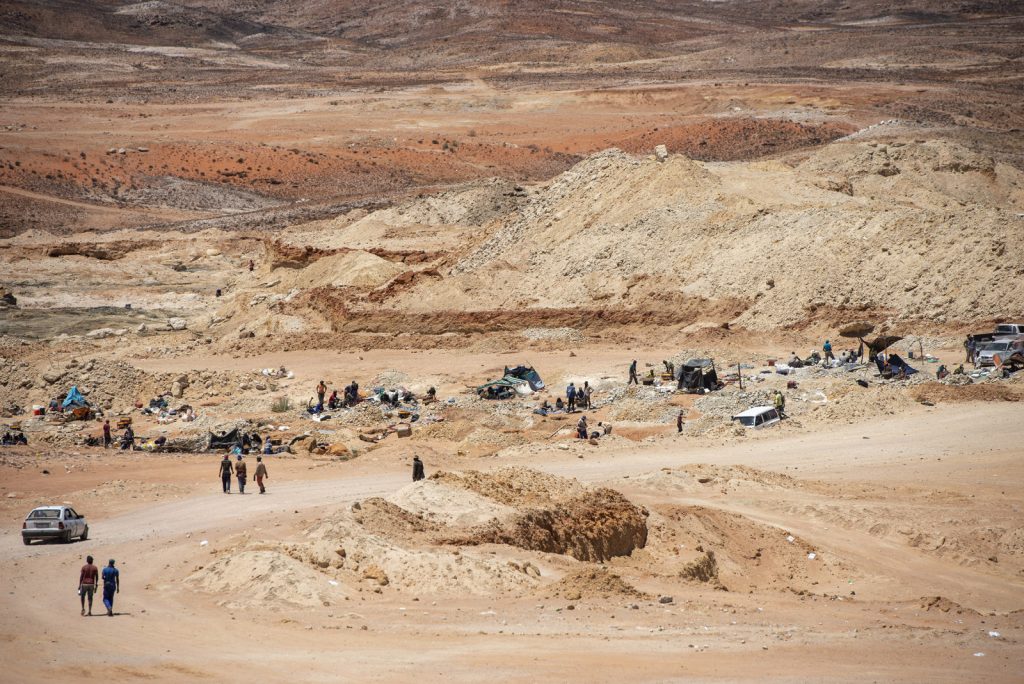
To the beat of shovels, drills and music, illegal miners are eking out a living at the abandoned Nuttaboy mine about 70km southeast of Port Nolloth in the Northern Cape.
In the parched semi-desert plains surrounding Nuttaboy, one can find cigarettes, mageu, alcohol, roosterkoek, vetkoek, pap, boerewors, flame-grilled tjops — and uncut diamonds.
“I do not buy,” says PG while driving his 4×4. He says he has people digging at Nuttaboy, dismissing the miners’ allegations that he, and the person in the passenger seat, buy diamonds found at the mine.
He soon contradicts his claim when the passenger waves away an approaching seller.
PG says he keeps the four Cs in mind when determining the price of a diamond — carat, clarity, colour and cut.
Many diamonds mined in the area end up in Gauteng, according to PG, but people from Namibia also buy the gems.
Artisanal miners told the Mail & Guardian that uncut diamonds of about 0.3 carats fetch between R300 and R800. On one occasion, four diggers working together found one diamond valued at a mere R120. Divided between them, each was left with R30.
But if they are lucky, a diamond can be valued at thousands of rands, even millions. Several illegal miners say that it is the hope of finding “a big stone” that inspires them to keep on digging.
The Covid-19 pandemic led to an influx of illegal miners to the Northern Cape. The increase in the availability of diamonds also attracted more buyers. This naturally affects the price.
“Now the price is smaller because there are more diggers, more diamonds in circulation,” said Kriek, an informal miner in Port Nolloth. He also leads discussions with the local government about mining permits for informal diggers.
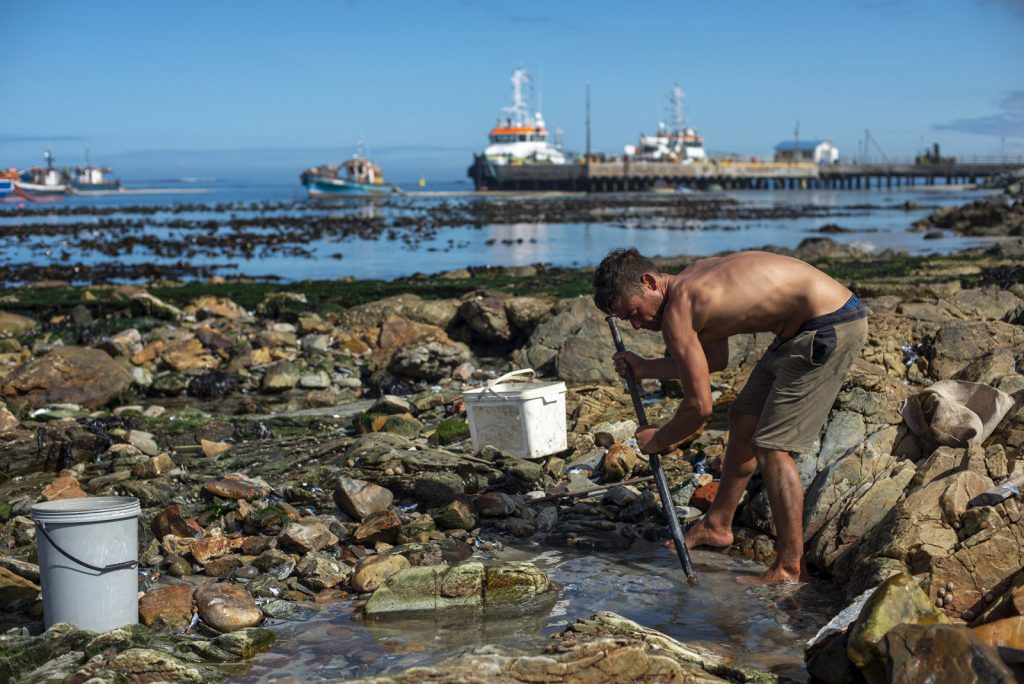 The new artisanal and small-scale mining policy may be a turning point for informal prospectors who want to mine legally. (All images: David Harrison)
He said that when he started to mine in 2020, there were only a handful of buyers. Today, dozens of buyers come to Port Nolloth in the afternoons to buy illegal diamonds.
At Nuttaboy, one of many abandoned open mines in the province, several miners send the profit they make from selling diamonds back home. Whether it is to Bloemfontein, Soweto, or another country, proceeds from illegal diamonds support families living many kilometres away.
During the M&G’s visit, a miner cut his finger while digging. He used a rag to prevent further bleeding and didn’t stop digging. The little cash he earns is sent to his children to help pay for their education.
Locals also spend hours at the mine, hoping to find a valuable stone they can sell to buy enough food for their families. Some miners dig “just to buy bread and a beer”.
Gert van Niekerk, chairperson of the South African Diamond Producers Organisation (SADPO), said: “the illegal side of mining and trading of diamonds is a huge risk to the industry as a whole.”
Van Niekerk distinguishes between syndicates and informal miners who dig illegally but “want to put bread on the table”. Yet, by keeping these illegal mining operations afloat, illegal structures are formalised, he says.
SADPO’s chief executive, Yamkela Makupula, said illegal mining creates difficulties for permit holders in that illegal miners operate on their land. In many instances, illegal miners end up in standoffs between private security companies and the police.
The illicit diamond trade is threatening South Africa’s good standing in terms of the Kimberley Process, according to van Niekerk, which enables the diamond industry to identify the origin of diamonds. This prevents “conflict diamonds” or “blood diamonds” being sold.
Legal mining operations contributed R127-billion to the total corporate income tax of R318-billion in the 2021-22 financial year. In the same year, minerals made up more than 60% of the country’s exports.
But a man with a shovel and sieve selling diamonds on the illegal market does not contribute to the national economy.
Most illegal miners the M&G spoke to when visiting Port Nolloth and the abandoned mines want to obtain a permit to mine legally.
To obtain a permit is a lengthy and costly endeavour. Van Niekerk said that under section 27 of the Mining Petroleum Resource Development Act (MPRDA) small-scale miners can apply for five hectares of land.
It took small-scale miners assisted by the SADPO 13 months from applying for permits, at the cost of R130 000 each (including the basic tools required to operate as a small-scale miner), to the permit being issued.
The mayor’s office of the Nama Khoi municipality in Springbok said there have been “constructive engagements” with the department of mineral resources and energy to legalise informal mining.
“Engagements evolve around relaxing red tape around mining permit approvals and
cooperation between mining companies and small-scale miners. Engagements are
continuing. It should be noted that mining remains a high-risk and expansive operation,” said Jason Milford, spokesperson for the mayor’s office.
Artisanal and small-scale mining policy
The department introduced the Artisanal and Small-Scale Mining Policy in terms of the Mining Petroleum Resource Development Act on 30 March.
Van Niekerk described this policy as a “true turning point” but added that it still needs fine-tuning.
“This new policy document acknowledges in writing that section 27 of the MPRDA has its shortcomings, and that to us is wonderful news,” says Van Niekerk, in that they “can now work towards a solution and better future”.
Makupula also welcomed the policy, adding that it “does acknowledge the fact that illegal mining is happening because of the stringent regulatory requirements, and the cost of mining itself in South Africa”.
The SADPO is optimistic that the policy can be used to amend current legislation.
“The diamond producing industry can now take hands and come with solution-driven practical, implementable measures,” said Van Niekerk. “As a policy document, it creates an opportunity for the industry to lobby and collaborate with the government to speed up processes and simplify the requirements for permits.
“Some of the current regulations would not be necessary to be enforced on these small operators, and that will at the end of the day allow these new entrants and these really struggling part of our communities to enter into our business again and be able to contribute towards the national fiscal,” through taxes and royalties.
Back at Nuttaboy, loud voices, jackhammers and shovels being used to search for diamonds are proof that the illicit economy is thriving. Above the sounds and the dusty wind, Kriek’s voice echoes the plea of fellow illegal miners: “We hang on promises.”
In this four-part series, mining in the Northern Cape is explored largely through the lens of informal miners whose efforts to obtain legal mining permits have been futile. They are not among the informal miners who work for syndicates who are not trying to get mining permits. The series hopes to bring forward the voices of the people of Namaqualand, a place often forgotten by many.
[/membership]