Mary Sibande’s ‘Wielding’. The joint exhibition of the work of these two artists, born nearly a century apart, is the fourth in a series of legacy exhibitions pairing prominent South African artists.
Domestic workers are often described as the most essential labourers in our economy because of the way they provide upward mobility for modern families who seek to realise their dreams.
On a philosophical level, and as service workers, they can also be seen to embody humanity’s capacity to aid others, even in spaces of unfamiliarity and strangeness. Still, while holding prominent positions in the intimate spaces of households, they tend to be hidden in people’s homes where they can be subjected to abuse and exploitation by those who employ them.
Despite the fact that domestic workers should be earning a monthly wage of R3 710 if they’re working a 160-hour month, according to minimum wage rates, data suggests one in five earns less than R1 500 monthly.
Even as South Africa boasts some of the most progressive labour laws for domestic workers in the world, these statistics paint a harrowing image of the lives of black women, who make up 97% of the one-million domestic workers in the country.
They also speak to the moral turpitude of the society that employs them. As a black woman myself, who comes from a long line of women who worked as domestic workers for white families during the apartheid era, it’s difficult to grapple with the degradation domestic workers’ experience in society.
It’s uncanny that, just as domestic workers’ lives remain hidden and are made invisible in the homes of their employers, one of our country’s most important portraits of a domestic worker has remained under-recognised in popular culture in the Pretoria Art Museum.
Under the auspices of the fine art auction house Strauss & Co, and its top curators Arisha Maharaj and Wilhelm van Rensburg, the portrait Cookie, Annie Mavata (1956), by Irish-South African artist Dorothy Kay, is breathing new life. It is being shown in a joint exhibition, alongside other works by Kay and those of post-modernist South African artist Mary Sibande, who is most famous for her depictions of Sophie, the captivating domestic worker, king-sized murals of whom decorated Johannesburg during the 2010 Fifa World Cup.
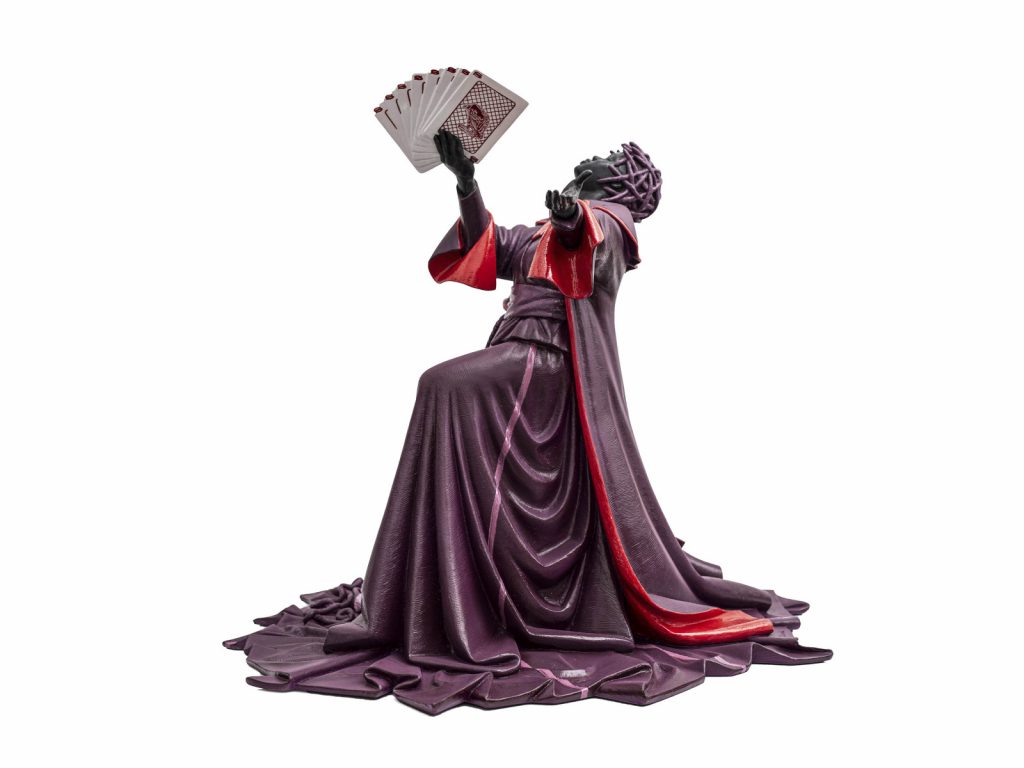 Mary Sibande’s ‘Wielding’. The joint exhibition of the work of these two artists, born nearly a century apart, is the fourth in a series of legacy exhibitions pairing prominent South African artists. Photos provided by Strauss & Co.
This collaboration of two artists who were born nearly a century apart is the fourth in a series of legacy exhibitions which pair distinguished South African artists: Louis Maqhubela and Douglas Portway (2019), Gladys Mgudlandlu and Maggie Laubser (2020) and George Pemba and Robert Hodgins (2021).
The collaboration, titled Dream Invisible Connections: Mary Sibande and Dorothy Kay, asks viewers to not only draw inferences between the work of these markedly different artists, but to also to engage in the practice of dreaming, exploring and immersing the self in the lives of their subjects.
“The title of the work — Dream Invisible Connections — is very important because here, dreaming is a verb for the characters in the art and for the audience.
“The invisible connections are things that you might not see immediately but, when you start thinking about them, the connections are there,” says Van Rensburg.
As impressive as they are, Kay’s works are muted and restrained in their colour palette (typical of the classical genre under which she was trained) which sometimes creates the effect of blending into the background of the walls.
In contrast, Sibande’s works, in photographic form and in miniature versions of her life-size sculptures, stand out vividly, jutting out dramatically from the works with which they are being compared.
Cookie, Annie Mavata, which was painted from a picture taken by Kay (Mavata’s employer), shows Mavata sitting on a stool wearing her domestic worker’s uniform: a royal blue garment beneath a long, white apron and a doek.
On her lap she holds a sharp knife in her right hand along with an empty enamel bowl, which she used throughout her lifelong service to Kay.
She also wears pearl-white earrings and a golden bracelet.
With her stern gaze, tasteful jewellery, the sharp blade in her hand, and the stark black background, which merges with the walls, Mavata is regal and evokes a sense of “quiet dignity”.
The painting exists alongside other pieces in Kay’s oeuvre of 23 portraits of mayors in Port Elizabeth, a fact that seems to elevate Mavata’s status while expressing her employer’s appreciation of her.
In a letter, Kay remarked on the realistic nature of her painting, noting that the cut newspaper top looked “pure realism” and the “basin [looked] so real you could lift it!”
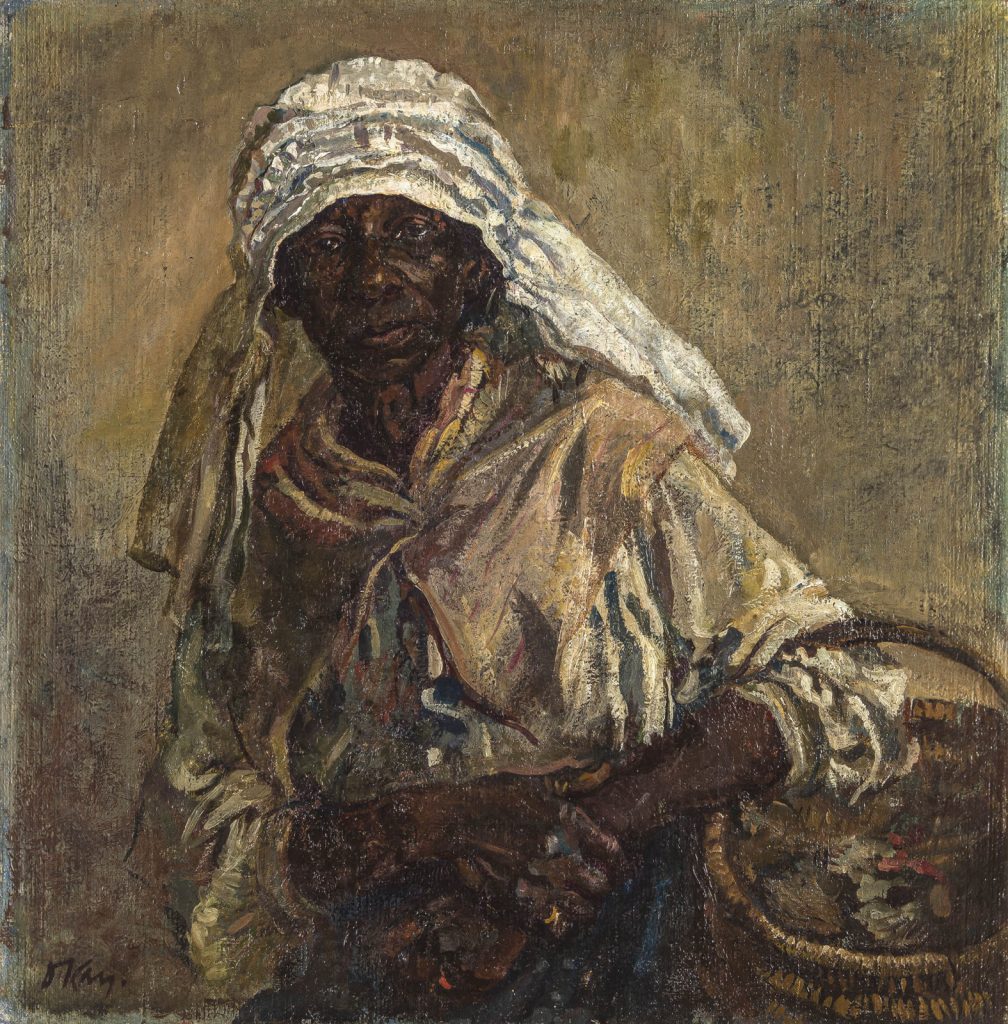 Generations: Dorothy Kay’s ‘Old Oyster Woman’
In the original picture, however, there are beans in Mavata’s bowl.
Even as Kay is said to have acknowledged, and not avoided, that Mavata was a worker who allowed her to ascend in her own career as an artist, her removal of the bean pods in the painting makes calls to examine this partial absence of her labour.
In honouring domestic workers through grand gestures, the tension of intimacy, existing alongside power imbalances within an economic, yet private domain, arises.
As dignifying as it is, the portrait, with the partial absence of labour and with Kay’s reference to Mavata as a “faithful friend and helper” rather than a worker, asks viewers to consider sociologist Shireen Ally’s idea which sees “domestic service as a species of intimacy vexed by colonial governance”.
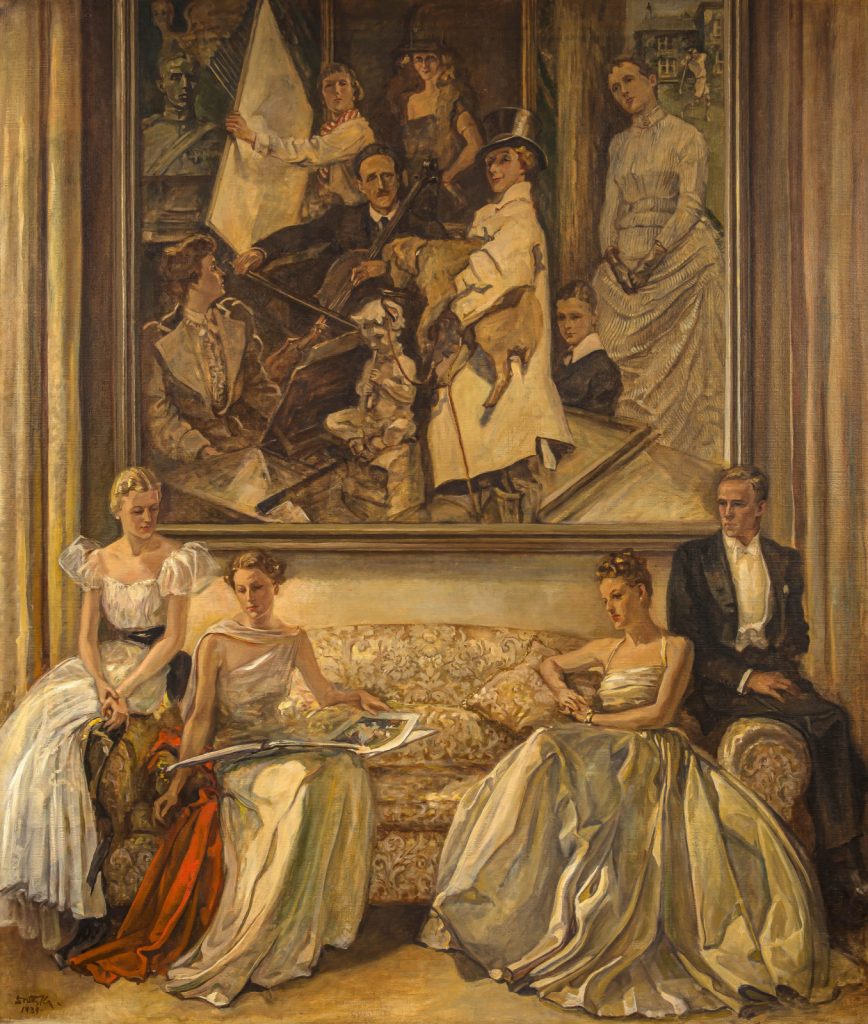 Generations: Dorothy Kay’s ‘Three Generations — After Sargent 1939’.
To offer an extreme example of this, in 2020, during the Covid-19 pandemic, TikTok videos of domestic worker Thembi Ubisi and her employer Malcolm Wentzel went viral. They depicted Ubisi and Wentzel engaging in friendly, almost familial, banter curated for online audiences.
Ubisi embodies the stereotypical sassy, and sometimes laid-back black domestic worker figure, redolent of fictional characters like Eve from Madam & Eve.
This incites laughter from the man behind the camera, the lenient, friendly employer who sometimes playfully, yet crudely, scolds his domestic workers.
In one video, Wentzel finds Ubsisi relaxed and watching Netflix instead of working, in another they play drinking games to negotiate her working hours and time off and in another, he jokingly scolds her for breaking his iron.
These Schuster-esque videos show an exaggerated sense of familiarity between the employer and the employed and the need for the employer to be viewed as a “good boss” in a way that might suggest his desire to efface his sense of white colonial guilt or to ignore legacy colonial terror. They also mask the grim reality of what often happens when a domestic worker fails to work efficiently or damages things.
To escape these realities of living as a domestic worker, Sibande’s Sophie, created in honour of her mother, grandmother and great-grandmother, who were domestic workers, transcends and defies the limiting inscriptions that the colonial and patriarchal systems of logic place on her.
That quiet dignity, set so firmly in Mavata’s eyes in Kay’s portrait, is transformed into something extraordinary when Sophie, with her eyes closed, exudes sublimity through her body and being.
In this imaginative experience she is granted transcendence over the mundaneness of real daily life.
Her dress seems to grow out of Mavata’s typical uniform, reshaping itself into an immaculate Victorian garment that prevents her from fully engaging with her work.
Her menial, toiling household tasks are replaced by Sophie occupying dominant and exciting roles, where she is, for instance, riding a horse (The Reign 2010), embracing her femininity (I am a Lady 2009), and one where she is holding a Zion staff and blessing a fictional congregation (I Put a Spell on Me 2009).
It is through these imaginings of herself that Sophie is able to create an identity, generate new fictions and offer validity to an agentic self expressed through her body.
Here, the theme of labour is multi-layered and is considered, not just a thing of the hands, but a practice that also exists in the mind through acts of dreaming and manifesting.
Throughout the span of Sibande’s career, Sophie has gone through a process of evolution that began with her seemingly fantasising and dreaming herself into oblivion to eventually actualising her dreams through the lives of her descendants.
In A Reversed Retrogress, Sibande shows two female figures, a blue figure representing the working class and the older generation (her mother, grandmother and great-grandmother), and a purple figure representing herself in the present, as well as the concept of resistance.
The sculptures offer the impression of being two bodies split from one. They partake in a blissful dance that signifies the regeneration of a self repressed by the structures of white governance. The piece seeks to express the power of imagination and how what is imagined can also be actualised.
In honouring her relatives and their labour as domestic workers, Sibande’s self-portraits go on a metaphysical expedition that releases them from the narrative that their significance is based solely on the upliftment of the people for whom they work.
In Sibande’s narrative, where Sophie seems self-possessed in her trance-like state, the domestic worker’s life and later, the lives of her children, take precedence over all others.
Matheko Mopuoa, a domestic worker employed in my family home, comments in Sesotho on the beauty of Sophie when I ask her what she thinks of her, but scoffs at the heavy dresses that prevent her from working.
“Yes, she’s very beautiful, but I can’t say I relate to her. The dresses look nice but, personally, I enjoy my work and I take pride in what I do. I’m not one for daydreaming,” she says.
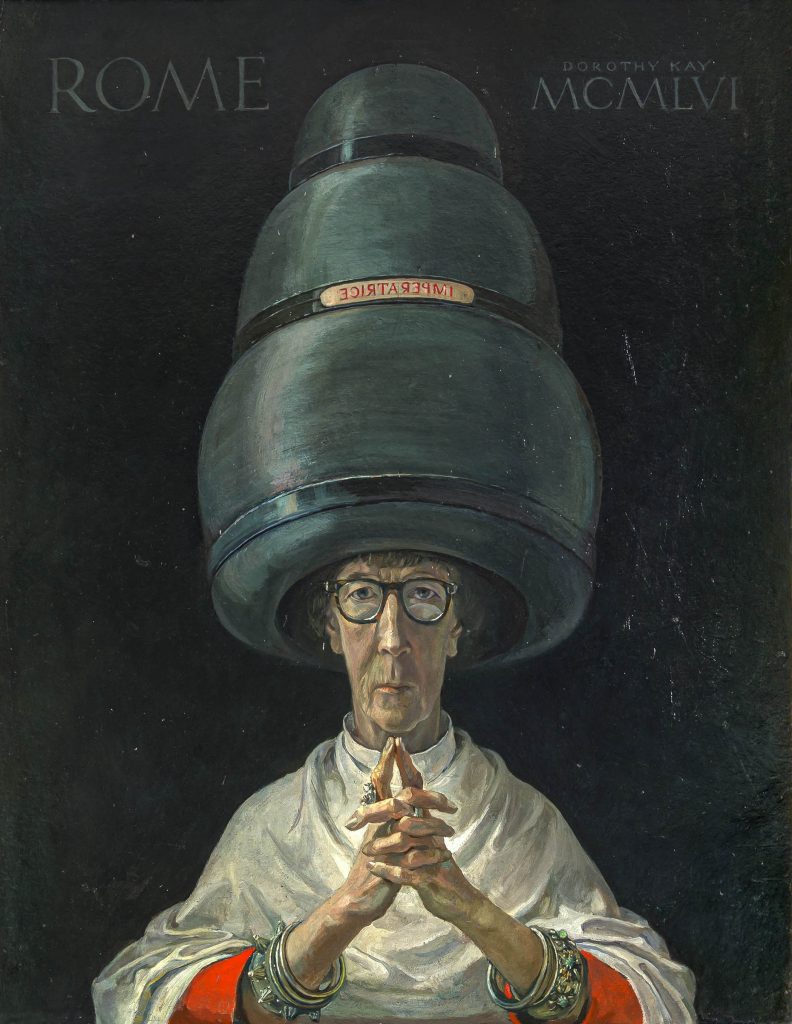
Dorothy Kay’s ‘Hairdryer Rome’ self-portrait
When she sees Mavata’s portrait, her attention immediately is drawn to the battered enamel bowl, which she suggests should be replaced. I tell her Mavata used it during her 40-year service to Kay and she emphasises, “Yah, it has to go.”
For Mopuoa, work offers a sense of pride, while keeping her occupied. It also provides her with the means to visit her home in Lesotho and support her family.
Even as Mopuoa struggled to identify with Sophie’s meditative state at work, Sophie’s style reminds me of my own mother, a child of a domestic worker whose mother and sisters were also domestic workers.
As a little girl, my mother used to tag along with my great-grandmother to her place of work. While she worked, my mother sat on the floor and watched television with the children of her employers who sat on the couches.
When they returned to their home in the township, my great-grandmother would inculcate in her family strict rules of thorough cleaning and propriety, accompanied by Victorian attitudes of femininity.
My mother and her sisters, like many others of her generation, came from the school of Christian values, etiquette and primness, of petticoats, stark white clothes, white bed sheets, glistening pots and Victorian-style tea sets with ornate floral patterns.
Although there might be sinister undertones in the charming fact that my mother, her sisters, a portion of her generation and Sophie share an appreciation for Victorian aesthetics, it’s interesting to note the way in which that aesthetic depends on the existence of domestic workers.
In her article examining the ways black labour functions in white homes, Ally writes that “inside white families, the servant was just one amongst the ‘things’ that gave white homes their propriety”.
She explains that black domestic workers absolved white women of the drudgery of “material toil” and “humanising labour”. Ironically, the racial stigmas that stereotyped black individuals as ‘dirty’ and ‘unclean’ in the past did not prevent white families from hiring black domestic workers to maintain the cleanliness of their homes.
By showing how domestic workers make for powerful agentic forces and subjects in the world of art and in real life, Dream Invisible Connections forces us to not only contend with the disheartening reality of abuse and exploitation faced by domestic workers, but to also recognise them beyond the sexist and racist tropes that rob them of their agency and individuality.
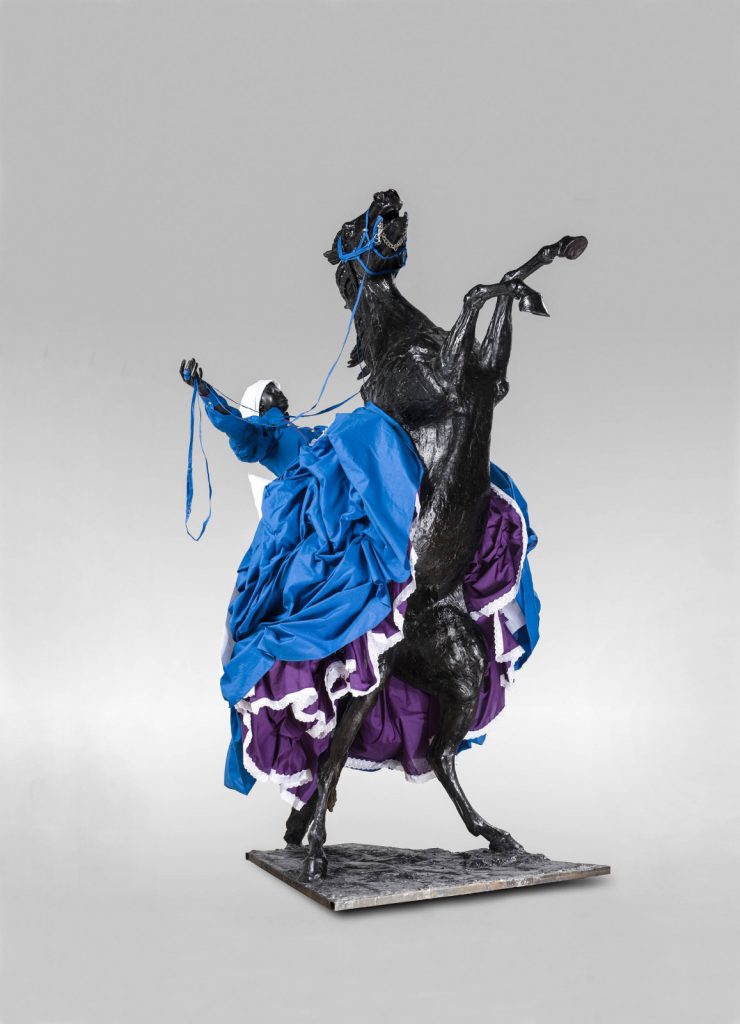 The reign.
Dream Invisible Connections: Mary Sibande and Dorothy Kay runs until 12 August at Strauss & Co in Houghton, Johannesburg.
Domestic workers are often called the most essential labourers in our economy because of the way they provide upward mobility for modern families who seek to realise their dreams.
On a philosophical level, and as service workers, they can also be seen to embody humanity’s capacity to aid and assist others even in spaces of unfamiliarity and strangeness. Still, while holding prominent positions in the intimate spaces of our households, they tend to be hidden in people’s homes where they are sometimes subject to abuse and exploitation by those who employ them.
Despite the fact that domestic workers should be earning a monthly wage of R3 710 if they’re working a 160-hour work week, according to minimum wage rates, data suggests one in five earns less than R1 500 monthly. Even as South Africa boasts some of the most progressive labour laws in the world for domestic workers, these statistics paint a harrowing image of the lives of black women who make up 97% of the 1 million domestic workers in the country. They also speak to the moral turpitude of the society that employs them. As a black woman myself, who comes from a long line of women who worked as domestic workers for white families during the apartheid era, it’s difficult to grapple with the degradation domestic workers experience in society.
It’s uncanny that, just as domestic workers’ lives remain hidden and are made invisible inside the homes of their employers, one of our country’s most important portraits of a domestic worker has remained under-recognised in popular culture in the Pretoria Art Museum.
Under the auspices of the fine art auction house, Strauss & Co, and its top curators Arisha Maharaj and Wilhelm van Rensburg, the portrait Cookie, Annie Mavata (1956) by Irish-South African artist Dorothy Kay, is breathing new life. It is being shown in a joint exhibition alongside Kay’s other works and works by post-modernist South African artist Mary Sibande, who is most famous for her depictions of Sophie, the captivating domestic worker, king-sized murals of who decorated the city of Johannesburg during the 2010 Fifa World Cup.
This collaboration by Strauss & Co of two artists who were born nearly a century apart is the fourth in a series of legacy exhibitions which pair distinguished South African artists, including Louis Maqhubela and Douglas Portway (2019), Gladys Mgudlandlu and Maggie Laubster (2020) and George Pemba and Robert Hodgins (2021). The collaboration of Kay and Sibande, titled Dream Invisible Connections: Mary Sibande and Dorothy Kay, asks viewers to not only draw inferences between the work of both of these markedly different artists, but to also engage in the practice of dreaming, exploring and immersing the self into the lives of the subjects and their own.
“The title of the work, ‘dreaming invisible connections’, is very important because here, dreaming is a verb for the characters in the art and the audience. The invisible connections are things that you might not see immediately but when you start thinking about them, the connections are there,” says van Rensburg.
As impressive as they are, Kay’s works are muted and restrained in their colour palette (typical of the classical genre under which she was trained) which sometimes creates the effect of blending into the background of the walls. In contrast, Sibande’s works, in photographic form and in miniaturised versions of her various life-size sculptures, stand out vividly as if jutting out dramatically from the works with which they are being compared.
Cookie, Annie Mavata, which was painted from a picture that Kay (Mavata’s employer) took, shows Mavata sitting on a stool wearing her domestic worker uniform: a royal blue garment beneath a white long apron and a doek. On her lap she holds a sharp knife in her right hand with an empty enamel bowl, which she used during her life-long service to Kay. She also dons pearl-white earrings and a golden bracelet around her arm. With her stern gaze, tasteful jewels, the sharp blade emanating from her hand, and the stark black background that merges with the walls, Mavata is regal and evokes a sense of “quiet dignity”. The painting exists alongside other pieces in Kay’s oeuvre of 23 other portraits of mayors in Port Elizabeth, a fact which seems to elevate Mavata’s status while expressing her employer’s appreciation of her. In a letter, Kay remarked on the realistic nature of her painting, noting that the cut newspaper top looked “pure realism” and that the “basin [looked] so real you could lift it!”
In the original picture, however, Mavata is carrying bean pods in the enamel bowl. Even as Kay is said to have acknowledged and not avoided that Mavata was a worker who allowed her to ascend in her own career as an artist, her removal of the bean pods in the painting makes calls to examine this partial absence of her labour. In the instance of honouring domestic workers through grand gestures, the tension of intimacy, existing alongside power imbalances within an economic, yet private domain arises. As dignifying as it is, the portrait, with the partial absence of labour and with Kay’s reference to Mavata as a “faithful friend and helper” rather than a worker, asks viewers to consider sociologist, Shireen Ally’s idea which sees “domestic service as a species of intimacy vexed by colonial governance”.
To offer an extreme example of this theory, in 2020, during the covid-19 pandemic, Tik Tok videos of a domestic worker named Thembi Ubisi and her employer Malcolm Wentzel, went viral online. They depict Ubisi and Wentzel engaging in friendly, almost familial-like banter curated for online audiences. Ubisi seems to embody the stereotypical sassy and sometimes ‘laid back’ black domestic worker figure redolent of fictional characters like Eve from Madam & Eve. This incites laughter from the man behind the camera, the lenient, friendly employer who sometimes playfully, yet crudely scolds his domestic workers. In one video Wentzel finds Ubsisi relaxed and watching Netflix instead of working, in another they both play drinking games to negotiate her working hours and time off and in another, he jokingly scolds her for breaking his iron.
These Schuster-esque videos show an exaggerated sense of familiarity between the employer and the employed and the need for the employer to be viewed as a ‘good boss’ in a way that may suggest his desire to efface his own sense of white colonial guilt or to completely ignore legacy colonial terror. They also mask the grim reality of what often happens when a domestic worker fails to work efficiently or damages household belongings.
To escape these realities of living as a domestic worker, Sibande’s Sophie, created in honour of her mother, grandmother and great-grandmother who were all domestic workers, transcends and defies the limiting inscriptions that colonial and patriarchal systems of logic place onto her. That quiet dignity, set so firmly in Mavata’s eyes in Kay’s portrait of her, is transformed into something extraordinary when Sophie, with her eyes closed, exudes sublimity through her body and being.
 Dorothy Kay’s oils with Mary Sibande’s culpture in the foreground on ‘Dream Invisible Connections: Mary Sibande and Dorothy Kay’.
In this imaginative experience she is granted transcendence over the mundanity of real daily life and her dress seems to grow out of Mavata’s typical uniform, reshaping itself into an immaculate Victorian dress that prevents her from fully engaging with work. Her menial and toiling household tasks are replaced by Sophie occupying dominant and exciting roles, where she is, for instance, skilfully riding a horse (The Reign 2010), embracing her femininity (I am a Lady 2009), and one where she is holding a Zion staff and blessing a fictional congregation (I Put a Spell on Me 2009). It is through these imaginings of herself that Sophie is able to create an identity, generate new fictions and offer validity to an agentic self that is expressed through her body.
Here, the theme of labour is multi-layered and is considered, not just a thing of the hands, but a practice that also exists in the mind through acts of dreaming and manifesting. Throughout the span of Sibande’s career, Sophie has gone through a process of evolution that began with her seemingly fantasising and dreaming herself into oblivion to eventually actualising her dreams through the lives of her descendants.
In A Reversed Retrogress, Sibande shows two female figures, a blue figure representing the working class and the older generation (her mother, grandmother and great-grandmother) and the purple figure representing herself in the present as well as the concept of resistance. The sculptures offer the impression of being two bodies split from one. They both partake in a blissful dance that signifies the regeneration of a self repressed by the structures of white governance. The piece seeks to express the power of imagination and how what is imagined can also be actualized.
In honouring her mothers and their labour as domestic workers, Sibande’s self-portraits go on a metaphysical expedition that releases them from the narrative that their significance is based solely on the upliftment of the people that they work for. In Sibande’s narrative, where Sophie seems self-possessed in her trance-like state, the domestic worker’s life and later, the lives of her children, take precedence over all others.
Matheko Mopuoa, a domestic worker employed in my family home, comments in Sesotho, on the beauty of Sophie when I ask her what she thinks of her, but scoffs at the heavy dresses that prevent her from working. “Yes, she’s very beautiful, but I can’t say I relate to her. The dresses look nice, but personally, I enjoy my work and I take pride in what I do. I’m not one for daydreaming” she says. When she sees Annie, her attention immediately draws toward the enamel bowl which she suggests should be replaced. I tell her that Annie used it during her 40-year service to Kay and she emphasizes, “Yah, it has to go,” For Mopuoa, work offers a sense of pride, while also keeping her occupied. It also provides her with the means to visit her home in Lesotho and support her family.
Even as Mopuoa struggles to identify with Sophie’s meditative state at work, Sophie’s style reminds me of my own mother, a child of a domestic worker whose mother and sisters were also domestic workers. As a little girl, my mother used to tag along with my great-grandmother to her place of work. While she worked, my mother sat on the floor and watched television with the children of her employers who sat on the couches. When they returned to their home in the township, my great-grandmother would inculcate strict rules of thorough cleaning and propriety, accompanied with Victorian attitudes of femininity. My mother and her sisters, like many other individuals of her generation, come from the school of Christian values, etiquette and primness, of petticoats, stark white clothes, white bed sheets, glistening pots and Victorian-style tea sets with ornate floral patterns.
Though there may be sinister undertones in the charming fact that my mother, her sisters, a portion of her generation and Sophie share an appreciation for Victorian aesthetics, it’s interesting to note the way in which that aesthetic depends on domestic workers to exist. In her article examining the ways that black labour functions in white homes, Ally writes that “inside white families, the servant was just one amongst the ‘things’ that gave white homes their propriety”. She explains that black domestic workers absolved white women from the drudgery of “material toil” and “humanising labour”. Ironically, the racial stigmas that stereotyped black individuals as ‘dirty’ and ‘unclean’ in the past, could not prevent white families from hiring black domestic workers to maintain the cleanliness of their homes.
By showing how domestic workers make for powerful agentic forces and subjects in the world of art and in real life, Dream Invisible Connections forces us to not only contend with the disheartening reality of abuse and exploitation faced by domestic workers, but to also recognise them beyond sexist and racist tropes that rob them of their agency and individuality.
Dream Invisible Connections: Mary Sibande and Dorothy Kay runs until 12 August at Strauss & Co in Houghton.
[/membership]