Small screen, big deal: Economic Freedom Fighters leader Julius Malema is seen on a monitor during a concourt hearing. Photo: Mujahid Safodien/AFP
Two weeks ago, the constitutional court heard an application to confirm the invalidity of sections of the Tax Act to allow public access to tax records, where it is in the public interest and would reveal major wrongdoing.
Arena Holdings Pty and Others vs Sars and Others began as a a media battle for access to former president Jacob Zuma’s tax records, but its implications go far wider, and are themselves a matter of great public interest.
LLB Twitter was poised to follow pleadings on whether the limitations that total tax confidentiality places on freedom of speech and access to information are constitutionally tolerable by, inter alia, Steven Budlender, Tembeka Ngcukaitobi and Wim Trengove. UCT law professor Richard Calland suggested to his LLM students they tune in to the proceedings.
This correspondent cast about for a link and was reminded by the Office of the Chief Justice that there would be none, since virtual court sittings had come to an end at the close of the second court term, following the lifting of the last Covid-19 restrictions.
The pandemic had meant more than two years of being able to dial in remotely or follow live broadcasts of important cases, in law and in politics, heard in Braamfontein and high courts, on the judiciary’s YouTube channel. These included JG Zuma v the Secretary of the Judicial Commission of Inquiry and Others, the former president’s application for rescission of his contempt of court conviction, which gathered 105 387 views.
The matter was an outlier, for obvious reasons, but it was not an anomaly.
More than 28 000 people watched the constitutional court appeal on whether the state can renege on a collective bargaining agreement and almost 18 000 the hearing of public protector Busisiwe Mkhwebane’s appeal against the high court ruling overturning her report on donations to President Cyril Ramaphosa’s so-called CR17 campaign.
AmaBhungane Centre for Investigative Journalism vs President of South Africa — where the media group argued the executive ethics code was unconstitutional in its provisions on private donations to intra-party campaigns — was followed by 4 900 viewers.
Almost twice as many watched the hearing on the Jon Qwelane hate speech matter. And the Rafoneke case, where lawyers who are not South African citizens litigated for the right to be enrolled to practise here, and were denied in a ruling that has raised questions about reasoning and context, drew nearly 7 000 viewers.
When sittings happened virtually, allowing wide access was as simple as sharing or streaming the meeting link. The court has screened proceedings to so-called overrun spaces, sometimes the foyer, when the public gallery is full but has done so by relaying the live footage of the media present at court on the day.
Independently filming and live-streaming court sittings will come with a cost outlay. And this implies a tender, at a time when the Office of the Chief Justice is reviewing all its supply-chain management processes after the CaseLines controversy, where a R225-million contract went to three senior, long-serving officials who then resigned.
The OCJ is clear its budget — R2.348-billion for the current financial year — does not extend to funding the infrastructure needed to broadcast its proceedings and that it faced too many competing priorities to contemplate this.
“Determination of court sittings is a judicial function and the management of judicial functions is the responsibility of the chief justice and the heads of court,” it told the Mail & Guardian.
“During the Covid-19 pandemic in 2020, the honourable chief justice issued a practice directive for the management of courts during the national state of disaster. It was during this time that the court commenced with virtual hearings so as to mitigate the risk of spreading of the virus. With the lifting of the national state of disaster by the president of the RSA, the court has resumed with in-person hearings.
“There is currently public access to the court; the need for live broadcasts is not seen as an urgent need.”
Those familiar with the inner workings of the apex court will recall that, in the past, there has been extensive debate about whether to allow proceedings to be filmed. Some, among them former chief justice Sandile Ngcobo, were highly sceptical. Others of the same persuasion believed for the court to maintain its authority, a measure of distance did not hurt.
Those in favour pleaded the case for transparency and access to justice, moreover, the fact that the court does not hear witness testimony lessened the chances of those giving evidence feeling intimidated by television cameras — or playing to them.
The tide turned on the live broadcast of criminal cases with the Oscar Pistorius trial. It was followed by foreign media and, for all the drama of the testimony and the doubts about the judgment, there was a sense, a former judge said, that the manner in which the trial was conducted reflected well on the state of the South African judiciary.
It was only seven years later that the pandemic made live broadcasts of high court and constitutional court proceedings the norm, which it has been in some countries since long before Covid. The UK supreme court has been live-streaming hearings since 2010, with the rationale that the court should be transparent and accessible because its rulings are binding on all lower courts and affect society broadly.
Advocate Kameel Premhid, who has regularly argued in virtual proceedings before the apex court, noted the US supreme court also allowed audio recordings and live broadcasts and said the decision went against international best practice and the court’s own jurisprudence.
“It is misguided because it undermines access to justice and the court’s own jurisprudence on the subject.
“Costs may be mitigated by allowing media houses themselves to do it but even if the court was to carry the infrastructure cost, that would be worth it and minimal.”
Apart from budgetary concerns, comments by officials in the judiciary make plain it was never the plan that these would continue once restrictions made way for a return to normal life.
One has privately commented the media have been “spoilt” for the past two years to have the benefit of remotely following hearings. Moreover, only a small number of reporters cover constitutional matters regularly and an even smaller number do it well, the same source suggested.
But the viewer numbers prove that the court has a far wider audience and non-profit organisations in the legal field say the end of live broadcasts is a loss for the country as a whole.
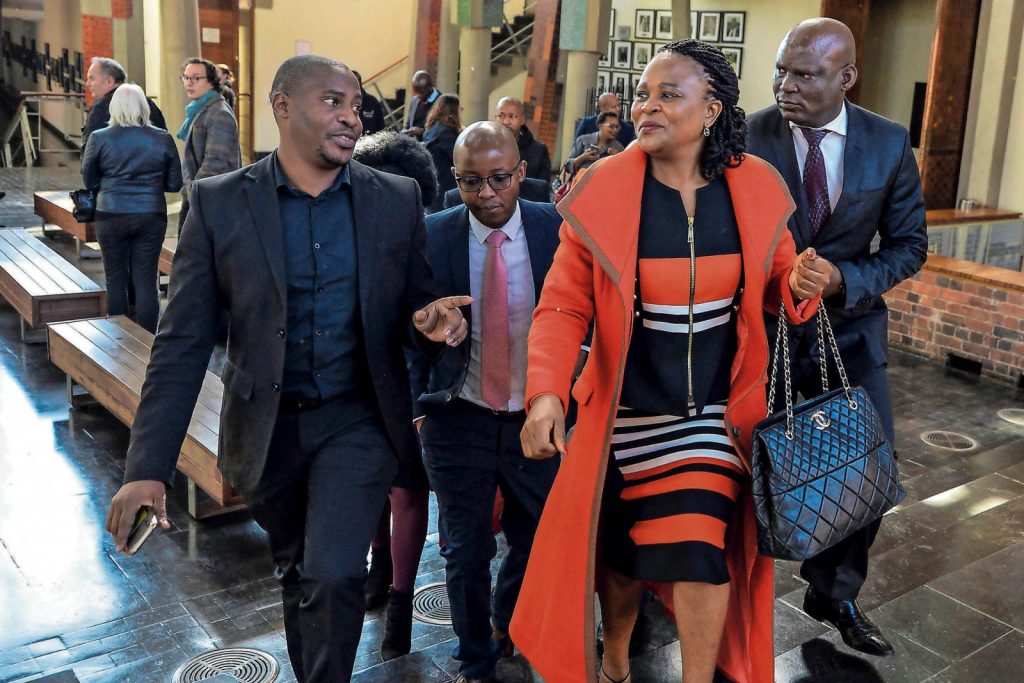 Glued: About 18 000 people watched public protector Busisiwe Mkhwebane’s appeal on donations to President Cyril Ramaphosa’s CR17 campaign.
It is worth remembering, one journalist stressed, that news writing on the law is filtered by news judgment. Live broadcasts meant any member of the public with a vested or general interest could follow hearings in full, from any part of the country.
Part of the court’s raison d’être is its seminal rulings on socioeconomic and sociopolitical rights. For the past two years, those affected needed only internet access to hear their case pleaded. And, Freedom Under Law’s executive officer Judith February noted, giving broad access to the court’s work is the best reply to those who launch spurious attacks on its relevance. Tourism Minister Lindiwe Sisulu’s rant about judges being “mentally colonised Africans” refers.
“The court has come under a great deal of political attack and the judiciary meets those attacks by speaking through their judgments,” February said.
“One of the ways in which you can deal with some of the political attacks on the court, and conspiracy theories about the way the courts operate, is to allow open access.
“Denying such also deprives young law students from seeing good advocacy in action and that is a pity. It makes the profession and us all the poorer for it.
“I think our democracy will be poorer for it.”
It was crucial, she added, that the court was not seen as an arcane institution pursuing the law but a living entity serving the people and it was regrettable that the public has been robbed of seeing this firsthand.
“The credibility and the legitimacy of the apex court is crucial for our constitutional democracy and part of that is about the dissemination of information — information is the oxygen of democracy.
“The matters which reach the concourt are of enormous public interest, whether it is the right to health care or on our electoral system. So, being able to see that broadcast, being able to watch it on YouTube, is a repository of information for South Africans. It is a great pity the court has taken a regressive step.”
Alison Tilley, convenor of Judges Matter, noted the legal fraternity found live hearings an invaluable tool for teaching and preparation.
“The live-streaming of constitutional court hearings has been a tremendous innovation and increased the understanding of how and why the court decides cases.
“We hope they will be able to begin live-streaming again.
“This transparency is a very important element of judicial accountability,” Tilley said.
Tina Hokwana, a law lecturer at Nelson Mandela University, agreed that live-streaming had allowed a closer reading of how a court had arrived at a decision — for litigants, law students, young lawyers and academics — and helped those in the field counter misconceptions traded on social media.
“Live-streaming allowed for a collapsing of the ‘ivory tower’ narrative — the court, the arguments made before it and the interactions between the justices and counsel allowed many, including myself, to have a deeper understanding of the arguments that informed the court’s judgments.
“This impacted greatly on my analysis of the decision — it allowed a thorough contextual understanding of the court’s reasoning.”
The OCJ has not done a costing for continued broadcasts. Judges Matter is motivating for donor funding that would enable it to step into the breach, in a similar way to which it has since 2016 live-streamed the Judicial Service Commission’s interviews with aspirant judges and opened a window onto how appointments to the bench happen.
[/membership]