Food prices are too high for some households to bear but more targeted relief might have a greater impact. Photographer: Waldo Swiegers/Bloomberg via Getty Images
Food prices have become painfully high, but — contrary to a recent demand by the Democratic Alliance (DA) — zero-rating more grocery items won’t necessarily unburden poorer households as much as more targeted relief would.
Last week, the official opposition made a call to the government to use tax policy to rein in high food prices. This is as Finance Minister Enoch Godongwana prepares to deliver his second medium-term budget policy statement later this month.
The DA wants, among other tax-related interventions, the government to scrap value-added tax (VAT) on the food items most commonly purchased by South Africa’s poorest households. Doing so would entail reviewing and expanding the zero-rated food baskets.
The current VAT system allows for 21 basic food items to be taxed at 0%.
Last week, during a question-and-answer session in parliament, DA leader John Steenhuisen repeated this plea, saying food prices were outstripping grants. Dropping VAT on certain food items, he said, would go a long way towards providing relief to households.
The party wants bone-in chicken, beef, tinned beans, wheat flour, margarine, peanut butter, baby food, tea, coffee and soup powder added to the list of zero-rated food items.
Zero-rating chicken alone would be a lifesaver, Steenhuisen said.
In response, President Cyril Ramaphosa said addressing rising food prices “is a matter that has been under consideration and continues to be under consideration” by the cabinet.
“We have set up a team of ministers who have been looking at this … And clearly the issue of zero-rating is a matter that treasury has been grappling with for years. They have looked at the practicality of doing it and the impracticality in terms of the VAT system,” the president said.
“I think, if we look at what other countries do, we should be able to find some solutions. But, at the same time, I don’t want to pre-empt what suggestions and proposals could come through this process that we are involved in.”
Considering the current price environment, the DA’s demand sounds attractive.
Inflation rose to 7.8% in July, before easing slightly (to 7.6%) in August, and is expected to average above the South African Reserve Bank’s 6% ceiling this year. Food and fuel prices typically remain the key inflation drivers. This year, consumer food price inflation has soared to its highest level in five years.
Though producer price inflation also eased in August, on the back of moderating petrol and diesel prices, manufactured-food price inflation continued on an upward trajectory, increasing by 15.4% year-on-year from 15.1% previously.
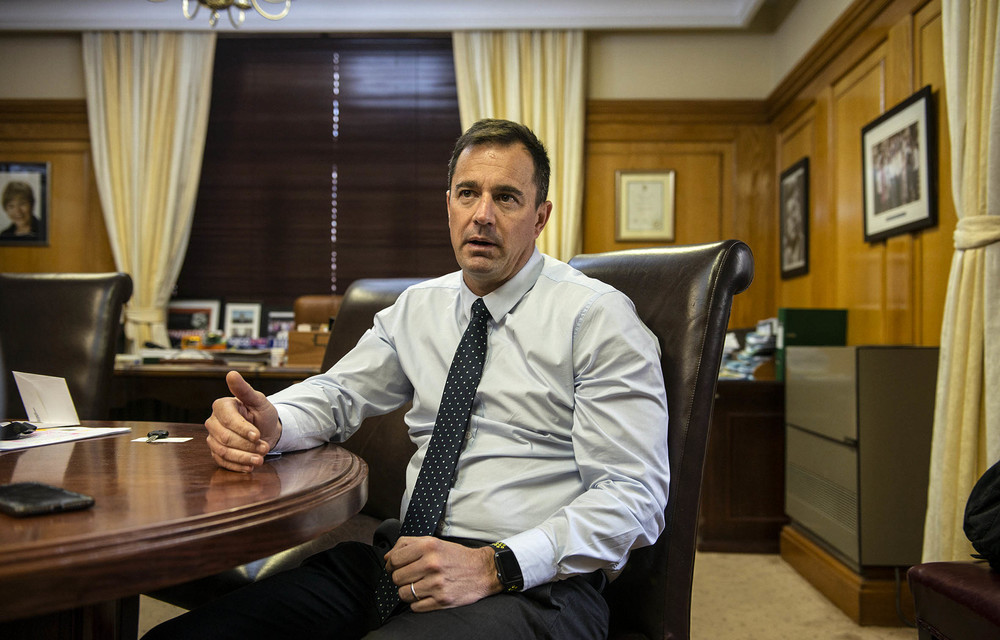 Democratic Alliance leader, John Steenhuisen. (David Harrison/M&G)
Data collected by the Pietermaritzburg Economic Justice and Dignity Group shows just how big an effect elevated food prices has on households.
According to the group’s most recent household affordability index, the average cost of the food basket was R4 805.86 in September — marking a R30 increase compared to August. Year-on-year, the average cost of the household food basket grew by R586.39 (an increase of 13.9%).
In a statement accompanying the index, the group noted that the average cost to feed a child a basic, nutritious diet was R828.64 in September, over R90 higher than it was a year ago. The child support grant is only R480.
Though zero-rating more foods seems like a good solution, economist Ingrid Woolard said this intervention wasn’t always targeted enough towards benefitting poorer households.
Woolard led the panel of independent experts appointed in 2018 to review the current list of zero-rated items. In 2018, the treasury increased VAT from 14% to 15%.
Woolard noted that chicken was a good candidate for zero-rating. However, the 2018 panel found, though chicken constituted 4.4% of the average expenditure by the poorest households, the VAT they paid was only R154 per year. In the richest households 0.5% of expenditure went to buying chicken but they paid R305 on VAT per year.
“It’s a tricky one. Because on the one hand, proportionately, there would be a bigger benefit to poorer households, so, it would be a progressive policy,” Woolard said.
“But, in terms of a rand amount that benefits households, it does disproportionately go towards higher-income households. None of these things are perfect.”
On chicken alone, the government would end up foregoing revenue in the region of R3-billion, Woolard said.
The best way to ensure relief is targeted is through direct cash transfers. The 2018 panel said that, in theory, it would be cheaper to return the cost of the VAT increase to the poorest households than to extend zero rating.
Commitments to increase expenditure on poor households in return for increasing their taxes “have been implemented only in part, if at all”, the panel’s report noted.
“Moreover, neither in-kind programmes nor cash-transfer systems are designed to reach all poor households and especially the working poor,” the panel said, adding that it was of the view that expenditure programmes had a role to play in mitigating the impact of the VAT increase on poor households.
The challenge is to ensure that expenditure actually reaches the bulk of low-income households — a dilemma that has to be factored into the deliberations about the future of the R350 grant.
[/membership]