In deep water: Tankers carrying water are used to deliver water yet dams such as Fika-Patso remain full. Photos: Delwyn Verasamy
Water tanker operators, dubbed “the tanker Mafia”, are pulling in big money in Phuthaditjhaba in the Free State because the local council fails to provide a consistent supply of water to residents.
In 2020, the Mail & Guardian reported that locals in Phuthadit-jhaba — also called QwaQwa — were lining up buckets outside their homes to collect rainwater. This year, residents wait for water tankers to drive through the streets and fill Jojo tanks supplied by the Maluti-a-Phofung municipality.
This is despite three potential water sources, Metsimatsho Dam, Fika-Patso Dam and the Sterkfontein Dam, being available for use.
The council service is highly inconsistent, with taps sometimes dry for a week and the water often dirty. As a result, many residents have turned to private suppliers. Others rely on standpipes.
An employee of Q-Water, a shop that supplies filtered drinking water, also pointed out that the tankers come during the day, meaning that residents who are not home are not supplied. The worker asked not to be named.
Businesses that require large quantities of water are taking strain. Phuthaditjhaba pig farmer Jill Weaver has 6 500 pigs that need about 65 000 litres of water daily to drink. She said she has not received municipal water for a year and has to buy water from private suppliers, paying between R900 and R1 400 for 10 000 litres a month.
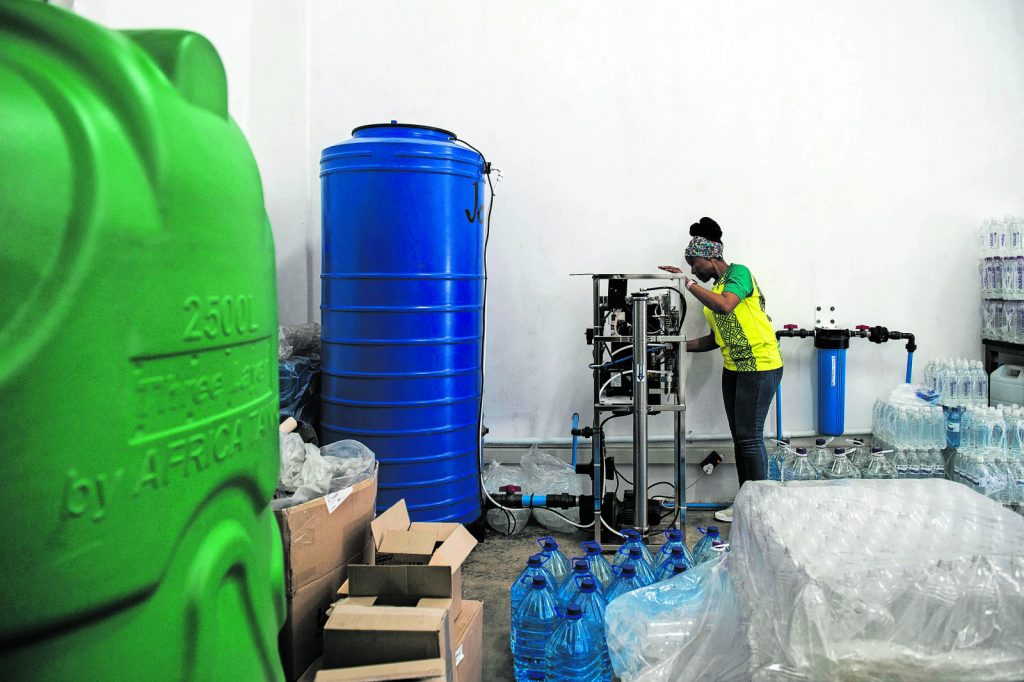 Sink or swim: A business in QwaQwa sells filtered drinking water. (Delwyn Verasamy/M&G)
“I know some businesses have contracts with the municipality to supply 30 000 litres for R2 400. I estimate that I buy at least 400 000 litres from a single supplier,” said Weaver. “Our business is severely threatened because pigs do not eat if they do not drink. The cost and stress of trying to get water is so high.”
Driving through QwaQwa, one sees water tankers that are labelled “MaP water”: these are tanks dispatched by the municipality.
Trucks that carry Jojo tanks and draw water from the free extraction points are unbranded; their drivers refused to speak to the M&G.
Alison Oates, a Democratic Alliance councillor in the Maluti-a-Phofung municipality, said a “tanker mafia” has made everyone too scared to talk.
No organised crime is linked with the operators, but a group of individuals do benefit from the municipality’s failure to supply piped water.
“You can make a fortune. Buy yourself two trucks that carry 20 000 litres of water and take three trips a day to the extraction point. There’s a lot of money to be made,” Oates said.
She said the water and sanitation department had supplied 16 water tankers to help distribute water. Although they were parked at the local fire station under 24-hour security, their batteries had been stolen.
Oates said that although there was no hard evidence, it was suspected the tanker operators, who are under contract to the council, were linked to councillors and council officials.
For locals without Jojo tanks who rely on municipal water to flow through their taps, the supply is sporadic, said a resident, Phehello Mthombeni.
“There are days where we have water for one hour, and then no water for four to eight hours,” he said.
Another local, Mohau Mokoena, added: “We may have water today, but no water for the next week.”
Mohammed, who declined to give his full name, buys drinking water from Q-Water every four or five days. He has seven containers each costing R20 to fill.
He also has a Jojo tank at his house in central Phuthaditjhaba that is filled with municipal water, which is often dirty.
The council’s community manager claimed that water is being supplied to 90% of QwaQwa. But, according to what the M&G saw, the taps at the Phuthaditjhaba community centre were dry.
Oates alleged that underpinning the problems with providing a consistent municipal water service are unaccounted-for funds and confusion about the primary water suppliers in the area.
In 2020, the former minister of water and sanitation, Lindiwe Sisulu, made R220-million available to Sedibeng Water to upgrade the main water infrastructure and supply communities with water tanks.
But Sedibeng Water went bust soon afterwards and was dissolved in June 2022. Oates said the budget to install water tanks was decimated and the money could not be fully accounted for.
In a parliamentary question in 2019, MP Shirley Motshegoane Mokgotho asked when the municipality would have reliable water supply on a daily basis after the department allocated R50-million through QwaQwa’s regional bulk infrastructure grant.
The department placed the responsibility directly on the council’s shoulders, saying: “Distribution of water from this bulk infrastructure to households and other end-users is the responsibility of municipalities.”
The new minister, Senzo Mchunu, announced that Bloemwater would address the water and sanitation issues in local authority this year, with a budget of R2-billion.
“Bloemwater has been operating since April but has yet to give the council feedback on its progress. Notably, the service level agreement does not require it to do so,” Oates commented.
Another water player is MaP Water, owned by the municipality. Established in 2005 as an income-generating entity, in the hope that it would replace Sedibeng Water and Bloemwater, the entity has been “incapable of implementing water projects”, she added.
In 2020, the council ordered 5 000 Jojo tanks at a cost of R5-million for schools and residential areas, so that locals could fetch water without having to travel long distances, said Nelson Moekoa, chairperson of the Business, Community and Development Association.
But Moekoa said that corruption resulted in only 1 500 Jojo tanks being delivered.
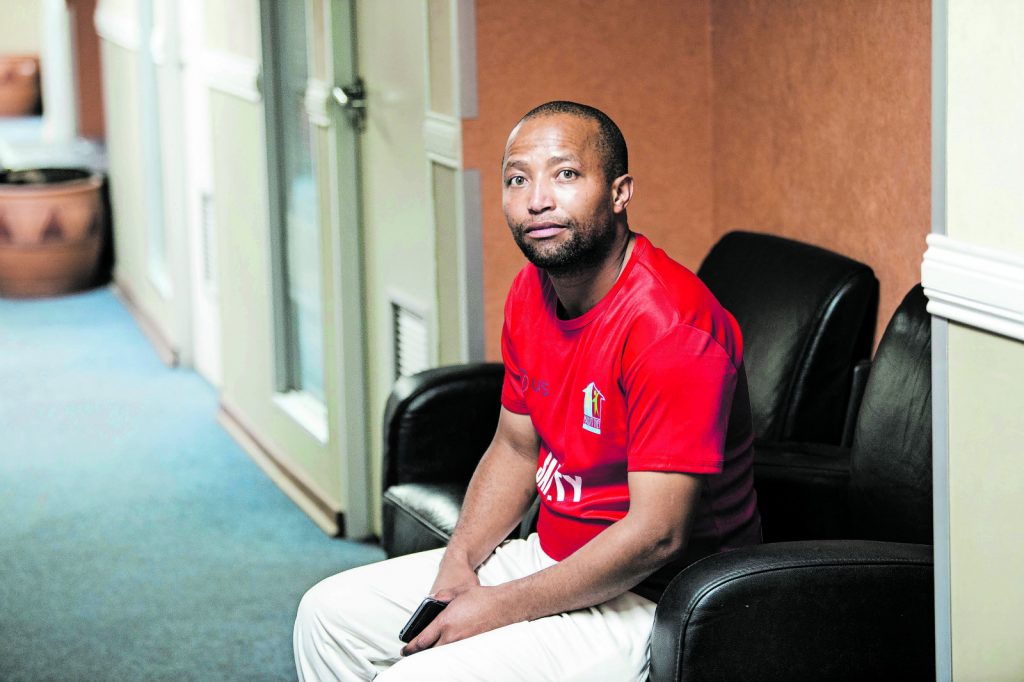 Nelson Moekoa, chair of the Business, Community and Development Association, says the municipality failed to fix the Fika-Patso treatment plant for water to be extracted from Sterkfontein Dam. (Delwyn Verasamy/M&G)
Moekoa, who was involved in the project, said the department of water and sanitation paid upfront, as reflected in a R5-million invoice for the tanks.
Thabo Kessah, the municipality’s communications manager, confirmed that, “delivering Jojo tanks to mitigate for the supply of water in affected areas is continuing if and when the need arises in various wards. The payment was done upfront and delivery is done according to orders”.
Moekoa said: “[MaP] was supposed to fix the Fika-Patso treatment plant conjoining the Sterkfontein catchment in a 10-megalitre project that would extract water from the Sterkfontein Dam.”
The project was never completed.
Because of a lethal combination of water and power shortages, QwaQwa’s businesses and main industrial zone are struggling to keep the town’s economy alive. Many textile and clothing factories have been forced to shut down, Moekoa said, with the plants abandoned and left to fall apart, and power cables stolen.
“In six years we went from 45 factories to 20, and from 36 000 employees to just 7 000. Having no water was a safety hazard and killed the regional economy,” he said.
Power cuts have had a knock-on effect on other water systems. In Johannesburg, the water utility recently said that parts of the city would suffer water shortages because it depends on electricity to pump water from reservoirs into water towers for distribution (see Page 6).
Phehello Mthombeni, who worked for a security company called Empire Security at an MaP Water substation, experienced first-hand how power cuts had exacerbated QwaQwa’s water shortages.
Troubled waters: Phehello Mthombeni (left) and Mohau Mokoena (right) say water may not flow from taps for days.
“The generator was operating abnormally because it was working less than four hours at a stretch. Then MaP Water redeployed the generator to power the lights and computers only, not even the pumps,” said Mthombeni.
SA Cloth, a major clothing manufacturer that Moekoa said had brought in R84-million since 2010, had closed down because it couldn’t meet clients’ demands as it was not able to operate without water and electricity.
He said this shutdown resulted in the loss of 1 700 jobs.
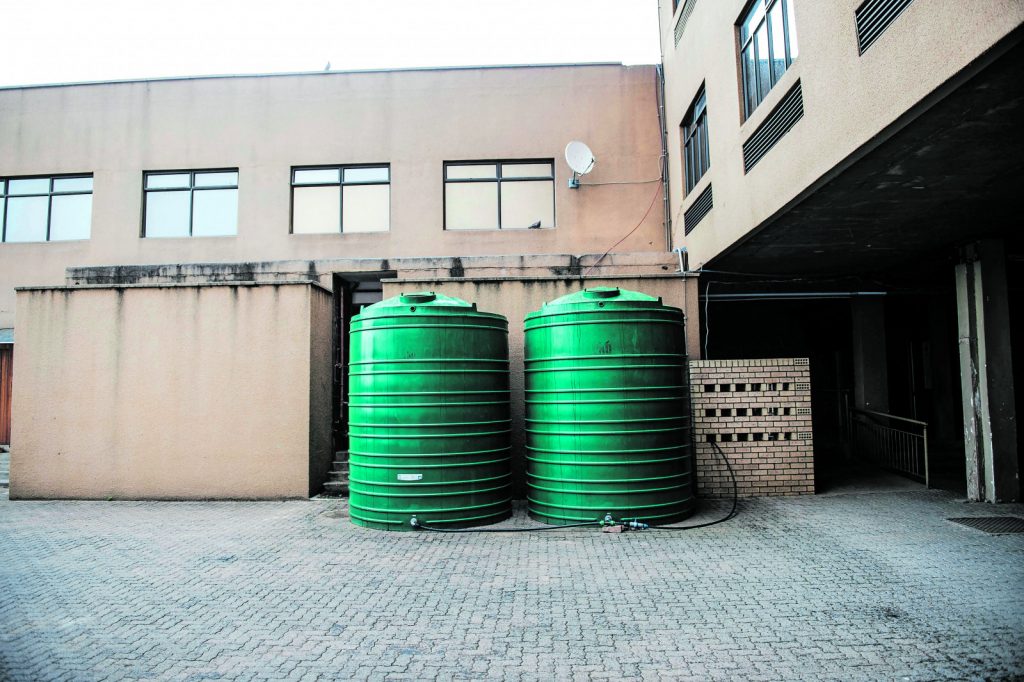 The municipality paid for 5 000 Jojo water tanks but only 1 500 were delivered to schools and residents. (Delwyn Verasamy/M&G)
“It’s the ripple effect of everything not being run properly through the whole of QwaQwa,” Moekoa added. “These shutdowns catapult back to the taxi industry, retail industry, clothing industry, even funeral parlours.”
“QwaQwa is an industrial town with tourism. If you don’t have water it affects agriculture, too.
“What we as industrial businesses are requesting is to create a reservoir that is primarily serving the industrial area so it is never without water,” said Moekoa.
“Imagine thousands of people for the whole day without water. We want to keep the industrial sector going, as it supplies the secondary and tertiary markets.”
Many QwaQwa residents mentioned a new governing coalition involving five entities — the Economic Freedom Fighters, MAP16 Civic Movement, African Independent Conference, the Public Servants Association of South Africa and the African Transformation Movement — which they hoped would make a difference.
“The new coalition is looking to prioritise the industrial zone, making this a provincial priority to give resources in order to attract investment back into [Phuthaditjhaba]. We need to know how much they are pledging and when they will start,” said Moekoa.
“We are fighting to keep that industry alive through marches; engage with [the municipality]; we take them to court; mass action; protests. The action is bottom-up.”
As the body that seeks to act as a bridge between business and the community in QwaQwa, Moekoa says the MaP development association is working to create one vision where the respective roles of the community and businesses are understood.
“Once the community and business come together, the next thing is governance. If these three things do not function properly, we are bound to move into an even worse situation. Unfortunately, the municipality is not having these conversations,” said Moekoa.
“Nobody seems to understand: if we want to build QwaQwa it is everyone’s responsibility. It seems that the government does not understand this — they have to go back to the basics and start supplying services.
“Leave everything else and focus on electricity, water, roads, sewerage and stormwater drainage. They should be focusing on those five things, but they’re failing.”
Moekoa said the new ruling coalition had initiated a new intervention project.
“They went to Investment South Africa and received R3-billion — R1-billion for roads, R2-billion for electricity. If there’s no electricity, they can’t pump water.”
Moekoa said 90% of people in QwaQwa do not pay for electricity. He asked: “Where will the municipality get the money to pay Eskom? We are not paying for water. Where will the municipality get the money to pay the water and sanitation department?”
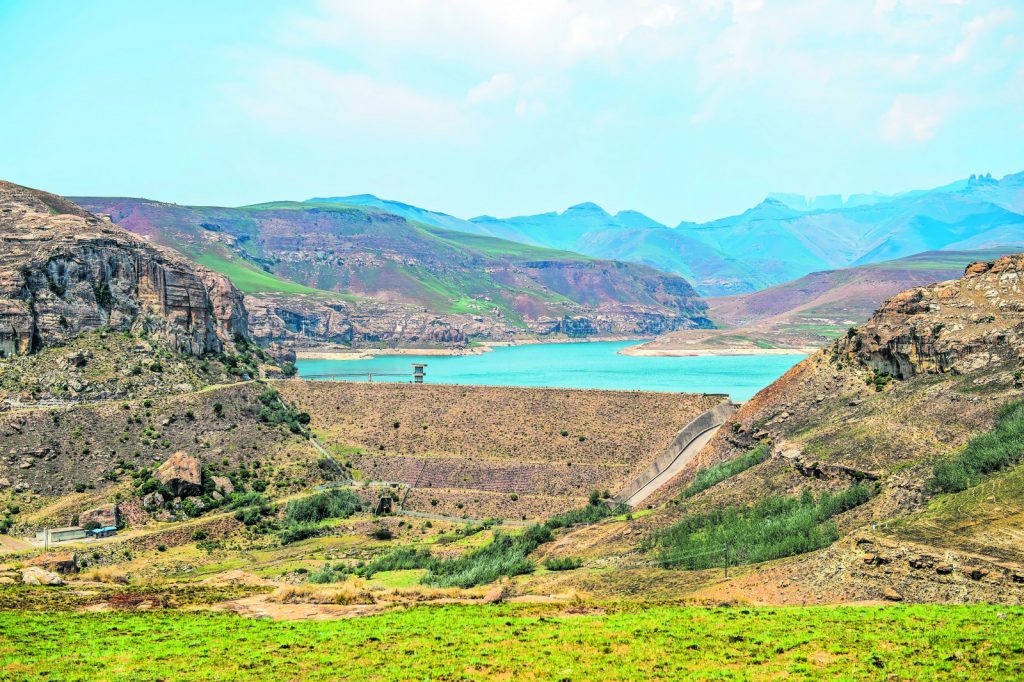 The Fika-Patso Dam. (Delwyn Verasamy/M&G)
The coalition may not be perfect, he said, but it could not be worse than the previous administration. It was, at least, trying different interventions to “mitigate problems on the ground”.
“It also understands the basics of business — profit — and that you need to be socially responsible. Everyone assumes that businesses have a magical amount of money.
“We have an irresponsible society. Until we get to a point of understanding each other’s role in making any society function, we are not going to get things to work,” said Moekoa.
What was needed was a shift in the mindset of consumers. “The ANC has convinced people everything will be free. But nobody can give a clear direction of where that money will come from, and you cannot always raise taxes.
“Where does the money come from? So the burden comes back and hits businesses,” said Moekoa.
[/membership]