‘Daddy, can I show the uncle my gun?’ (Joey Isaacs)
I have been working with gangsters on the Cape Flats for more than three years. When I spend time with them, there’s nostalgia in the air. I often wonder, had it not been for the funnel of the school system, the example set by authority figures and the safety net of both parents, how I might have turned out. “Gangster” might have been quite appealing.
On my childhood playground in London, at an all-boys primary school, I wasn’t one of the cool kids playing soccer on the concrete. I couldn’t get into it, perhaps because my father was never a soccer guy and it seemed to be one of those father-son things.
I pretended to support Manchester United for a while, but without the unyielding tribal mimicry to inherit from my father and little motivation to impress, my aspirations to fit in quickly fell apart and I withdrew.
The collector kids would assemble around a row of wooden picnic tables on the terrace above the playground. Scattered across the tabletops were heroic collections of strategy-based playing cards like Yu-Gi-Oh, Magic or Pokémon, depending on the “in thing’’. I collected them and tried to play against the others who had done the same, but again, I was imitating interest and my efforts were thwarted.
By the time I understood the rules, the next thing was in, and it was too late; nobody wanted to play anymore. Where I really found my place was with the kids that went to war.
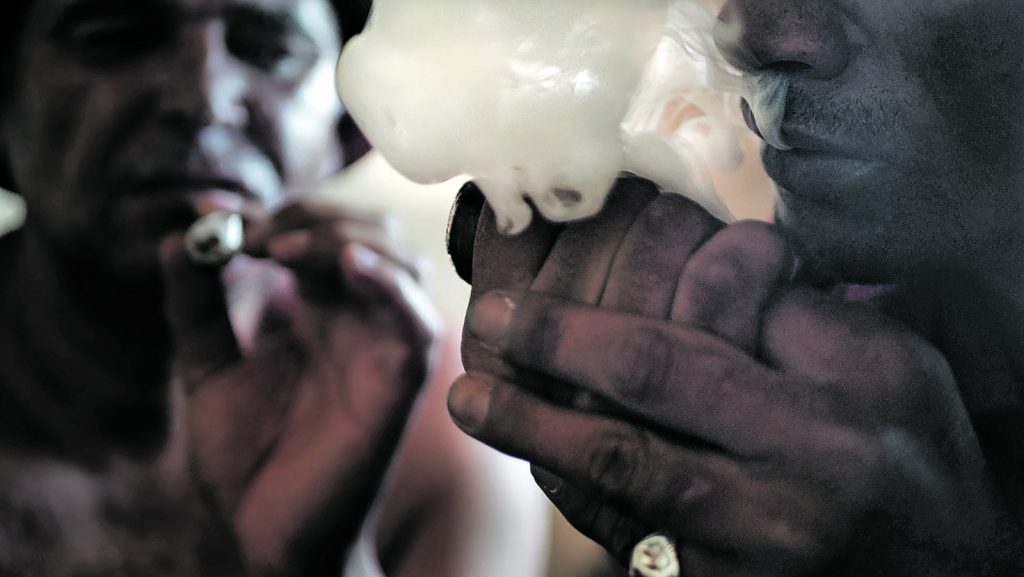 Gangsters smoke Mandrax and exchange war stories
This was an unusual group. It was inclusive. It didn’t invite but it didn’t chase away. It was highly creative, but it was tough. It was chaotic, but highly organised, and break times were either to prepare for war or engage in battle.
Either end of the concrete playground was home turf and we would clash in the centre — the soccer kids would run between us as if we weren’t there. Some would simulate fighter jets, some foot soldiers, and the bigger guys, tanks — the smallest, quietest guys were often the ones that surprised us.
We ran lucrative trading routes, built our communities and took prisoners. We would get bruised, battered and bloody but rarely seriously hurt. If anyone got hurt and exhibited vengeful behaviour, the conflict would be mediated, the perpetrator forgiven or punished, and the victim supported. If we wanted to play on without intervention from teachers, we had to find resolution while it was still in our control.
Each group — the soccer kids, the collector kids and the war kids — was participating in different activities. Naturally, there were fads that dropped in and out, and dovetails and crossovers between groups, but broadly speaking, there were no major migrations.
Although we were unfamiliar with the term or mechanism, we were all subject to hierarchy within our respective groups, be it measured by skill or competence, leadership or allegiance, intelligence or observance. One thing we all shared, somewhat unconsciously and instinctively, and across the set of all hierarchies, was that we were conforming, competing and self-regulating.
Within our grade as a whole — the mock “societal hierarchy” — the group we most identified with and our reputation within that group was a fairly reliable predictor of our overall status. We were all working out our place in the world and evaluating the limitations of our peers as well as our own.
As we hit puberty and entered high school, the soccer kids replicated their primary school experience — the team sports model is a triumph in its efficacy across time, those top-performer “all-rounder” students almost always came from this group.
The collector kids were the most studious and their intellectual competitive edge translated well into academia — although I must add that occasionally they would cross over into the realms of the war kids and they bloody loved it.
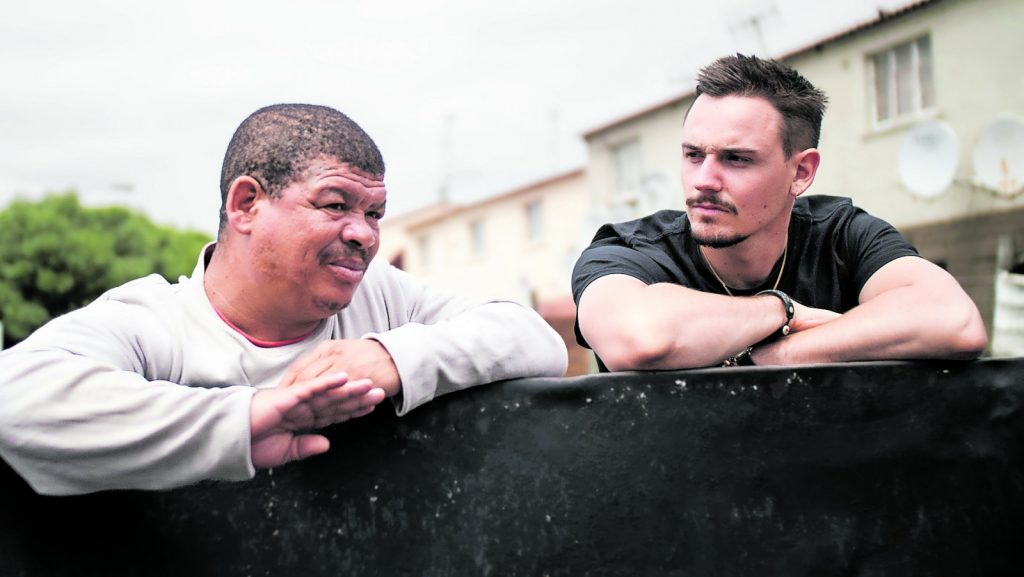 The writer Pete Barlow with Kenneth ‘Nongi’ Donson in Hanover Park. (Joey Isaacs)
As for the war kids, the way high school played out was slightly more complicated. With little concern or shame, the bottom sets for most subjects were populated by our group. There were, of course, anomalies. Some would do well with things that involved design or would be interested in that which involved some element of engineering.
Some were big into contemporary music — drums, guitar and the like — others maybe weightlifting.
Although these are worthy pursuits, they were seldom celebrated in school the way academia, classical music or sport was.
We were almost always the first to experiment with things like cigarettes, alcohol and, later, drugs. We were certainly the most adventurous and open to breaking rules, with little concern for consequence, and the way in which we broke the rules was often creative — a phase of egging houses comes to mind. Breaking into old, empty buildings was also fun. Something that was notably rare in our actions, though, was malevolence.
What does this have to do with gangsters? An awful lot, I would say.
In my estimation, the war kids got something right. There was a natural urge to test our limits, individually and in a group setting, without a set of clear, preconceived rules — we had to create them ourselves.
You can’t play soccer without following the rules and those who break them are vilified and uninvited. Similarly, with the collector kids competing with strategy-based card games and other fads, if you cheat or attempt to bend the rules, you’re out.
The war kids were comfortable with, or maybe excited by, not assuming a broad set of rules to abide by and rather endeavoured to figure them out independently, adapting them for the most preferred outcome. If you don’t want to play by our rules, you can’t play the game.
This and the above, I have experienced, is closely akin to the rules of gang life.
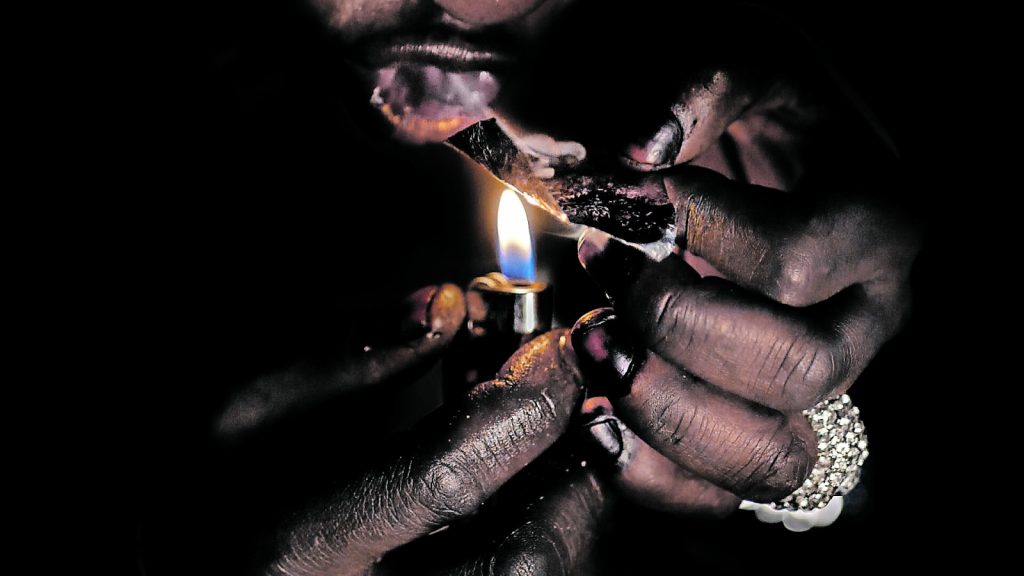 Up in smoke: A gangster gets his fix of heroin. (Pete Barlow)
Some difference in the trajectory of our maturity is based in early childhood. There are sets of reliable indicators to identify the kids that are at risk of gang recruitment — most evident is home life.
The absence of a father, or even both parents, or if the parents are present, the type of relationship they have with each other, be it abusive, fuelled by substance, or any other number of destructive qualities. But not all young boys growing up in broken homes become gangsters.
The war kids identify as a group of children with little desire to follow the rules that already exist. This doesn’t mean they discredit the concept of rules completely but, what it does signify is the desire for autonomy in the creation of rules which benefit the group.
And the benefit to the group is the freedom to continue the game.
As we became teenagers, the qualities we had been practising seemed to lack utility, at least at that age, and we were funnelled through the system as the naughty no-gooders, something we inevitably latched onto as an identity for some years, and for me, into early adulthood. The war games we were playing had to stop, and we had to fit into the mould, otherwise what were we going to do with ourselves when we left school?
Despite our resistance, what we learnt was a clear map for the elevation of status within a hierarchy, and across sets of hierarchies, and perhaps most crucially, how to adopt manageable responsibility.
With these two broad tools, we would be able to one day demonstrate our value and more easily mimic the actions of those around us to build meaningful lives and contribute to the betterment of society.
Although there are imperfections to this, and some concerning contention at the extremes, First-World societies have done a reasonable job of building this model and applying it. Although, to allow space for improvement, this model could do with some minor adaptations.
Something gangs do particularly well for the teenage-bound war kids of the Cape Flats is lay out a clear map for the elevation of status within a hierarchy and give opportunities to adopt manageable responsibility.
They don’t wait until you’re older to do so and test your competence and interests once you’ve left school. They do it now. Having trouble at home? Not doing so well in school? No problem, with us you can feel useful, loved and valued, and here’s how to do it.
But why this need to elevate your status? Despite my affiliation with the war kids group, I seemed to be dynamic and able to move between cliques and maintain, at least for some period, friendships with people at various levels of popularity — I always knew who my true friends were, though, and the moments of clarity were coupled with moments of distress.
But I, as any, was vulnerable to the allure of status and my dynamism helped me taste the waters of its value, or in some cases, its vulnerabilities.
To elevate your status, you demonstrate your value through competence in managing your adopted responsibilities. The allure of status is obvious — preferential access to resources, such as good food, interesting people, new technology, choice of partner and others.
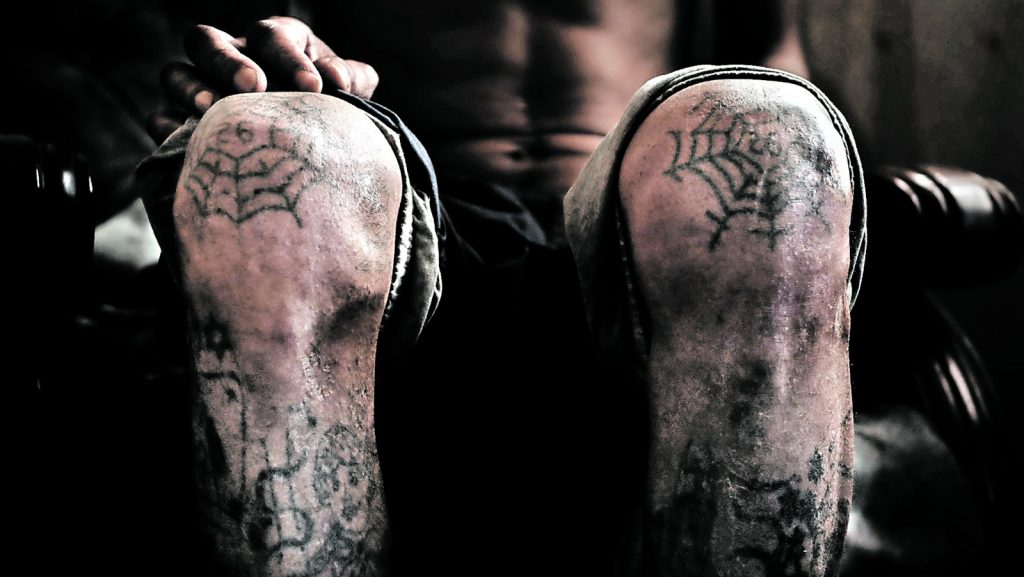 A gangster shows his tattoos. (Pete Barlow)
But what is not so clear is that it still must fill you with purpose and be meaningful and that plug can only be filled by the appreciation of those in reach, so who are you keeping within reach? Is it your gang brothers who hold you to account? Or is it your family, friends or colleagues?
Particularly for men, who play only a brief role in the creation of life, what purpose is left if not to demonstrate value and improve access to resources? Inhibit a man’s ability to demonstrate his value and catastrophe looms.
And what do gangsters represent for the rest of us? Perhaps it’s easier to assume that their actions are malevolent and without sense, but in the same stroke, they push a button in all of us.
It’s not as though we don’t all have malevolent thoughts that we want to act on but choose not to. Do we choose not to because we are afraid of the consequences? And what do we mean by consequence? Is it the fear of imprisonment or the fear that it is against the demonstration of our value system and will affect the elevation of our status across time?
Like the attraction to the bad guy in a movie, can we accept the allure of temptation and our dark desire for vicarious living?
To one, a gangster is the enemy who must be destroyed. To another, a gangster is the fantasy that acts on malevolent thought. To me, a gangster is the childhood friend who lost his map. For you might wish to have been something that I will always be — a war kid.
[/membership]