Janusz Walus, the extremist who killed South African Communist Party (SACP) leader Chris Hani in 1993
The constitutional court on Monday declared Justice Minister Ronald Lamola’s decision to deny parole to Janusz Walus, who murdered South African Communist Party leader Chris Hani in 1993, irrational and ordered that he be released within 10 calendar days.
Walus has spent just over 28 years in prison for an act that brought pre-democratic South Africa to the brink of civil war.
In a unanimous judgment, Chief Justice Raymond Zondo said in weighing the history of administrative decision-making on Walus’s repeated attempts to secure parole he was deeply mindful of the severity of the crime, and the calamity it nearly caused, but also of the fact that those who drafted the Constitution, adopted a few years later, intended all and not just those who supported the transition, to enjoy fundamental rights.
“I have also borne in mind that when the fathers and mothers of our constitutional democracy drafted our Constitution, and included in it the bill of rights, they did not draft a bill of rights that would confer fundamental rights only on those who fought for democracy and not on those who had supported apartheid or who had opposed the introduction of democracy in this country,” he said.
“They drafted a bill of rights that conferred fundamental rights on everyone, including those who who supported apartheid with all their hearts. Indeed, they drafted a bill of rights which conferred fundamental rights even upon visitors to our country so that, upon entry to our country, they begin to enjoy the benefits and protections of our bill of rights.”
Walus was convicted in 1993 and sentenced to death but this was converted to life in prison after the death penalty was declared unconstitutional. He has been waging a court battle to secure his release on parole since 2016.
In 2020, the current justice minister again denied him parole, noting that the aim of the assassination was “to create chaos and mayhem in the country” and that those who plotted with him had time to consider the probable consequences, but proceeded nonetheless.
“It was preceded by weeks of planning,” the ministry noted in its record of the decision.
Lamola took the view that parole was a privilege, not a right, and on Monday Zondo recalled this as he read out the ruling by the apex court.
In March 2020, in rejecting the application, the minister said: “The record before me clearly reveals that the court took this fact into consideration when sentencing Walus to death. The crime was intended, and had the potential, to bring about a civil war within the republic at the time.”
He added that placing Walus on parole “would negate the severity that the court sought when sentencing him. With this premise, and balancing both negative and positive factors, the placement on parole for offender Walus is not approved at this stage.”
But Zondo said the appeal had to take into account that Walus was convicted of cold-blooded murder, that he had been involved in planning it over weeks and “that his conduct nearly plunged this country into civil unrest”.
Moreover, in murdering Hani, Walus and his co-conspirator, Conservative Party MP Clive Derby-Lewis, nearly derailed the democratic transition. However, these were not the only factors for consideration, Zondo said.
These included the policy on the minimum period that convicts of this order had to serve before becoming eligible for parole, he said, adding: “The applicant became eligible for parole more than 17 years ago. It is now close to 20 years.”
He said Lamola had cited the same reasons for refusal his predecessor had when an application was first filed. Lamola had conceded that all the factors considered, save two, counted in favour of the applicant.
The minister also conceded that Walus’s behaviour had been commendable since he was sent to prison, that he had clearly shown remorse and that the risk of re-offending was low.
In his application, Walus had submitted that the remarks of the sentencing court were indelible and, if the minister relied on them to deny him parole, he would spend the rest of his life in prison.
Zondo cited case law that has held that the exercise of executive power cannot be arbitrary, to pass constitutional muster. He then turned to the relevance or otherwise of the trial court remarks that heavily influenced Lamola’s decision to deny parole.
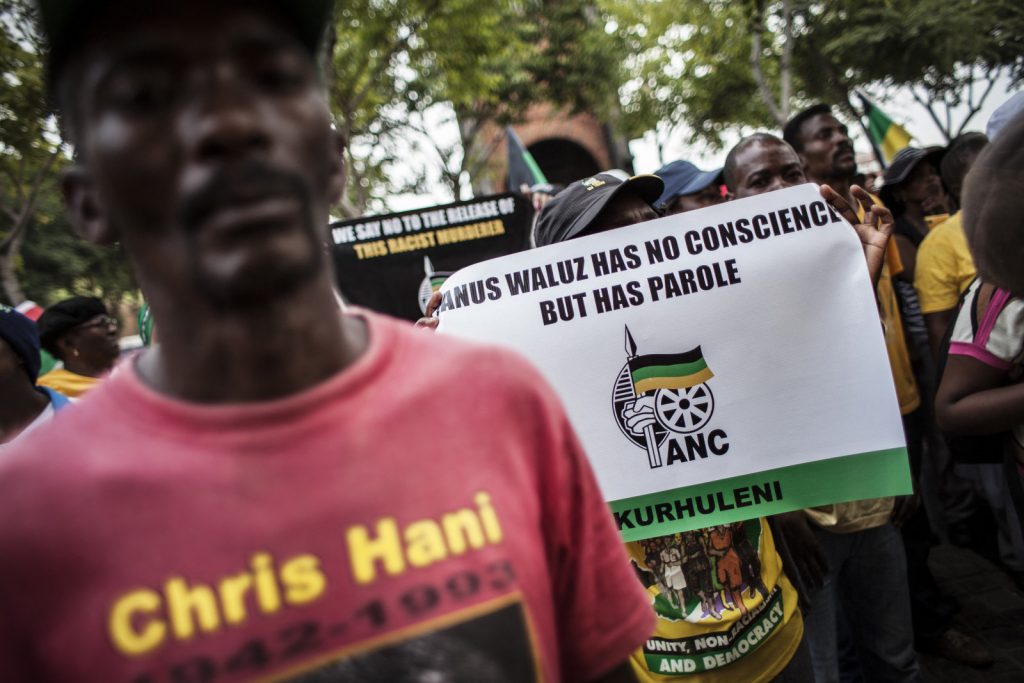 People protest the decision of the ConCourt to release Janusz Walus on parole.
“In my view they are not,” he said.
He went on to say that Lamola had conceded that these remarks were relevant above all to the decision the trial court made at the time towards motivating the severity of sentence.
It meant the factors in Lamola’s record of 2020 that argued against granting parole only concerned the seriousness of the crime.
It was the department’s policy that a prisoner be placed on parole as soon as possible after they became eligible, Zondo said. In Walus’s case, this was in 2005. He added that Lamola did not exclude the possibility that he could order Walus’s release at a future date.
But when that day came, the sentencing remarks of the trial court would remain, he said, posing the legal conundrum for the minister that to date these have served as a basis for denying parole.
Hence, Zondo said, Lamola would be confronted with the question: “Why is it that he did not release him in 2020 on the same facts?”
His failure to explain this rendered his decision to deny the applicant parole baffling.
“If it is inexplicable. It follows, as day follows night, that it is irrational,” the chief justice concluded.
He said the conditions existed wherein the court could substitute the decision of the executive with one of its own, including that here it was in as good a position as the ministry to make a decision on the facts and all relevant factors.
Derby-Lewis, who had allegedly ordered the hit carried out by Walus, was granted medical parole in 2015 and died the following year of cancer.
[/membership]