In the mix: The land earmarked for the project includes Woodstock Hospital. (David Harrison/M&G)
A rift between residents of Cape Town’s historic suburb of Woodstock and the city council has deepened as authorities press on with plans to develop about 800 social housing units while a final heritage impact assessment is still under review.
Woodstock residents had just over a month to comment on the city council’s notice informing them of plans to close and sell land in the area for a social housing development known as the Earl Street Social Housing Project.
The land earmarked for the project includes Woodstock Hospital and a bowling green bordering the historic Melbourne Terrace in Earl Street.
Residents claim the notice — sent on 5 December — was issued prematurely during the festive season when only a few people were at home and that there was not enough time for comments before the window closed on 10 January.
One of the main objections from residents is that further densification of the area would put immense strain on water and sewage infrastructure.
The final heritage impact assessment, which could have enabled residents to offer constructive feedback on the proposed development, is expected to be submitted to Heritage Western Cape on 27 January.
Only a select few local organisations and residents were offered the chance to comment on the heritage impact assessment in June last year.
In response to some of the comments, the city council approved carrying out a further social impact assessment. Once reviewed, the study will form part of the broader heritage impact assessment that will be submitted to Heritage Western Cape for feedback.
But a case of conflict of interest has brought the validity and independence of the social impact study into question. Bridget O’Donoghue, who was appointed to conduct the heritage impact assessment, is married to Tony Barbour, who was appointed to conduct the social impact assessment.
A homeowner on a street bordering the land argues that the studies were conducted with a predetermined outcome in mind.
In their objection to the city council, seen by Mail & Guardian, the owner recalls a telephone call with O’Donoghue, who allegedly said the sale of the land to a social housing company would proceed whether residents of the area “like it or not, because the city has a political mandate to provide social housing”.
O’Donoghue refused to respond to questions and referred the M&G to the council.
In addition to the impact assessment, a local spatial development framework for Woodstock has not been completed.
The spokesperson for Cape Town’s mayor Geordin Hill-Lewis, Lyndon Khan, confirmed that “work is underway” to formulate such a development framework for Woodstock and Salt River, which falls under the broader Table Bay district’s spatial development framework.
An employee at the company contracted by the city council to facilitate the land use management processes in Woodstock told M&G, on condition of anonymity: “We do not know which way Earl Street is going to go at this point. We, as the project team, are just going ahead with our appointment to get the town planning approval — if we get it — or at the very least heritage approval or feedback”.
Apart from delays caused by illegal occupants moving onto land earmarked for social housing, the employee said the council has not dealt with the process of releasing the portion of land in “the right way”.
“They should have been a little bit more patient and let the groundwork get done, and then knowing what they need and that they can accommodate this without causing problems for the community,” the source said, adding that the council needs the outstanding spatial development framework to make “guided, proper and informed decisions, especially in this area that is heritage-sensitive”.
“It is quite dense already,” the employee added.
While the development framework should inform the project management team, both processes are taking place at the same time, the employee noted, adding that the mayor “is pushing for this housing [project] to happen without understanding what is happening on the ground”.
Asked for comment, the mayoral office said public discussions had taken place regarding the Earl Street social housing project.
“This includes engagements around the site usage scope of the developable portion, as well as heritage and social impact consultations,” said Khan.
The city’s mayoral committee member for human settlements, Malusi Booi, said engagements with interested and affected parties for the heritage impact assessment started in 2021 and “included active civic organisations in the area and neighbouring properties”.
But residents insist that not enough consultation took place between themselves, the city council and consultants for the heritage and social impact assessments, and say the spousal relationship between the consultants makes their findings ripe for review because these cannot be considered independent.
Despite confirming over the telephone that he, “as the middleman” between the residents and the city, would respond to questions from M&G, Woodstock’s ward councillor, Ian McMahon, did not answer whether he had attended or facilitated consultations with residents.
Another resident who objected to the 5 December notice wrote: “The proposed closure and alienation of the land is considered premature, ill-considered and done in complete isolation of the other proposed developments in very close proximity.”
A third resident, who has lived in Woodstock for more than 20 years and attended community meetings regarding social housing in the area since 2005, said the proposed closure and sale of the land “does not take into account the significant impacts/affect it will have on the heritage and culture of Woodstock, its community and its social values”.
Referring to the abandoned Woodstock Hospital, where more than 2 000 people occupy the land, the resident said the area had seen “degradation and … social nuisances residents are subjected to”.
Outside the hospital’s well-guarded fence, two women who have lived there for more than a year told M&G that they did not feel safe because of the presence of gangsters, theft and rampant drug dealing. They explained that each of the 10 sections in the defunct hospital had representatives, one of whom was on the premises during the M&G’s visit, although he declined to comment.
The two women are unemployed and cannot afford a monthly rent elsewhere. Although they do not pay rent, they are required to make a monthly “contribution” of R150 to the “leaders” to secure their residency. The women said they had not been notified about a possible relocation should the hospital land go to the housing development.
Another resident, Lien Vanneste, said Woodstock’s residents were not opposed to social housing.
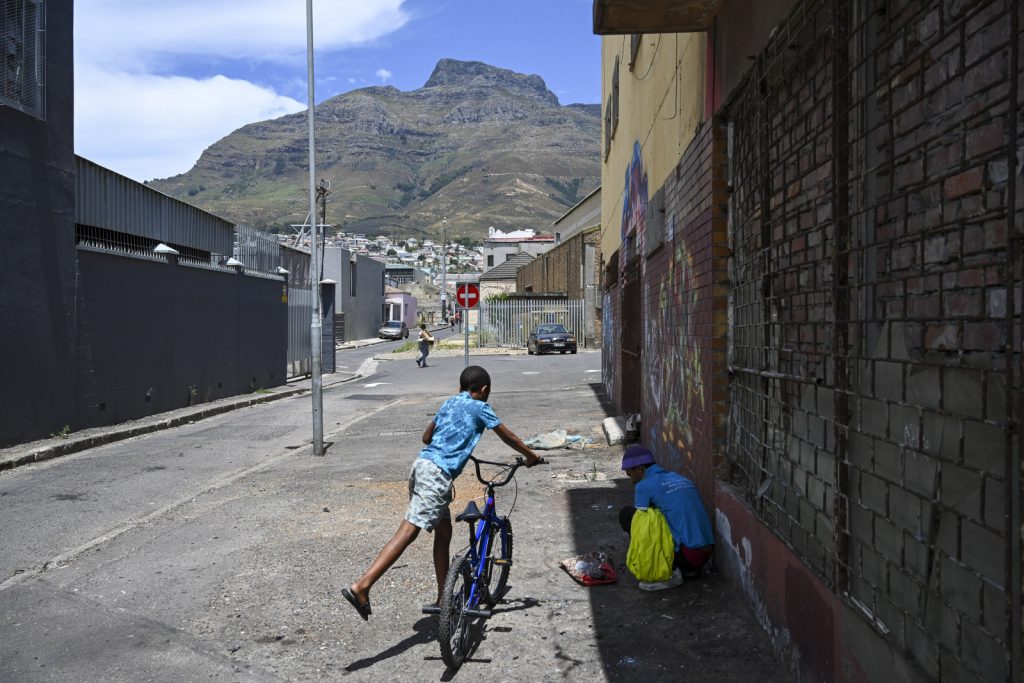 In the mix: The land earmarked for the project includes plot bordering the historic Melbourne Terrace in Earl Street.
“In principle, we support social housing, but the hospital [land] is going to be developed, right across from us. We don’t understand how the neighbourhood is supposed to facilitate thousands of people moving in, while we already have limited facilities and limited green space.”
Vanneste said the additional housing units would put more pressure on water and sewage infrastructure as well as schools and clinics.
“All the schools in the area are full, no plans have been put in place to increase the capacity of existing schools, or build new schools,” said Vanneste, who lives in the Melbourne Terrace, which is believed to have been built in 1900 and was proclaimed a national monument in March 1991 by Heritage Western Cape.
The area borders land known as the bowling green, which is illegally occupied, and included in the City’s proposal to develop social housing.
In her objections to the City’s proposed plan, Vanneste said the bowling green needs to remain green.
Another resident noted in a formal objection filed to the city: “The Castle Bowling Green is the only bowling green in the city that the council is prepared to relinquish for social housing, despite intense pressure to do the same elsewhere. Yet the other bowling greens are located in areas where residential plots are larger than those in Woodstock. Houses here do not have gardens. As a result children play in traffic.”
Similar to other structures and residential buildings in Woodstock that have been declared heritage sites, Vanneste points out that Earl Street has significant social and historic value for residents, in part because it served as a voting station during South Africa’s first democratic election in 1994.
Ernest Ford, who has lived in Woodstock for 59 years and who chairs the Woodstock Aesthetics Advisory Body, says many consultations regarding social housing over the past 25 years between the City and the advisory body took place, “but with little progress or cooperation from the City”.
Ford said corporations “are taking advantage of the poorer, but no less heritage-worthy buildings, [which] generally means redevelopment, which sadly is too lightly allowed by the City”.