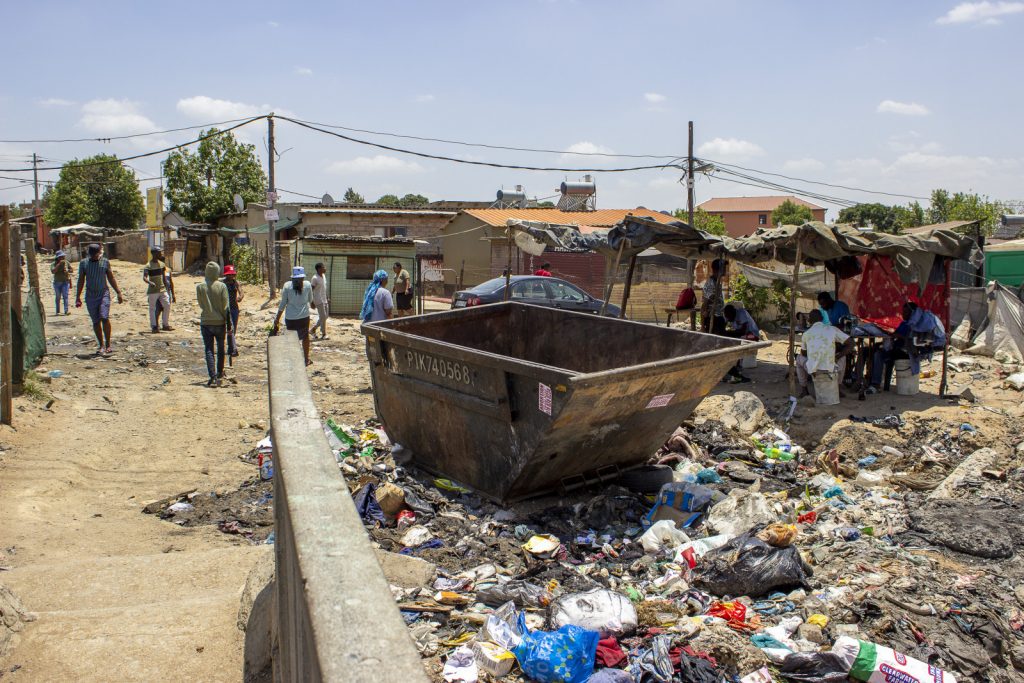
Trashed: A polluted stream in Tembisa’s Kanana Extension 5. (Delwyn Verasamy/M&G)
Residents of Tembisa, on Johannesburg’s East Rand, are up in arms over uncollected waste that is piling up in the area and has become a health hazard. They are demanding that the municipality clean up and are threatening a service delivery strike if the situation does not improve fast.
In August, a service delivery strike in Tembisa led to the death of four people and the Ekurhuleni Customer Care Centre being set alight.
In Tembisa’s Kanana Extension 5, street vendor William Shiburi’s stall is beside a stream filled with litter. He said he seldom sees a rubbish collection truck in the area.
A bridge over the stream serves as the entrance to Shiburi’s neighbourhood from the nearby main road.
“The rubbish can get so much that it blocks the bridge …. Rubbish will be thrown into the stream of water as people try to make space to walk over the bridge. We have families, and children we are raising in this community — it is not safe,” Shiburi said.
“Not so long ago, the bridge was full of rubbish, and because there is limited space, young people pushed an old lady into the stream full of rubbish by mistake and her leg was cut open. I don’t know what happened to that lady after she was rushed to hospital. I never stopped thinking about that lady for a very long time.”
The heavily littered bridge has become a breeding ground for crime, said three young women, who asked to remain anonymous. “You cannot go to Kanana over that bridge after 7pm. It is dangerous,” one said.
Thugs often hide behind the trash when it’s dark, and pounce on their victims, taking their belongings, another woman said.
In November, the body of a newborn baby, shoved in a plastic bread bag, was found by a resident on the banks of the dirty stream. Horrified residents are worried about what else gets thrown into the stream.
In Phomolong, which is adjacent to Kanana, Fezile Mazibuko and Sphamandla Khumalo confessed they had no choice but to regularly dump their trash at a nearby street corner.
“We don’t like to do it, but when the municipality does not come to collect the trash for days, we have to go place it at the nearest corner, as does everyone in our community. No one wants to live among filth in their yard,” Mazibuko said.
“It does not sit well with us that our neighbourhood looks like this but what else should people do?”
Not far from there, young boys were practising soccer on a field, amid the stench from a nearby pile of trash.
“There is a bad odour in the air, and I know it affects the boys, but where else can we go? We tried speaking to our councillor but that did not make a difference,” said their coach Marks Mashile.
He added that the boys had no other place to train. The youths often removed the rubbish themselves but it was inevitably back after a few days.
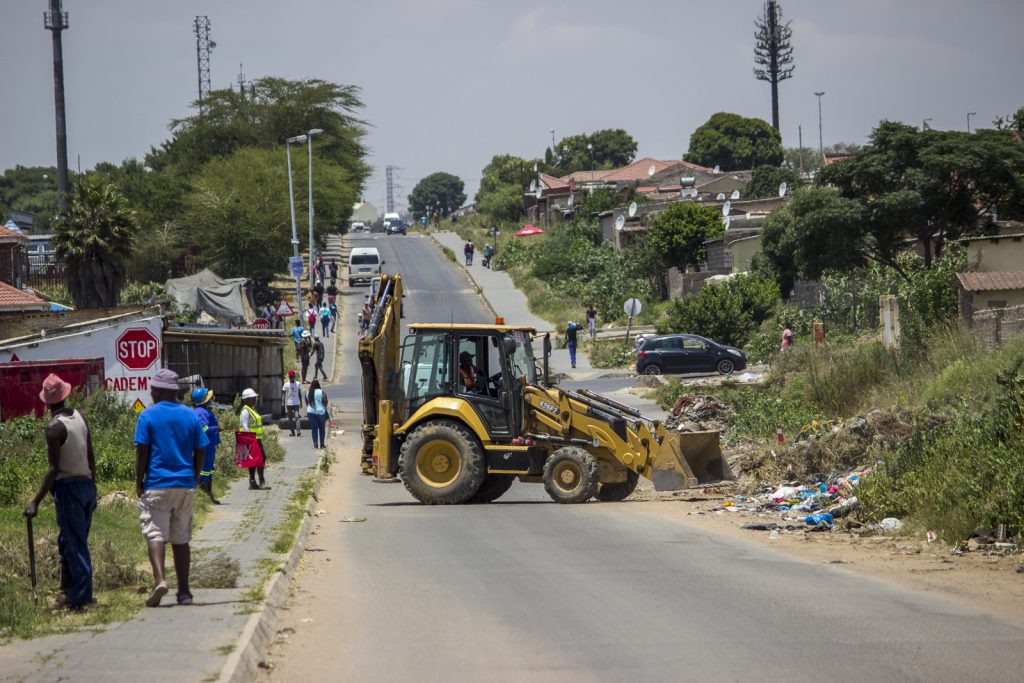 A rubbish situation: Residents of Tembisa in Johannesburg live alongside piles of uncollected waste while the municipality claims operational difficulties. (Delwyn Verasamy/M&G)
In Olifantsfontein, residents have decided to clean up the area themselves after realising they cannot count on the city council to do so, says Tebogo Pitse.
“It is not fair that we have to do this ourselves but when we leave our area like this, it affects us,” he said.
A study on waste disposal by the United States National Center for Biotechnology Information found that uncollected rubbish can be a danger to human health and also makes its way into drains, blocking them and polluting waterways.
“The stagnation of water in waste items attracts mosquitoes and other insects, which breed and spread vector-borne diseases. Food waste attracts flies, insects, rodents and other vermin which act as vectors that spread infectious diseases.
“In some instances, domestic waste is burned, which creates smoke that contains carbon monoxide, particulate matter and nitrogen oxides, all of which are hazardous to human health,” it said.
One reason for the pile-up of waste in Tembisa is that the landfill for disposal is far away, said City of Ekurhuleni project manager Busisiwe Mokoena. In addition, the council does not have enough equipment to clear illegally dumped rubbish, meaning each region had to wait a long time for its turn.
The problem of uncollected waste had been going on for six months, she acknowledged.
Ekurhuleni municipality spokesperson Zweli Dlamni said the issue had been compounded by the fact that waste collectors who had not been paid on time had decided to withdraw their services, creating a backlog.
Mokoena said aside from the landfill being too far away, the contract with the site had ended. The city was in the process of renewing it.
“The city is still busy with processing the [paperwork] and that will be concluded very soon.”
According to the treasury, “The municipal waste business is worth about R8 billion per year and has grown by about 25% in real terms since 2009. Municipalities have increasingly relied on service charges to fund solid waste services; these charges were equivalent to about 85% of the operating expenses for waste in the eight metros.”
Removing waste was expensive for municipalities and efforts to separate waste at source and increase recycling were expensive compared to the value of the materials recovered. Landfill sites were filling up fast but securing new sites took a long time, it said.
These challenges cannot be solved by a single city, national department, sphere of government or investment programme alone. Instead, an integrated response, based on a broad social consensus, was needed, the treasury said.
Residents must also take some of the responsibility for the mess in Tembisa, Mokoena said, adding that population density made it hard to keep the township clean.
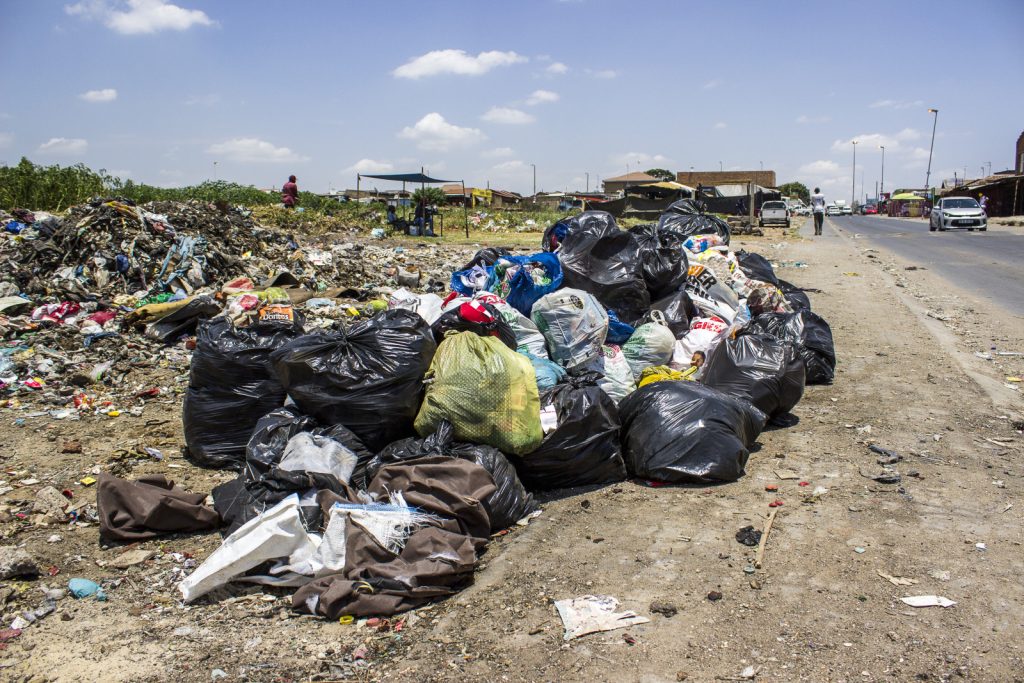 Residents of Tembisa in Johannesburg live alongside piles of uncollected waste. (Delwyn Verasamy/M&G)
“You can’t compare Tembisa with other townships,” she said. “Tembisa has a high density of population. You will find that in one yard, there are 20 families, people have built flats in their backyards and you will find that the 240-litre bin that we issue to each and every house is insufficient.”
Mokeona said residents had shown little interest in the council’s cleanliness awareness programmes but Thabang Jiyane, the convenor of councillors in Tembisa, said although meetings had been held to discuss clean-up campaigns, it was not fair to put all the blame on residents for the filthy state of Tembisa.
“No, it can’t be the community … I blame the fact that the new administration has been allocated a minimal budget. If they had more resources, they would be able to tackle the issue of dumping in Tembisa,” Jiyane said.
Asivikelane, an organisation advocating for the rights of informal settlement residents, who are often deprived of basic services, said across South Africa’s metros, only about 59% of informal settlement dwellers had access to enough water, while 43% had access to clean toilets and 47% to regular refuse removal.
Asivikelane said more funding must be allocated to providing such areas with taps, toilets and refuse removal. According to its study, more of Ekurhuleni’s 2023-24 budget needs to be set aside for regular refuse removal.
The council can and should do more to improve rubbish collection in Tembisa, said Willem Snyman of Fresh, a nonprofit organisation that aims to clean up South Africa’s rivers, dams and waterways.
 (Delwyn Verasamy/M&G)
The situation is extreme, he says, with residents having to live next to heaps of dirt for years and often being forced to burn rubbish, to the detriment of the air quality.
“You find that the litter that has been discarded by bridges eventually makes its way into the Kaalfontein River, which ends up in the Hennops River. You cannot imagine the amount of waste we find in the Hennops River,” Snyman said.
He said of the council’s clean-up campaigns: “As great as this may be, it should not be a burden that the community has to carry; the municipality must step up.”
“These people have nowhere to go, so we cannot say overpopulation is why Tembisa is the way it is. The municipality needs to collect rubbish as regularly as possible.
“There are solutions — there must be more dustbins in every household. The pick-ups should also be regular. No one likes to have piles of rubbish in their house, which is why some put it on the corners.”
[/membership]