I believe: Greater powers guide Fano Buthelezi, who owns a business making doors and other items in Katlehong township, Gauteng. (Delwyn Verasamy/M&G)
Fano Buthelezi, a carpenter who spent about R2 million to start his workshop in Katlehong, Gauteng, rubs his isiphandla to stress how his ancestors intercede in protecting his business amid Eskom’s blackouts.
Isiphandla is a bracelet made from a goat or cow’s skin that is worn by Africans after completing an ancestral or spiritual ceremony.
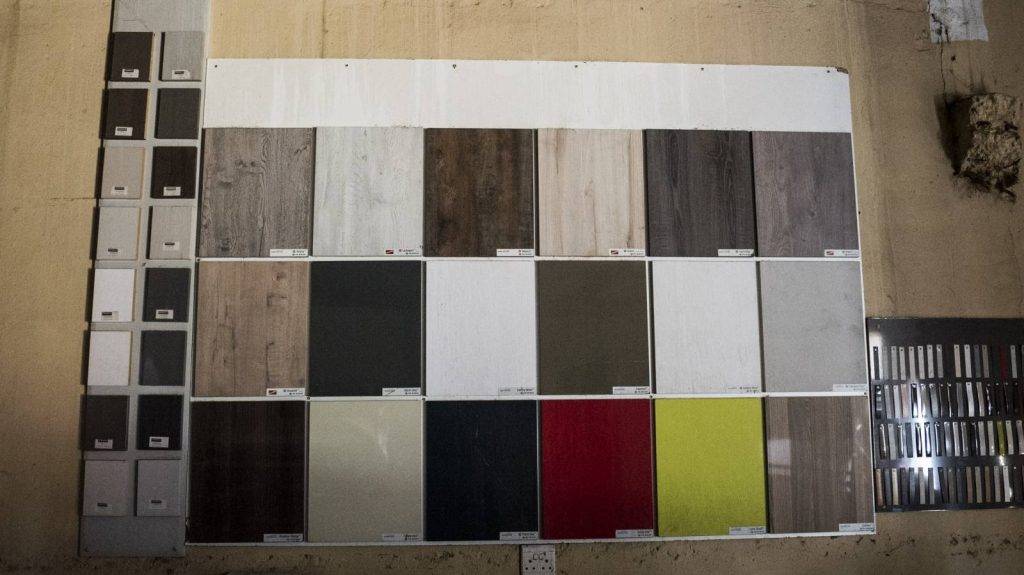
Buthelezi’s business, Boards & Doors, began in 2017 and is a bustling workshop of high-tech machinery and seven employees — three full-time workers and four part-time.
Buthelezi places his African spirituality at the centre of his entrepreneurial journey. He is umZulu who is proud of his cultural and spiritual background.
“I’m a strong believer that we don’t exist because we are, but we exist because there are those that walked these paths before us.
“I’m a firm believer that, yes, there is God who is above us all. But, working with God, there are angels — being my ancestors and those that walked before me — who intercede on my behalf.
“Walk around in the wood or carpentry industry; there is no black guy, at my age, who has what I have. So, I can’t say I’m lucky — I’ve been fortunate and blessed.
“This is the reason for wearing isiphandla. I have to go back, do a spiritual ceremony to say, ‘You know what, I’m thankful for your protection. I’m grateful.’”
When the Mail & Guardian visited his workshop on Monday, Eskom had just switched the lights off in Katlehong township for another bout of load-shedding.
Buthelezi said he has not been spared the brutality of the state electricity utility’s cuts, saying it would put him out of business if he were to buy the equipment needed to mitigate the blackouts.
“The load-shedding has affected us quite a lot. I did a quotation on a generator that will run [two of my heavy machines] at a time, because I must be able to run at least two at a time. That generator, based on the quotation I received, would cost me R350 000.
“I then sourced solar energy quotations to try and be off the Eskom grid. I am even afraid to mention what the price would be — but it is in the millions of rand.”
He added that all his machinery works on a three-phase system, mostly used in commercial and industrial settings. Residential homes use single-phase power supply.
“To run a three-phase solar power supply or three-phase generator power supply will cost us an arm and a leg. Unfortunately, this is how we work — we have had to learn to adapt.
“What we do is that we check the schedule; that is why you see that none of my employees are here. When the power is cut at 10am, like today, the guys will come in at 7am to do some work and move out to the site [where our client is].
“But we also need to check on site if there is electricity there. There are days when you find that, when we’re done in the shop, there is no electricity on site. So, we have to sit and wait here for electricity to come back at the site,” he said, laughing wryly while explaining the rigmarole Eskom forces them to endure.
 Adapt or collapse: Employees work shifts that are determined by Eskom’s load-shedding schedule. (Delwyn Verasamy/M&G)
Buthelezi said he drew inspiration from his spirituality, and the ancestral rituals that resulted in him wearing the bracelet is his source of strength during the hard economic conditions he has to navigate.
Refiloe Letuma, a registered traditional and spiritual healer who is regulated by the Traditional Health Practitioners Act, said of the importance of isiphandla that it is an acknowledgement that the family has performed a ceremony to give thanks or ask for blessings.
“It is usually more recognised in the Zulu culture; for example, after a funeral when a loved one has passed away, or for birthdays, usually a 21st birthday celebration, or by slaughtering a goat or a cow for a thanksgiving ceremony.
“[Wearing isiphandla] does not have to be for anything specific,” Letuma said. “But ubungoma [becoming a sangoma] — whether you are Sotho, Xhosa, Tsonga — it is known that, if you are a traditional healer, you put on isiphandla to acknowledge the ritual you perform for the ancestors; the journey that you have taken on.”
Buthulezi said this spiritual journey keeps him focused, adding that he has been learning from the Islam faith of how Muslim people incorporate their religion in their everyday lives.
“What I have admired about Muslim people is that what they believe religiously is what they are culturally. So, when it is Ramadan religiously, it is Ramadan culturally as well.
“Spiritually, I have learnt from Muslim people to say that my culture, my religion and my everyday existence must be in sync. In whatever I do, when I come to work, I will not only pray my Christian prayer, but also alert my ancestors that, ‘I have arrived in my workshop. Please guide me and watch over me as I work.’”
The intercession prayers to his ancestors did not mean that he had abandoned the Christian faith in which he was raised. It is possible to be embedded in African spirituality while also observing Western religions.
“That is where my spirituality comes in because I know that I am not alone and whatever I have and achieve, I need to acknowledge those that are with me. I need to acknowledge the greater powers that I move with.”