Erika Bornman is among a group of survivors who are taking the Commission for the Promotion and Protection of the Rights of Cultural, Religious and Linguistic Communities to court over its toothless report. Photo: Courtesy Erika Bornman
Angry survivors of KwaSizabantu Mission have lambasted as “flippant” a report into allegations of rape and human rights abuses at the Christian mission north-west of Durban, and are preparing to file a court application for it to be reviewed.
The Commission for the Promotion and Protection of the Rights of Cultural, Religious and Linguistic Communities (CRL) released the report last Thursday after survivors and witnesses filed an application in the Pretoria high court to force it to do so.
The CRL issued the report almost three years after it held a series of emotionally charged hearings where more than 20 witnesses, including former employees, residents and pastors, shared their personal testimonies in Durban and Johannesburg and others filed written statements, as part of its investigation into the allegations.
KwaSizabantu Mission (KSB) is located in Kranskop between Greytown and KwaDukuza and includes a multi-billion rand farming business and aQuellé spring water bottling facility on the 550 hectare Emsini Farm. It also runs Domino Servite School and a drug rehabilitation centre.
Erlo Hartwig Stegen, a German evangelist among the Zulus since 1950, founded the non-denominational church mission in 1970.
Among the allegations raised during the hearings were complaints about rapes, sexual abuse, domestic abuse where children were brutally and publicly beaten with plumbing pipes filled with sand until they bled or fainted, forced virginity testing, labour abuse and racial discrimination where black children were forced to cut their hair.
The report noted regarding the allegations of child abuse that: “Some would be beaten while naked for minor things and get locked in the rooms for 24 hours. Children of co-workers would be punished publicly to set an example to other children, by making them mop the floor with their hair while their legs are up. They further alleged that drug addicts would be beaten until they pee on their pants. It is alleged that one person died after he was corporally punished by one of the church leaders,” the report noted.
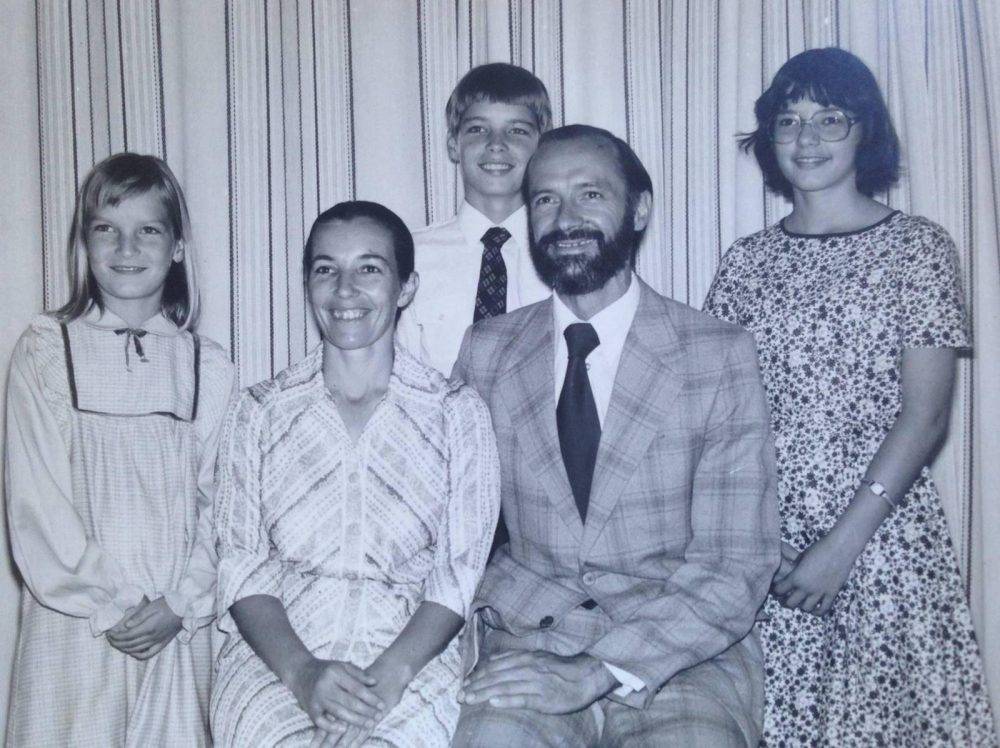 Erika Bornman (far left) as a child with her brother and sister, Chris and Hanna, and their parents, Daniel and Esther, just before her parents left them at the mission and went to France. Photo: Courtesy Erika Bornman
In addition, there were also allegations of corruption and money laundering. Some of the alleged incidents took place 30 years ago.
The CRL confirmed in the report that one rape took place at the mission and that the perpetrator was serving a jail sentence. It also said corporal punishment had been practised but had ceased, and that virginity testing had been conducted with the permission of parents but now had been stopped.
But it said it had consulted an expert and found that the mission’s practices were not conducive to that of a cult. “The commission found that the teachings, principles, rules (doctrines) of the mission are within the scope of freedom of religion as per section 15 and section 31 of the Constitution.”
Among the report’s recommendations were:
•All criminal matters such as about rape, assault, corruption, murder and money laundering should be reported to the police.
•The mission must work with the department of social development to implement child protection programmes.
• Labour related disputes must be referred to the Commission for Conciliation Mediation and Arbitration.
•Forced virginity inspection should not be conducted.
It also recommended that “the mission is to apologise to the complainants and or former members for the hurt which they could have caused as a result of the practices of the mission”.
“Most of all, reconciliation between the mission and the former members, who have been hurt or wronged by the practices of the mission, be facilitated for the purposes of peace and unity,” the report read.
But a 63-page draft report – which the Mail & Guardian has in its possession – included a recommendation by the KwaZulu-Natal government that there be a further investigation into the mission.
It alleged some of the mission’s business enterprises were non-compliant with labour legislation, that it was running an unregistered drug rehabilitation facility that should be closed with immediate effect, and that there was no access to healthcare at the mission. It also called for a deeper investigation into the “Orania type … self-governing territory” and that its tax compliance be verified and its school audited.
These findings were omitted from the amended report released to the public.
Erika Bornman, a former mission resident who alleges she was sexually molested by her counsellor, Muzi Kunene — who is now serving a sentence of life imprisonment for murdering Ballito estate agent Lynne Hume in October 2007 — when she was 16 years old, said she is angry the report recommends the mission apologise to its victims.
Instead, as a Chapter 9 Institution under the Constitution it should have exercised its powers to recommend a police investigation into the rapes and human rights abuses, she said.
“How can they conclude and say KSB must apologise if someone was hurt by them. We had wanted to go straight to the Human Rights Commission and then the CRL took it on themselves, and the Human Rights Commission said they would wait for the CRL report,” she said.
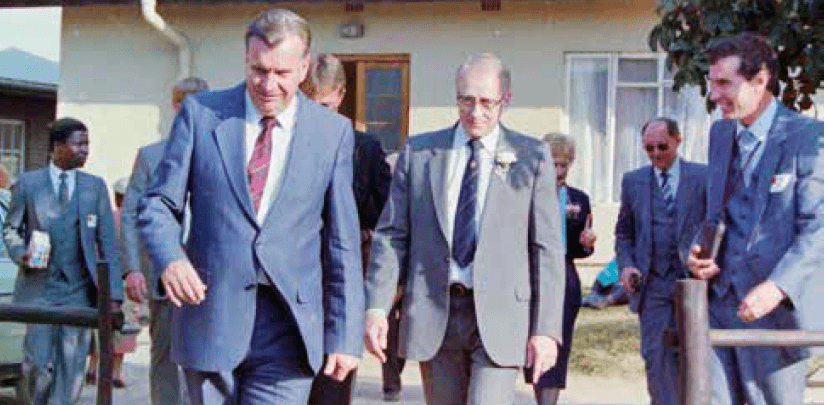 KwasizaBantu leader Erlo Stegen takes former law and order minister Adrian Vlok on a tour of the mission, accompanied by a young Koos Greef (far right). Photo: Courtesy Koos Greef
Bornman said the CRL had been “appalling” to deal with and its report was problematic because it did not quantify how many witnesses it had spoken to and how many statements had been collected.
“The commission spoke to three rape victims I know of, and another rape victim sent them a long letter and they never contacted her,” she said.
“It is a mass gaslighting exercise to tell us we have not been abused. I would love to know what these commissioners earn. It is my tax money they used, and they wasted our time. I am so angry. I am furious — they begged us to talk to them.”
Bornman said victims are preparing papers to challenge the CRL regarding its report in the Pretoria high court.
In August 2021, Borman published her book, Mission of Malice, in which she tells of her experiences of abuse at the mission and vows to “be a thorn in their side until they stop breaking the spirits of children in their care”.
She said she also spearheaded a News24 investigation into the mission that highlighted victims’ stories in the documentary Exodus.
Celimpilo Malinga was expelled from the mission when she was 16. Her crime was accepting a bowl of chocolate from a boy.
“I was expelled, and my dad was made to beat me with a pipe loaded with sand in it — to make sure he understood why I was being expelled. I was beaten not just once. There was a time I was part of a group that performed a stage play and it had music and we rocked and danced and after that the whole school was beaten because someone said they had seen demons coming out,” she said.
She alleged that she had witnessed a girl being stripped to her panties in front of the whole school and then beaten because she was in a relationship with a boy. Communication and relationships with the opposite sex were forbidden, she said.
Malinga said she feels “almost defeated” by the report’s recommendations.
“There is a very famous saying that everything that is done in darkness will one day be exposed in the light. I think that day came for KSB but because they are demigods, they have now tried to reverse that day. I hope for their sake God will forgive them for the atrocities they have done in other people’s lives,” she said.
Malinga does not want an apology from the mission but rather remorse and a reformed system.
Another former resident, Hester Smit* (not her real name), who claims she was banished from the mission after working there for 12 years without remuneration other than board and lodging, is still dealing with the trauma of her experience. She asked not to be named because, 12 years after fleeing, she is afraid of the leaders at the mission.
Smit claims one girl who was abused and raped at the mission, was accused of having a “spirit that breaks up marriages” and of being a satanist. She said the girl was locked up and treated as if she was mentally ill, interrogated for hours daily and forced to confess her sins, before being locked up again.
“I was sexually abused by Mr [Muzi] Kunene and other people at the mission,” Smit claimed.
She alleged witnessing brutal beatings of children and is horrified the report did not call for action regarding the atrocities.
Smit said the CRL had embarked on a “catfishing” exercise to find the survivors.
“I am speechless. I am very disappointed, and I want KwaSizabantu to be exposed as a cult because a cult has certain rules — one being that if you do not confess your sins, you are out, and you had to confess your sins daily. KwaSizabantu is a very dangerous cult that has deceived many people,” she alleged.
Koos Greef, a former pastor, counsellor and head of security at the mission, said he had witnessed the alleged beatings of children and was aware of an incident of child sexual abuse. He alleged that he had raised issues for years with the leadership who “made excuses” for the perpetrators. He eventually left the mission when he realised that it would not act.
“It [the CRL investigation] was political brinkmanship because the way the commission interacted, it was grandstanding, it was a farce, there was nothing serious about it. It was flippant,” he said.
The CRL had not responded to questions at the time of publication.