The labour court last week halted an attempt by the South African Police Service management to subject Major General Feroz Khan, its head of security and counter-intelligence, to an expeditious disciplinary process which could have led to his summary dismissal.
(Delwyn Verasamy/M&G)
The South African Police Service (SAPS) is an “outdated”, “captured and corrupted”, ill-disciplined organisation in decline that will not win the fight against crime simply by boosting its ranks with 10 000 new recruits each year.
This was the scathing criticism levelled at the police service by security experts, who weighed up its 186 180 staff complement and R102 billion budget in 2022-23 against its declining ability to solve serious and violent crimes, and bring corrupt officers to book.
They said a paradigm shift towards a decentralised, federal policing model, rooting out political appointments and corruption, professionalising and modernising the service, along with technology training to fight organised criminal syndicates and cybercrime, was necessary. The reforms should also include allowing neighbourhoods to directly appoint station commanders.
The police announced on 5 August that it was recruiting 10 000 officers, while raising the qualifying age to 35.
There has been a 7% decline in the number of police officers from 199 345 in 2011-12 to 186 180 in 2023, despite an 86.5% higher budget than the R57.9 billion of 2011-12. But simply boosting staff numbers will not improve policing capabilities, argued Institute for Security Studies (ISS) justice and violence prevention programme head Gareth Newham.
According to an ISS report analysing police staffing and performance, the key reason for the decline is the Safety and Security Sectoral Bargaining Council agreement which stipulates that non-commissioned officers receive promotions every four years regardless of performance. In 2018-19, 42 000 officers were automatically promoted without any performance review, adding R1.2 billion to the salary bill.
“The rationale for the decision was to improve morale but this ups the morale of corrupt officers who get promotions and reduces the morale of honest and hard working police officers. In any government department in the world, you don’t get promoted just for coming to work,” Newham said.
Despite the ballooning budget, the police’s crime solving ability has waned. According to ISS data drawn from police statistics, the police solved just 10% of armed robbery cases and 14.5% of murders in 2022-23 compared with 53% and 31% respectively in 2011-12.
“That reduction in capability is not about the numbers of police but how you train, motivate and reward them. The police have been in serious decline over the past decade but the only response the government has is, ‘we are not going to fix the system but will just have tens of thousands more going through it’,” said Newham.
“It is unlikely they are going to make a difference because training is outdated, it doesn’t keep up with the types of crime we are facing.”
He said corruption among new recruits was a problem — the police are investigating allegations that new recruits bought their way into jobs during the 2022 drive — and performance management systems are dysfunctional.
“The systems for motivating and rewarding are not working, and neither is performance management if you are a bad cop, if you are brutal. We have seen with the VIP incident [where Deputy President Paul Mashatile’s protection officers assaulted military trainees on the N1 freeway in Johannesburg last month] that the disciplinary system has collapsed,” Newham said.
He said this was evident in the fact that 95% of the 55 000 complaints to the Independent Police Investigative Directorate (Ipid) from 2011-12 to 2022-23 led to no sanction against implicated officers.
“The least likely outcome is to be dismissed,” Newham said.
He added that recruits are not properly vetted and training is outdated, rendering the police unable to deal effectively with extortion and organised crime.
“Civilian claims indicate what unlawful police behaviour has been costing the police. In 2012 the police paid out R100 million in damages to civilians and last year they paid out more than R500 million. In the last five years victims of police brutality and unlawful behaviour were paid out R2.3 billion.”
The National Development Plan (NDP), a policy document that aims to eliminate poverty and reduce inequality by 2030, notes that “the serial crises of top management” is having a negative effect on the police service.
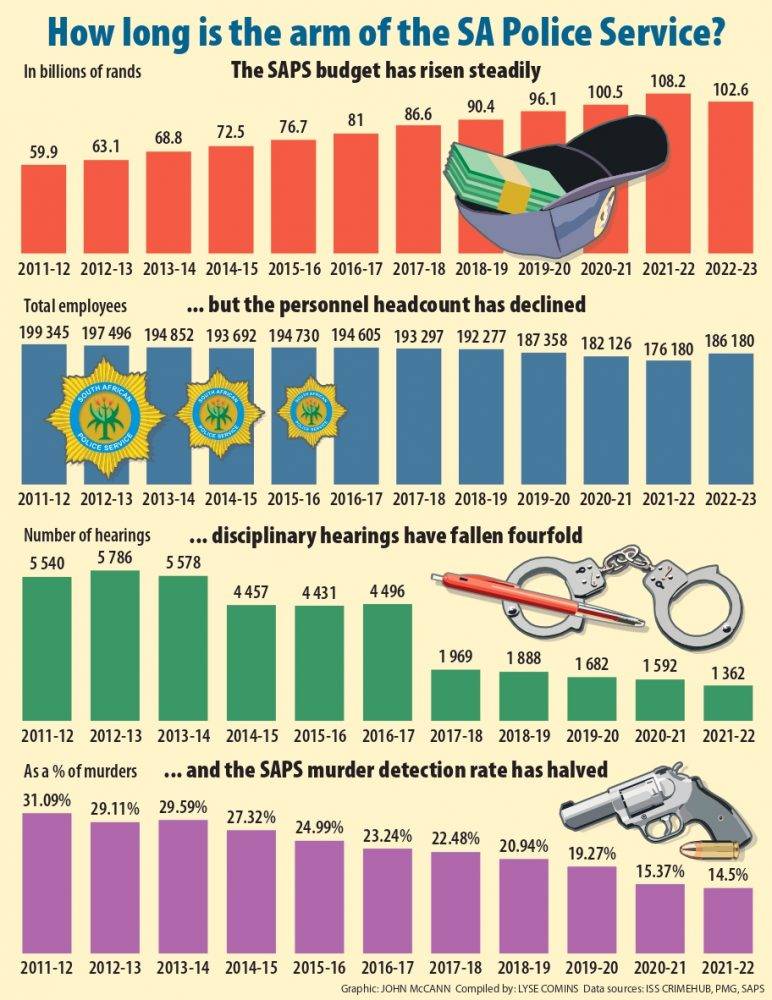 (Graphic: John McCann/M&G)
“A national policing board should be established with multisectoral and multidisciplinary expertise. It will set out the standards for recruiting, selecting, appointing and promoting police officials and police officers,” the NDP says. “The board will also develop a professional code of ethics and analyse the professional standing of policing, based on international norms and standards.”
It also proposes the strengthening of the justice system, the professionalising and demilitarising of the police service, and increased community participation.
“If government were serious about fixing the police the first thing they have to do is get an independent panel — retired generals, international experts and civil society — to do an assessment of top management and see who is not qualified, get rid of who should not be there, and then make new appointments based on merit,” Newham said.
“If this had been implemented 10 years ago as proposed in the NDP, we would be in a much better position and have a highly responsible cohort of police learning best lessons from around the world.
“In the next 10 years cops are going to have to be able to use laptops, because cybercrime is growing, they are going to have to understand how organised criminal networks work. They need to be problem solvers, innovative thinkers and be able to work in teams.
“But these are factors they don’t think of when recruiting; it is all height, age and weight, they don’t look at aptitude.”
Newham believes President Cyril Ramaphosa is “the only one who can fix” the police system “but he doesn’t seem to think it’s a crisis because he is saying nothing, not a word in any speech, that he wants to fix it”.
The problems facing the police include the “politicisation” of investigations and limited resources, Institute for Race Relations (IRR) researcher Marius Roodt said.
“South Africa is also fundamentally a violent society for a number of complex reasons. If we look at crime statistics, crime started coming down [in] the mid-1990s but this trend started reversing in 2010, partly because of the destruction of many institutions in the Zuma years, not least the police,” he said.
“In addition, it seems that some of the police have been infiltrated by criminal gangs.”
The IRR has published proposals to fix the police in its regular Broken Blue Line reports. Some of these include the need to re-instil respect for the chain of command; create a university-educated officer corps; better equip Ipid; establish a new investigative agency in the department of justice; decentralised decision-making in station leadership and allow neighbourhoods to directly elect station commanders.
It has also proposed that the appointment process be depoliticised, that Neighbourhood Watch groups integrated with private security companies be formed and the police be decentralised to allow for the establishment of provincial police services.
Gideon Joubert, an independent security consultant and the owner of the online platform, Paratus, warned that the state of the police service is “dire and declining and perhaps irrecoverably so”.
“The SAPS has haemorrhaged long-serving and experienced members since before 2010. A significant number of officers with specialised skills have either left for the private sector, pursued better career opportunities overseas — where they are in high demand — or taken early retirement. Many of these skills are permanently lost, since there is nobody to transfer them to new recruits.”
Joubert said the police service employs about 97 600 people for visible policing duties. But officers work a four-shift rotation to provide 24/7 policing, so only about 24 400 officers are on visible policing duty at any given time.
“For a population of about 60 million people, this gives roughly one police officer on duty for every 2 500 people, which is far below the minimum global recommendation of one officer to 342 people.
“To further exacerbate matters, the SAPS is an extensively criminally-infiltrated organisation where corruption appears to have become completely endemic and firmly-rooted,” Joubert said.
Problems facing the police include “political interference, criminal capture and infiltration, and terrible management combined with a lack of competent leadership.
“This has resulted in a collapsed police service, which in turn has created a colossal security vacuum. This vacuum is presently being enthusiastically exploited by various criminal groups, from zama zamas to the construction mafia to the taxi mafia, drug smugglers, human traffickers, highway pirates and everything in between. The fact that so many of these criminal groups have high-level political connections is additionally concerning.
“Communities and private sector actors are now obligated to step in and fill this vacuum however they can in order to preserve law and order in the absence of a state which is rapidly receding.”The SAPS had not responded to questions from the Mail & Guardian by the time of publication.