Shunt: With the train service dysfunctional, most carless Capetonians rely on minibus taxis. The taxi industry is in partnerships with local and provincial government but some fear taxis will lose out in the City of Cape Town’s transport plan. Photo: ER Lombard/Gallo Images
Minibus taxi operators’ share of the public transport market is bound to shrink if the City of Cape Town implements a multibillion-rand plan to reconfigure the transport landscape, which seeks to expand and encourage use of the metro’s own MyCiTi bus service.
Fifty-eight percent of commuters in the city use their private vehicles, while 22% rely on minibus taxis and 9% use conventional buses. The threat the “hybrid model” plan poses to the taxis’ dominance in the public transport sphere forms part of the backdrop of the industry’s deadly standoff with traffic authorities this month.
Priced at a whopping R5.2 billion, it is the largest public transport infrastructure project the Western Cape has ever seen, the metro said.
Termed Phase 2A, the project will expand MyCiTi bus services to the metro’s southeast, providing a scheduled bus service from Khayelitsha and Mitchells Plain to Wynberg and Claremont.
“If all goes as planned and there are no delays beyond the city’s control”, the routes will be operational by 2027, Cape Town’s mayoral committee member for transport, Rob Quintas, noted.
But Henry “Hawk” Williams, a regional taxi leader in Mitchells Plain and member of the public transport service Route Six Integrated Rapid Transit, claims the full implementation of Phase 2A would only have space for 15% to 18% of taxi operators.
Partnerships between the city, the Western Cape government and the taxi industry do exist.
Umanyano Travel Services, which is owned by the South African National Taxi Council (Santaco) in the Western Cape, entered into a contract with the department of transport and public works in May 2020 to transport healthcare workers after lockdown hours to and from state health facilities at the height of the Covid pandemic.
In February last year, the N2 Express service was reintroduced after a three-year deadlock was resolved between taxi organisations and the city.
The N2 Express is equally owned by the Congress of Democratic Taxi Association’s Lisekhonikamva in Khayelitsha, the Mitchells Plain Rapid Transit and Golden Arrow Bus Service. It consists of four routes that connect Mitchells Plain and Khayelitsha with the city centre.
The MyCiTi’s Phase 2A forms part of the city’s overall five-year Comprehensive Integrated Transport Plan, which aims to provide sustainable and cost-effective transport to relieve traffic congestion and facilitate a shift from private to public vehicles.
In addition to the metro’s southeast expansion, a further R57 million is budgeted for a new MyCiTi station in Maitland. The station will form part of route extensions between Dunoon, Maitland and Century City.
In the long haul, the metro wants to transform the dysfunctional passenger rail service to form the backbone in the metro’s integrated public transport system, but it needs the national government to grant it control of the rail service.
A rail feasibility study by the city council found that an efficient passenger rail service in Cape Town would save lower-income households up to R932 million, create 51 000 jobs and contribute R11 billion to the local economy each year.
But even without this, the expansion of MyCiTi is viewed as an imminent threat to the unregulated and informal taxi services, although the city downplays this.
It maintains the MyCiTi service does not compete with other public modes of transport, “but are rather intended to support other public transport services, in particular in areas where the choice of and access to public transport services is limited”.
After identifying conceptual flaws during the first phase of the MyCiTi services, comprising the Atlantic corridor routes connecting Atlantis and Table View with the city centre, the metro introduced its “hybrid” approach.
“Rather than attempting to fully replace minibus taxis, we are looking at a model where the new MyCiTi service and transformed minibus taxis can complement each other on the network,” Quintas said.
Minibus taxis will be the “feeder and distributor” component that will provide unscheduled and demand-led services in local areas, he explained.
This hybrid approach would reduce taxi operators to being the link between commuters and the bus or passenger rail services, and result in there being fewer taxis on major routes.
But the sedan taxis known as “amaphela” already fulfil this middleman role. Despite authorities and residents suspecting them of being responsible for numerous violent attacks on alternative modes of public transport, amaphela operators provide critical services to commuters by providing transport between residential areas and transport interchanges in areas such as Nyanga, Khayelitsha, Gugulethu and Philippi East.
Previously known as the Kiki Murray Taxi Association, the Amaphela Taxi Association is a member of the Cape Amalgamated Taxi Association (Cata), which voiced its concerns about Phase 2A to Santaco.
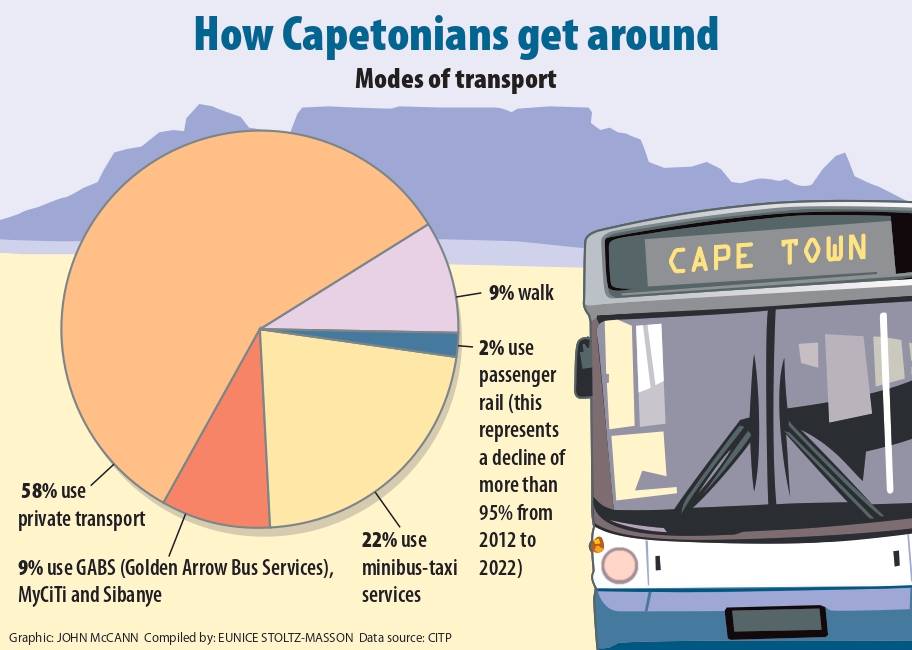 (John McCann/M&G)
Santaco’s provincial chairperson, Mandla Hermanus, said Cata is concerned the second phase of MyCiTi excludes the role amaphelas perform in the integrated transport network.
In response to Cata’s concern, the city pointed out that it does not recognise amaphelas as a minibus taxi type service “and, as such, is not part of MyCiTi”, said Hermanus. “This, in our view, will result in conflict between the Kiki-Murray and the other taxi associations.”
Another uncertainty that accompanies the expansion of MyCiTi is the 12-year contracts offered to taxi operators and employees affected when the first phase of MyCiTi was implemented.
The MyCiTi bus service’s operational budget varies between R500 million and R600 million annually. Part of the budget is allocated to the four vehicle operating companies that are contracted by the city to run MyCiTi services for a period of 12 years. Three of these companies are owned by shareholders from the taxi industry, said Quintas.
Taxi operators who handed in their operating licences in exchange for a 12-year contract are concerned about what will happen when the contract expires.
“Anyone can then apply and win the tender to provide a bus service,” Hermanus said. “So there is no guarantee that those who handed in their operating licences will still be operating MyCiTi after 12 years. This is the biggest challenge.”
Golden Arrow is the fourth beneficiary of the metro’s 12-year contract and also holds a contract with the provincial transport department, which was delegated to it by the national department of transport. This contract is subsidised by a national grant valued at slightly more than R1.1 billion for the current financial year.
Cape Town recorded a surge in population growth over the past 15 years, which the city says has strained the metro’s budget and workforce for maintaining infrastructure.
In addition, Quintas said the city’s road networks are under excessive pressure as a result of the collapse of commuter rail services.
“Given the implosion of passenger rail, the city has seen a huge increase in the number of people now making use of road-based transport … not only in terms of maintenance needs but also congestion and pressure on the city to provide more and bigger public transport interchanges to accommodate buses and minibus taxis.”
In the wake of the recent taxi strike, Cape Town mayor Geordin Hill-Lewis has redoubled his calls for the devolution of passenger rail to the metro. Earlier this week he issued an ultimatum, giving President Cyril Ramaphosa until month end to set up a joint working committee on rail devolution, failing which the city would declare an intergovernmental dispute.
Ramaphosa’s office countered that it would not respond to “threats”.
Quintas said until the rail crisis is resolved, all modes of public transport should operate in support of each other to save commuters time and cost.
“There is a role and place for both the MyCiTi bus service, and Golden Arrow, as well as the minibus taxi industry,” he said.