Former Joburg mayor Mpho Phalatse. (Photo by Gallo Images/Luba Lesolle)
An unstable coalition arrangement, endemic corruption and criminal syndicates are part of the toxic mix that has created the rot in the Johannesburg inner city, resulting in the fire which saw 77 people die in Marshalltown last week.
The Mail & Guardian spoke to former Johannesburg mayors to uncover the political challenges that, ultimately, led to the disaster.
Former mayors Mpho Phalatse and Herman Mashaba’s accounts of their time as city political heads have revealed some of the challenges they faced during their terms.
Phalatse — elected the Democratic Alliance (DA) mayor last year — painted a bleak picture of the conditions in the city.
She said as far back as 2019, while she was the member of the mayoral committee for health, the council had been forced to close down a clinic in the inner city as a result of the state of the building it was housed in. The clinic was part of a programme aimed at getting healthcare centres in high-demand areas to operate around the clock. But after an environmental health ruling found the building unsafe, it was condemned and the clinic became a thing of the past.
A significant part of the problem, according to Phalatse, was the Johannesburg Property Company (JPC), the custodian of the city’s properties, which is charged with administering and maintaining hundreds of millions of rands worth of real estate. Part of the JPC’s mandate is to rent out municipal property for social housing purposes, while maintaining the properties and collecting rent on behalf of the city.
“It was dysfunctional — there was mismanagement, corruption and a lack of accountability,” Phalatse said.
“We didn’t know how many buildings the city owns, what state those buildings are in, what sort of revenue we were deriving from those properties — and if it’s what we ought to be deriving.
“We had a firm belief that we should be deriving a lot more revenue from its properties. We had a firm belief that there was corruption.
“We had whistleblowers exposing corruption. These whistleblowers were reporting it to the crime-busting Group Forensics and Investigation Services” she said.
In 2016, shortly after Mashaba took office as mayor, also with the DA, he appointed former Directorate for Priority Crime Investigation (the Hawks) head General Shadrack Sibiya to the Group Forensics and Investigation Services.
Sibiya would operate independently, with a mandate to uncover corruption within the city, and was expected to report to the chair of the group audit committee, an external forum to the city.
“We went as far as to suspend the chief executive but our decisions were overturned each time we were ousted,” said Phalatse, who was twice removed as mayor.
“Each time, we would do a clean-up and move people [but] as soon as we got ousted, the ANC and its partners would undo all of that. Even the suspension of the CEO was undone. The board that facilitated the suspension was replaced.
“That is the major problem when you have an entity that is supposed to be managing your property portfolio and they are not doing their job, they are not accounting to you.
“That is why we are where we are today — because the JPC was supposed to close off those buildings to avoid further invasions of the property and work around what’s next,” Phalaste added.
According to Mashaba, who is now leader of ActionSA, by the time he resigned as DA mayor in 2019, the City of Johannesburg had awarded 154 of the hijacked buildings to the private sector to start its revitalisation and rehabilitation programme.
Of those buildings, 30% were earmarked for housing for low-earners, who were paying R1 000 to R1 500 for a room in the buildings.
Under the programme, these buildings were expected to yield a return of R32 billion, creating 22 000 permanent jobs during and after construction and providing 14 000 housing opportunities.
During his three-year term, Mashaba’s crime-busting unit under Sibiya uncovered 600 hijacked buildings and 44 of them were returned to their owners.
“The hijacking of buildings started after hardly 10 years of democracy. By the time I came in, it had already reached unprecedented levels,” Mashaba said. “These syndicates took away properties by force. What is sad about it is that the reason why I could not get help from the criminal justice system was because some of the senior politicians were working with these hijacking kingpins.”
After Mashaba resigned, the problems persisted.
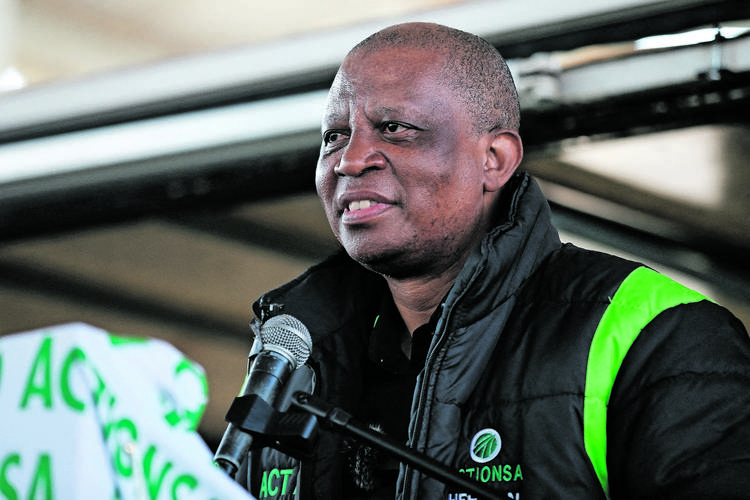 Former Joburg mayor Herman Mashaba. (Photo by Phill Magakoe / AFP)
Crime and corruption
According to Sibiya, some of the hijacked properties became hiding places for criminals. He said he identified the problem during his time as Hawks provincial head in Gauteng and created a unit within his office to deal with it.
“When I left, no one further entertained that. I had to start it again when I went to the city of Johannesburg. It was a big team and we handed many buildings to their respective owners.”
Sibiya’s time in the city’s crime-busting unit came to an abrupt end when he faced political interference. Then acting municipal manager Floyd Brink revoked his investigating powers, arguing that he did not have authority to investigate section 56 employees.
“If you want to tell me a unit does not have the right and mandate to investigate [Brink] because he is a Section 56 [appointee], it’s a cause for concern. That is why you see corruption is so rife in these municipalities,” Sibiya told the M&G.
Section 56 of the Municipal Systems Amendment Act governs the appointment of municipal officials.
The removal of Sibiya and the subsequent process to strip away the GFIS’s independence to investigate are part of the problem in Johannesburg, Phalatse said.
Unstable coalition
Trying to lead an unstable coalition in the metro resulted in Phalatse being removed as mayor twice.
When Sibiya resigned after a bitter battle with the city, Phalatse appointed his deputy, Lizzie Ramogale, as GFIS head.
“We appointed his right-hand person; they had institutional knowledge and the capacity to ensure that nothing falls through the cracks. When we were ousted in September [last year], they replaced that person immediately,” she said.
In October, the Johannesburg high court ruled that Phalatse’s ousting was unlawful and she was reinstated.
“When we came back, we brought them back and then when we were ousted again, they replaced them again and they went out to suspend them on frivolous cases,” Phalatse said this week.
“There were cases of corruption the unit was on top of within the JPC. You ask yourself, where are those cases now?”
Sibiya said the intelligence-gathering equipment acquired by the unit was used in its investigation of hijacked buildings.
“We realised that, if we were doing everything manually, it would be difficult for us to comprehend the facts of the problem to who is involved, who is connected with who and who is working with who,” Sibiya said.
“We needed to have all these buildings in a database. We needed to know which ones belong to the city and which ones belong to private people and whose owners are deceased. At that time, we had over 1 500 hijacked properties.
“We were sitting with a problem where the owners would say, ‘My property has been hijacked and these people are not paying rent, electricity and I’m the owner. When I come they are assaulting me.’ We had to come in because the city was losing now.”
Mashaba said while JPC was part of the problem, corruption was rampant all over the city.
“It was really a free-for-all,” he said.
The metro’s electricity and water utilities, City Power and Johannesburg Water and the finance department were part of the problem contributing to the property challenges, with more than 2 000 properties not paying for services.
“The issue is much deeper than looking at one entity,” Mashaba said.
Illegal immigrants
Both former mayors said the majority of those living in hijacked buildings were undocumented foreigners. This created a further problem as the city could not process them without assistance from the department of home affairs.
“The role of home affairs is crucial. It’s a fact that 80%, sometimes 90% of the people occupying hijacked buildings will be foreign nationals, many of them undocumented. It gets complicated for the city because our mandate is limited,” Phalatse said.
“Having a structured partnership with home affairs, where they can plan their raids together, bringing the right resources on board is important. That partnership must be revised and ongoing.”
“My request to the minister [Aaron Motsoaledi] was that immigration in Johannesburg is not adequately capacitated to deal with the raids we need to conduct in the inner city. The minister came to the party,” Phalatse said.
The biggest challenge in reclaiming hijacked properties has been the provision of temporary housing for people who have been evicted.
“If you take over 500 buildings in the inner city, for example, where do you get the temporary emergency accommodation (TEA) to accommodate people? That’s why that partnership with home affairs was important.”
“It would have significantly reduced that demand for TEA’s because not everybody would qualify and those who didn’t qualify, home affairs would process them accordingly. We would deal with people who qualified and the numbers would be less and we could move a little bit quicker.”
In a submission to the Johannesburg high court last year, the city revealed it had 11 temporary emergency accommodation units, all of which were full, and it required an additional 1 500 beds to accommodate those who were already in need.
Former ANC mayor Parks Tau and Amos Masondo, Johannesburg’s longest-serving mayor, from 2000 to 2011, were not immediately available for comment but said they would speak to the M&G next week.