Durban beaches are clear of high levels of E coli pollution and open for swimming as the city braces for a bumper festive season. (Photo by Frédéric Soltan/Corbis via Getty Images)
Durban beaches are clear of high levels of E coli pollution and open for swimming as the city braces for a bumper festive season, said eThekwini mayor Mxolisi Kaunda.
But tourism businesses have warned that the season’s success depends largely on the whims of the weather and whether the El Niño climate pattern, expected to peak in late 2023, will keep away the threat of heavy rain from washing high levels of pollution in rivers into the city’s beach waters.
The faulty wastewater treatment works also present a threat.
Kaunda, speaking at the Durban beachfront, said the city is “open for business”, its beach waters are safe and swimming pools open and that it has procured an additional 62 metro police vehicles that will patrol the city to keep tourists and locals safe during the holidays.
“This is yet another opportunity for us as a city to demonstrate that Durban is ready to welcome visitors for an exciting and memorable festive season … We have pulled out all the stops to ensure our residents and visitors have a wonderful stay in eThekwini,” Kaunda said.
He said the city forecast that it would receive an estimated 950 000 visitors during the season, achieving hotel occupancy of 62%, up from 57% last year.
“We want to assure our visitors that when they come to Durban they will find the city clean, our warm beaches and swimming pools open. Currently the city has 23 bathing beaches and 34 swimming pools that are open and safe for swimming.”
He said the city had recently conducted joint water quality sampling with the nonprofit environmental organisation Adopt A River, which had tested its samples at the independent laboratory Talbot.
“We are pleased that the water quality results are comparable and reflected that our water was safe for swimming. The joint sampling is to enable the credible comparison of results and to ensure transparency and public safety,” Kaunda said.
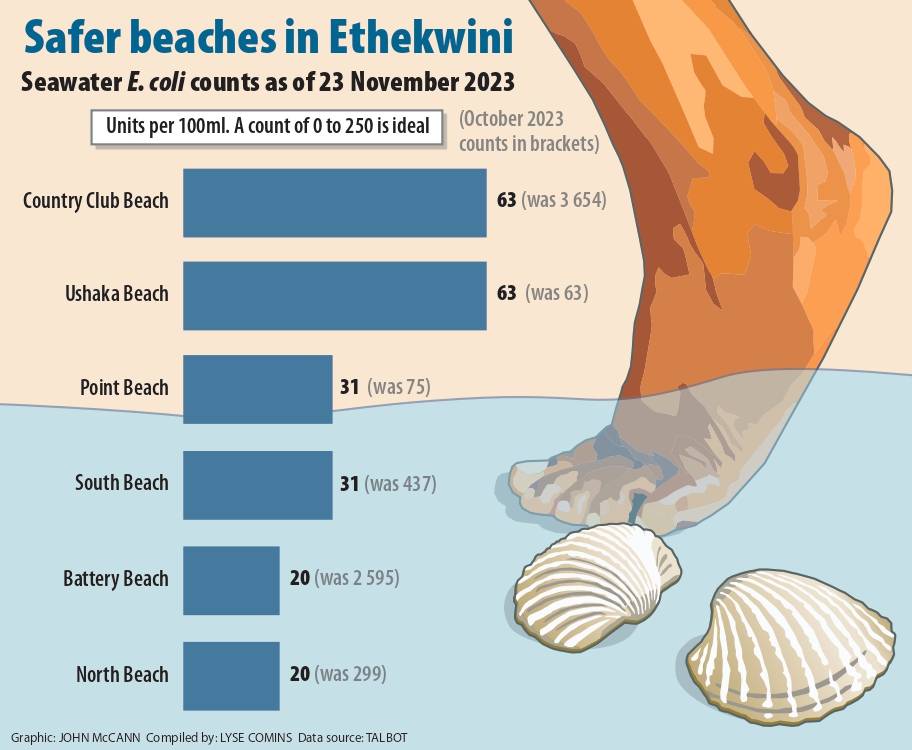
According to the latest water quality tests conducted at the city’s beaches on 23 November, and released on 28 November on Talbot’s website, all of the water tested at Point Beach, uShaka Beach, South Beach, North Beach, Battery Beach and Country Club Beach fell between the ideal safety range of between 0–250ml E coli count per 100ml. The range of bacteria levels recorded was between 10ml/100ml to 63 ml/100ml with the latter recorded only at
uShaka and Country Club beaches. (See graphic.)
But water quality samples taken in the uMngeni River, into which dysfunctional wastewater treatment works discharge treated water, told a vastly different story.
Water samples taken at Northern Wastewater Treatment Works ranged between 517 200 and 648 800 E coli/100ml; those taken at Kingfisher Canoe Club were between >2 419 600 and 5 794 000 E coli/100ml, while Riverside’s samples reflected between 155 310 and 249 160 E coli/100ml.
Adopt A River founder Janet Simpkins said beach water quality had returned to within acceptable levels but the quality of river water had been poor since before the April 2022 floods, when the organisation began testing. She said the legal maximum E coli count in water treatment works water discharge is 1 000 E coli/per 100ml.
Heavy rains would exacerbate water quality because sewers are connected illegally to stormwater drains, Simpkins said, while load-shedding also affected the functioning of treatment works because most did not have generators.
“Our work has been over time to look at trends as to where it is safer generally, and we have picked up two problematic beaches, which are Country Club and Battery Beach. We are aware of the problems and that when we have quite heavy rains there is a greater inflow and we pick up a spike [in E. coli levels] — but the sea does cleanse itself.
“What we know for a fact and certainty is the river is still contaminated and it speaks to a greater problem — that our sewage infrastructure is not fixed,” Simpkins said.
Kaunda said the city’s water and sanitation technical teams are monitoring all coastal wastewater treatment pump station plants to ensure optimal operations.
“Working with Umgeni-uThukela Water, we are accelerating the operation and maintenance of 10 of our wastewater treatment plants that handle over 90% of the total wastewater generated by the eThekwini metro,” he said.
 (Graphic: John McCann/M&G)
Brett Tungay, Federated Hospitality Association of South Africa’s East Coast chairperson, said it was still too early to know the final occupancy figures for the upcoming season and whether trade would be exceptional, but bookings for hotels and resorts across Durban and the rest of KwaZulu-Natal were promising.
“At this stage bookings are looking good for December, but there is quite a bit of variance between different establishments. It’s too early to call if it is going to be a better than average season but most places are looking full from 20 December to 3 January. All the traditional tourist areas — the North Coast, South Coast and the Berg are all looking good.”
But, Tungay said, the success of Durban’s holiday season would depend on the rainfall over the period given the city’s failing wastewater treatment infrastructure.
Business had been hearing promises from eThekwini municipality “every three months for the last two years” that it is accelerating maintenance of its infrastructure but the problem had not been resolved, Tungay said.
“Unfortunately it is going to be dependent on the rainfall over the season. At the moment there is very little E coli being pushed into the sea from the rivers because there hasn’t been heavy rain.
“We are supposed to be experiencing El Niño so it should be a drier season this year and if it stays like that we might have a good season as far as the beaches go.
“It is a farce and a tragedy that we are relying on the whims of nature. We are just hoping the weather will play along and that we will have a good season,” he said.
Economic Development Tourism and Environmental Affairs MEC Siboniso Duma said the province was anticipating 69% occupancy during December and some 845 000 visitors, including 52 000 international tourists.
“The expected contribution to our provincial economy will be around R3.6 billion,” he said.
Asked why the province’s tourism arrival estimates differed from those of eThekwini metro, a spokesperson for Tourism KZN said its figures are estimates that may be based on different methods of calculating targets for the festive season and that the municipality may have factored in local residents enjoying tourism offerings.