Faeza Meyer, African Water Commons Collective founder, collecting fresh water for her family from a pipe left out at a neighbour’s plot in Silvertown near Malmesbury. (Photo: David Harrison)
Faeza Meyer’s home in Silvertown, in the Western Cape’s Swartland municipality, is isolated, with no proper roads and few shops and houses in the near vicinity. There is one water pipe close by and there is no electricity.
Meyer recently moved to the small house she shares with 18 of her family members and friends, but these conditions leave her less worried than her previous home in Mitchells Plain, on the Cape Flats, where water bills are a source of fear.
“We will live in the dry, dehydrated conditions, because we can’t afford the water,” she says, sitting on a couch in the house.
For almost 10 years, Meyer has worked with other women activists across the Western Cape to end the City of Cape Town’s water policy that restricts water to predominantly poor and marginalised people.
A founder of the African Water Commons Collective (AWCC), Meyer began resisting the metro’s policies after seeing her neighbours in Beacon Valley, Mitchells Plain, struggle to get enough water for their basic needs.
The imbalance in access to water in Cape Town is stark. A study published by scholars in the Nature journal in April 2023 found that the city’s most vulnerable people use less than 30% of its water, but face pressure from the municipality to save the resource.
“What is most striking from these results is the total amount of water consumed by the elite and upper-middle-income groups. Despite representing only 1.4% and 12.3% of the total population respectively, [these] groups together use more than half (51%) of the water consumed by the entire city,” the study found.
“Informal dwellers and lower-income households together constitute 61.5% of Cape Town’s population but consume a mere 27.3% of the city’s water.”
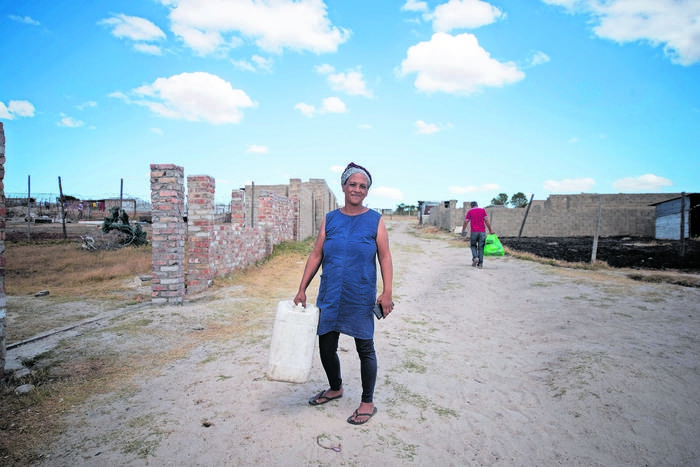 Faeza Meyer, African Water Commons Collective founder, collecting fresh water for her family from a pipe left out at a neighbour’s plot in Silvertown near Malmesbury. (Photo: David Harrison)
These results suggest that the struggle for water in Cape Town — as in other parts of the world — is closely connected to struggles for land and housing. The AWCC emerged from a branch of the Housing Assembly, a grassroots housing rights movement in Beacon Valley. This was after residents in townships began experiencing disruptions in their water supply after the city council installed meters to monitor usage.
Critics say local government officials are penalising the poor to reduce water consumption, when research shows that they are not the biggest water users.
City of Cape Town spokesperson Luthando Tyhalibongo confirmed that water restrictions in poor areas were aimed at addressing the scarcity of the resource in the metro.
“South Africa and Cape Town is a water-scarce region and with unpredictable climate change, it is important that the city ensures that all users of services use water wisely,” Tyhalibongo said. “As part of achieving this objective, the city has a process to ensure all indigent beneficiaries limit their consumption and to manage excessive usage of service.”
The city refers to the meters as water management devices or WMDs, but activists have nicknamed them “weapons of mass destruction” for their harmful effect on residents who have become fearful of using the water they need.
When the city began installing the meters, it failed to properly inform people of the accompanying price tag: a R4 000 installation fee that would immediately put affected households in arrears. Added to this, poor water infrastructure means that pipes frequently leak, and people are charged for using more than the 200-litre free basic supply they are allowed during the day. The costs have driven people away from using water in their homes.
“You could smell from the driveway that people had a WMD. People would wash their washing today and rinse their washing tomorrow,” says Meyer. “One house with 17 people would only flush their toilet once for the day. The children don’t wash before they go to school.”
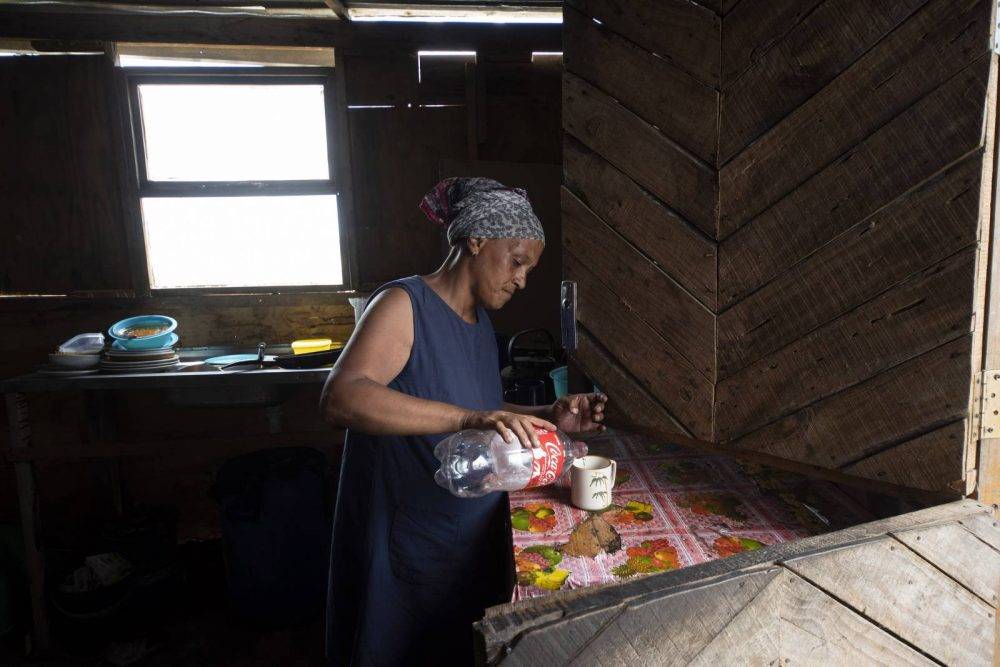 In deep water: Faeza Meyer may have to collect fresh water for her family from a pipe left out at her neighbour’s plot in Silvertown, near Malmesbury, but the water problems in Mitchells Plain, where she used to live, was more difficult to manage. Photo: David Harrison
Activists became aware that the government was rolling out the devices in about 2007. By late 2010, the city had installed 45 000 devices, which restricted people to using 200 litres of free water a day, with an extra 150 litres available for a fee. At the time, activists argued that this limit could not meet the needs of households in townships, which are bigger than those in suburban areas.
The AWCC’s research in many areas shows that 200 litres is not enough for residents. In many cases, one household could comprise multiple backyard dwellings, which means there are multiple families living in what the city counts as one household.
The World Health Organisation recommends that 100 litres of water per person a day can cover basic needs and the city’s estimates vastly undercounts the needs of impoverished residents where households are often larger than five people.
The device has another use: it can monitor which households exceed the free basic limit, and are therefore in arrears with the city. If these charges are not paid, the city can deduct payments from prepaid electricity meters, reducing the amount of electricity residents can buy, activists say.
The city confirmed that this is part of its “debt management” protocol, which is in line with its credit control and debt collection policy.
The debt owed to the city means residents can’t get the social grants they desperately need.
The city said it can provide assistance to affected residents on “a case-by-case” basis to address their debt.
When she lived in Mitchells Plain, Meyer witnessed her neighbours turn off their geysers and use alternative energy to save costs, but there is no alternative source for water.
“Electricity has alternatives. You can use candles, you can use gas. For water, there is no alternative,” she says.
The cost of basic services is one of the key problems the AWCC is fighting. Its members say municipalities around the country — and the world — are privatising resources that belong to the public.
AWCC member Koni Benson, a historian at the University of the Western Cape, says that privatising water has falsely led poor people to believe they are at fault for not having money for basic needs, when the reality is that politicians have failed them.
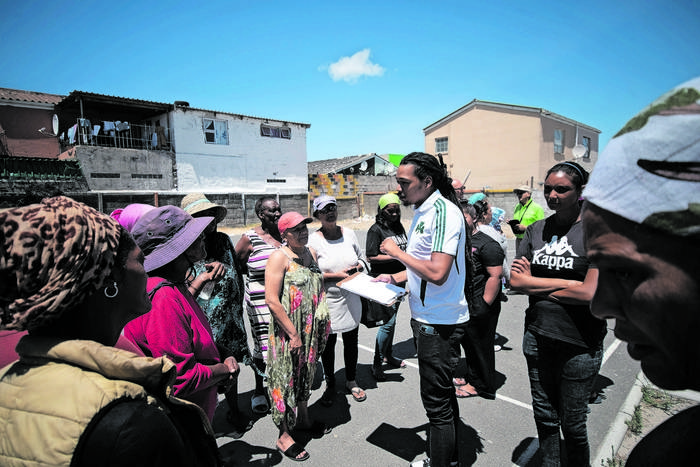 Beacon Valley community activist Joseph Jacobs (white shirt) talks to a group of fed-up residents who are tired of struggling to access water. (Photo: David Harrison)
“Water inequality is an issue of structural inequality,” Benson says. “In the drought leading up to Day Zero, people were being asked to use 25 litres of water per day and we are saying that there are people who’ve been living with Day Zero for the past 300 years and that water actually needs to be redistributed.”
Although water remains costly, the work of the AWCC has become increasingly effective. In Beacon Valley, Bishop Lavis and parts of Khayelitsha, residents began chasing plumbers and city officials away from their areas to prevent the installation of the water devices.
In the Witzenberg municipality, about 135km from Cape Town, the government received R25 million to install water monitoring devices. But the Witzenberg Justice Coalition, a movement associated with the AWCC, challenged this and only seven were installed. Members have since persuaded the municipality to remove five of the devices and are demanding that the remaining two be taken away.
The AWCC has grown to include 18 members and 15 water action committees with residents in communities.
They are now fighting a new measure that the city is implementing.
During 2021, the Covid-19 pandemic caused turmoil. The need to practise safe sanitation became urgent, particularly in densely populated areas on the Cape Flats. It was in this heightened environment that the city announced new water technology to replace what it referred to as “expiring” WMDs.
Initially, the news was met with optimism. The city said the new device would allow residents 500 litres of water per household a day, a significant increase on the old technology. But activists soon began noticing that the device had the potential to be more punitive than WMDs.
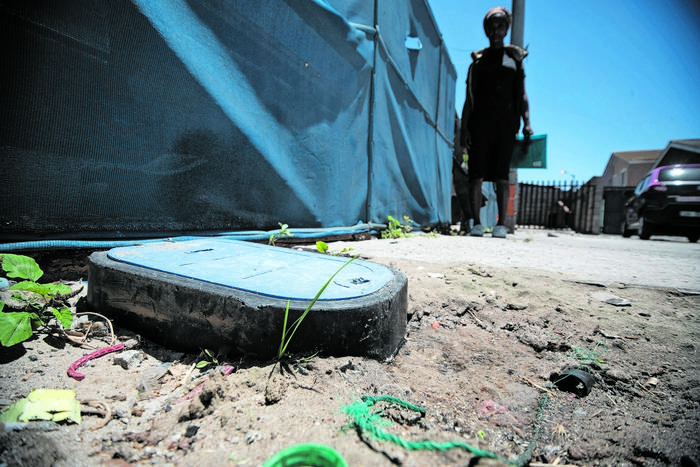 Leaking: A City of Cape Town Water Management Device (Weapon of Mass Destruction) installed in the Beacon Valley community of Mitchells Plain. (Photo: David Harrison)
According to city regulations, if a household uses more than 500 litres of water a day for three months, then a coin-shaped utensil is inserted in the meter to reduce the flow of water from a tap to a drip. Residents are forced by the city to live on the drip system for one year before it can be removed.
While the WMDs allow access to only 350 litres of water a day, the latest meter allows a free flow of water, which means people are unable to monitor their use and limit it to 500 litres.
In addition, residents fear that the new rules give the city manager power to put them on a prepaid water system if they fail to adhere to the 500-litre water limit for two years.
“The working class will die. People don’t have food on the table. They will not be able to afford it,” Meyer says.
Researchers from the University of Cape Town (UCT) and AWCC activists noted that although the city lauded the drip system as an improvement, it had been implemented before the WMD and had resulted in a protest campaign called “ditch the disc’”. The protests, organised by residents and members of the South African Municipal Workers Union, led government officials to withdraw the drip system.
The biggest flaw of the drip system, researchers say, is its failure to address systemic issues such as ageing infrastructure and the city’s housing backlog, which affects vulnerable people more than any other population group in the Cape.
“No one, especially the poor, can survive with water trickling out of a tap. Proposing yet another technological fix for a problem of poor infrastructure and historic inequality is racist, inhumane and disingenuous,” researchers and activists said in a joint article summarising their response to the City of Cape Town’s announcement.
In 2019, the national department of water and sanitation reported that 5.3 million households and 21 million people did not have access to potable water, despite money spent to upgrade infrastructure. It also said that more than 30% of the country’s water was lost in leaky pipes, almost 50% of wastewater treatment plants were in a dire state, and 11% were dysfunctional. These results are summarised in a 2022 research paper by Suraya Scheba, a researcher in UCT’s environmental and geographical sciences department.
“The existing infrastructural network of dams, pipelines and reticulations (valued at R1.3 trillion) is falling into disrepair and collapse,” Scheba wrote.
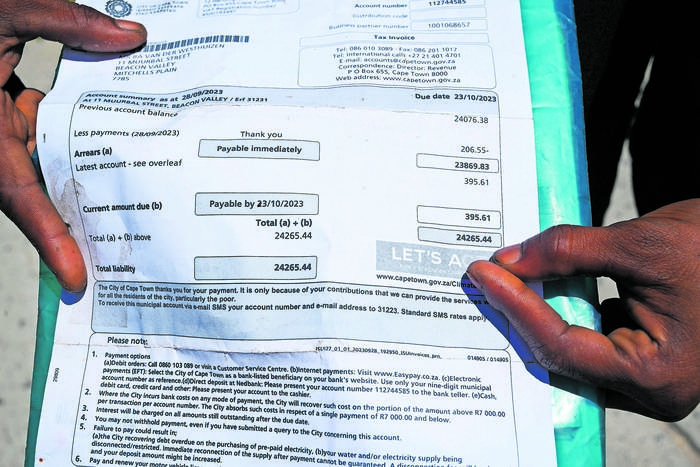 A City of Cape Town water bill for over R24,000 sent to a Beacon Valley pensioner held up by his daughter. A water management device (WMD) installed at the property has been leaking since late 2023 pushing up the amount due to the city. Photo: David Harrison)
Meyer says women in particular feel the effect of the water restrictions and the failure to fix poor infrastructure. Girls have avoided going to school when they are unable to wash, particularly during menstruation, and mothers have been concerned about the sanitation and health of their children with both a dwindling supply of water and their fear of using the water they are meant to get for free. Reports of children with diarrhoea have become anecdotally more common, causing increased fear for health and safety.
The contrast with wealthier areas is stark. Activists say people living in the Western Cape’s impoverished areas have seemingly been forced to pay a high cost for water, while those who use water the most face no restrictions.
Activists and researchers have referred to the city’s water restriction policy on the poor as “water apartheid”.
It is a theme that the AWCC recognises across the continent where people are paying the price for water scarcity even though Africans have not been a major contributor to the global climate crisis.
“We are not naive, we know climate change is real. But what we also know and can see with our naked eye is the inequality of how water is being distributed,” Meyer says.
“SA Breweries has been based on water springs for over 100 years. There’s a golf course that uses thousands of litres of water for a rich man to play a game and down the street there’s an informal settlement where hundreds of people use a few taps.”
The AWCC wrote a letter to the city outlining its demands for an end to the unfair distribution of water and high costs. During a protest on 7 December last year, the AWCC handed a letter over to the municipality.
On 18 January, the mayoral committee member for water and sanitation Zahid Badroodien replied, saying the city “is mandated by the legislation and council approved policies and bylaws to collect all monies due to the municipality”.
Meyer says the city’s failure to provide equitable water services is entrenching a legacy of apartheid that hurts the poor most.
“This is what the apartheid government did. They said you are all not white, and you deserve that and we deserve this. It feels very apartheid what’s going on here. They need to think about that,” she says.