About 5 000 farmers supply fresh produce to the Joburg market. (Delwyn Verasamy/M&G)
It was 7:45am on a warm Tuesday morning at the Johannesburg Fresh Produce Market in City Deep.
With the sun sweltering against their backs, Mubarak Lolo and his working partner were fixing a punctured tyre. Their bakkie was packed with boxes of bananas, tomatoes, onions, pineapples, apples and other fruits and vegetables.
“We are usually out from here by 6am or 7am, but today this car is delaying us,” Lolo said while his eyes searched around for plan B.
The two were heading to the West Rand to deliver their produce to shop owners. But Lolo said his customers were beginning to complain about how much they had to pay for the produce.
He has been coming to the market for many years and has noted the increases in prices.
 About 5 000 farmers supply fresh produce to the Joburg market. (Delwyn Verasamy/M&G)
“It’s expensive. Every day it’s going up or going down and we don’t even know why. One day tomatoes is R120. Next day it’s R200.”
He said a box of bananas was about R150 three weeks ago, and this week it had increased to R220.
That’s an exorbitant price hike for the outsider, but there’s an intricate economy within the market itself that is being explored.
The Competition Commission launched an inquiry into 21 fresh produce markets in South Africa in March 2023. It is prioritising the Johannesburg, Tshwane, Cape Town and Durban markets because of their high volumes and turnover, the Joburg market being the largest of the three.
The Fresh Produce Market Inquiry (FPMI) will examine the efficiency of the markets given their role in food safety, food security and market access for small players, said the commission’s spokesperson, Siyabulela Makunga.
“One of the prompting facts for the initiation of the FPMI was notable price increases in fresh produce, notably above inflationary levels,” he said.
“A key consideration for the FPMI is to understand what the driving factors are for price increases [and decreases]. Part of this consideration is whether these increases are ascribable to normal market forces [such as supply and demand] or whether market distortions are responsible for such increases.”
The Johannesburg market serves about 5 000 farmers who send their fresh produce to be traded to a large buyer base, averaging about 10 000 daily, which includes transporting to Southern African Development Community regions, according to the market website.
The Joburg market is divided into ten large sales halls, but the main trade takes place in three food hubs: the fruit hub, the potato and onion hub and the vegetable hub.
Buyers and agents rush into the market on Heidelberg Road no later than 4am. Cars, vans, bakkies with and without trailers, trucks and taxis enter the market grounds through the two boom gates at the entrance.
Vegetables are already piled up in boxes, crates and trolleys. Mini forklifts are fighting for space — their constant beeping and red lights signalling for customers to move out of the way. Behind them, hydraulic trolleys transport more boxes of vegetables across the concrete floors. Trailers with wooden palettes are loaded with vegetables, snaking between the forklifts and trolleys, leaving little space to walk.
The Joburg Market’s senior manager for marketing and communications, Hope Mabaso, said the market welcomes the commission’s inquiry because it will provide clarity on business practices.
He said often informal traders, retailers and farmers misunderstood how the market works, particularly when it comes to establishing prices.
The transactions run on the basic principles of economics: supply and demand. The prices can change daily, and they largely depend on the availability of stock, weather conditions and projected yields from farmers.
“There is a principle called price discovery which uses demand and supply. So, farmers enter into agreements with agents. And the rates they set are between them. As a market, we are not party to those rates.”
He said when buyers can negotiate prices with agents, and if they buy in bigger packs, then the unit price is reduced.
Johan Meyer, who sits in the potatoes and onions hall, has been a market agent for 16 years, and he sells on behalf of farmers.
With his expertise in potatoes, he can confidently say, “A potato is not [just] a potato and they all have different tastes and textures.”
He said no one entity sets the prices in the market and they can fluctuate daily.
“Last year, potatoes were scarce, so they were more expensive. But this year the price has gone 50% down,” he said.
Bags of potatoes were stacked up behind him, and to his side were small wooden crates on a shelf, resembling one at a conventional shop, with potato samples to show the size and average price.
“I have been doing it for years and years, so I know more or less what’s the demand for the day,” he said, adding that that the demand also depends on the previous day or week.
“You can’t fix prices in the market,” he said.
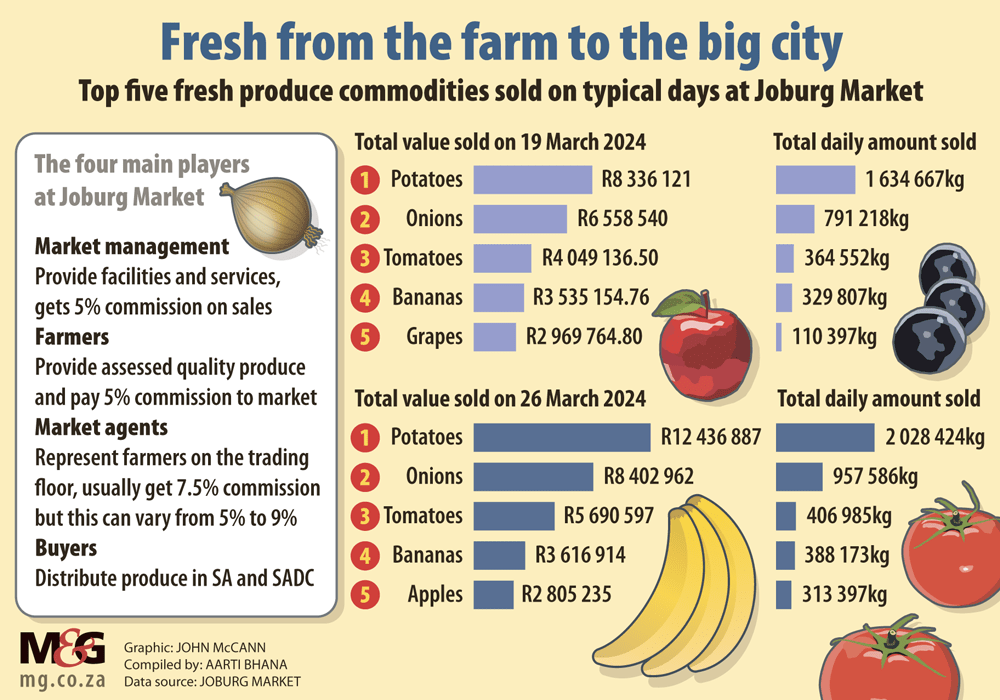 (Graphic : John McCann/M&G)
The players in the value chain are market management, farmers, market agents and buyers and their earnings are based on commissions.
Makunga said the FPMI is considering the position of vendors [farmers who supply produce to the markets] and buyers [including informal traders] as part of its work, with a particular focus on small to medium enterprises and historically disadvantaged farmers.
Notably, the unsold stock will either be sold at a cheaper price or sent back to the farmer, if inspectors and farmers permit.
Produce is delivered from 2am to 4am every day. It comes from farms all over the country — from Cape Town to Free State, Limpopo and Gauteng.
Transporting produce is another factor driving up prices.
“Fuel is pushing the prices up the most. It’s the most important thing for farmers,” said another agent, who has been working at the market for decades and who asked not to be named.
He said that in addition to fuel prices and packaging costs, there are fewer farmers, which affects production. As the buying population increases, food supply shortens, which could also be a factor in price increases.
“[When I started working at the market in the 1970s a bag of onions was 25 cents. Five years ago it was R50 to R80 and in 2023 and 2024, it’s around R100.”
He said decreases in sales could also be attributed to unemployment and the rising cost of living.
The FPMI was prompted by the findings from the Concentration Study, which showed that large farms make up just 6.5% of all farms in South Africa, but that they accounted for 67% of total income in 2017-18. Furthermore, it noted that farming units — a section of a piece of farming land — had decreased. In 1993, there were just fewer than 58 000 farming units and just more than 40 000 in 2017, representing a decrease of 31%.
Additionally, the study showed a 65% drop in the number of potato farmers from 1993 to 2008 and a gradual decline since then to 532 farmers in 2017.

 Trade: About 10 000 buyers purchase fruit and vegetables from the Johannesburg Fresh Produce Market in City Deep for reselling.
Photos: Delwyn Verasamy/M&G
The FPMI’s aim is to find remedial actions for any adverse effects on competition in the market. It plans to publish its provisional report in May 2024 and to finalise and publish the final report on 1 October 2024, Makunga said.
The FPMI is honing in on selected fruits and vegetables that represent the fresh produce value chain — apples, citrus, bananas, pears, table grapes, potatoes, onions, carrots, cabbage, tomatoes and spinach.
These fruits and vegetables account for at least 70% of fresh produce production and sales throughout South Africa, the FPMI said in a statement.
The market’s website contains a daily price list, which changes at noon daily, when things start to quieten down.
Just before heading off in a bakkie packed with boxes of vegetables, Gerard, who owns an informal business in the suburb of Brixton, said he noticed price increases at the end of the month, but sometimes the prices would retreat.
While loading bags of potatoes in the remaining space in his bakkie, he said potatoes will sometimes be R80 to R90 a bag, but then change to R50 the following week. A porter who was passing the bags of potatoes to him said there was no balance in the market. “One day potatoes will be cheap, but then onions and tomatoes are expensive.”
Gerard said customers complain because they don’t understand the price increases, adding that the cost of living is becoming “very high”.
Meyer pointed out that although low prices make it easier for buyers, it also creates an unfair marketplace outside the market itself.
He said when prices are too low, there is an oversupply of produce, which the agents then struggle to sell. In addition to this, formal shop owners have to compete with informal traders with few to no overhead expenses.
But, said Meyer, markets remain a central space where buyers have a variety of choices and where they can evaluate quality and produce properly.
“The market is extremely important for the economy. The nation has to eat and we don’t have enough small farmers to provide.
“A lot of people will be going hungry if they take the market away.”