Nonhle Mbuthuma successfully took on Shell in landmark court victory to stop seismic testing on the Wild Coast
In 2021 Nonhle Mbuthuma heard from tourists visiting the Wild Coast that Shell planned to launch seismic surveys to prospect for oil and gas reserves below the seabed in the ecologically sensitive region.
Many sleepless nights would follow for Mbuthuma, the co-founder and spokesperson for the Amadiba Crisis Committee.
On Monday, Mbuthuma and co-winner Sinegugu Zukulu, the programme manager for Sustaining the Wild Coast, were announced as the African recipients of the 2024 Goldman Environmental Prize for the fight they mounted against Shell. Otherwise known as the “Green Nobel”, the prize is the world’s foremost award for grassroots environmental activists.
Zukulu and Mbuthuma are Mpondo from the Amadiba administrative area of Mpondoland. “This it’s a big thing and I was not expecting it,” Mbuthuma said. “Being an environmentalist you’re always feeling it’s the kind of work that’s never being recognised so this recognition is incredible.”
She and Zukulu join the ranks of five previous South African grassroots environmental activists honoured with the Goldman award, including Liziwe McDaid and Makoma Lekalakala in 2018, Desmond D’Sa (2014), Jonathan Deal (2013) and Bobby Peek (1998).
In September 2022, the pair stopped destructive seismic testing for oil and gas by Shell off the Wild Coast, which is rich in marine biodiversity.
The high court in Makhanda found that Shell’s consultations with select leaders were inadequate and should have included the entire affected coastal communities. It further ruled that, when granting approval to Shell, the government had failed to consider the potential harm to local fishers’ livelihoods, the effect on Mpondo cultural and spiritual rights, and the contribution of gas and oil exploitation to climate change.
“Organising their community, Nonhle and Sinegugu secured their victory by asserting the rights of the local community to protect their marine environment,” the Goldman Environmental Foundation said.
“By halting oil and gas exploration in a particularly biodiverse area, they protected migratory whales, dolphins, and other wildlife from the harmful effects of seismic testing. Asserting the rights of the local community, they protected this incredible marine environment in a landmark case against a titan in the fossil fuel industry.”
The historic court decision was the “most important victory for indigenous communities everywhere”, Mbuthuma said.
“The destruction of the environment is happening all over the world, and especially where there are indigenous communities. Corporations always target where the indigenous communities live because they know that we don’t know our rights and cannot stand up and defend the environment.”
“But what we’ve done with the Wild Coast, we surprised many people when we stood up to say no to the seismic surveys in our ocean. For us the ocean is not just an ocean. The ocean for us is a home, a sacred place and now when you destroy the ocean, you destroy us. Nobody can sit and wait when you see somebody come and destroy your home.”
The thought of the Wild Coast ultimately being drilled for oil and gas was unimaginable. “We started mobilising communities in our villages along the Wild Coast … and also to connect with the other environmental organisations around South Africa because I knew that this was going to be the biggest battle.”
Crucially, this was about connecting with their ancestors, she said. “In our culture, our ancestors are residing in the ocean. We met with them at the ocean to tell them that the big battle that is coming we need them to support our struggle; we need to work with them.”
Mbuthuma said the mobilisation worked brilliantly, bringing together the coastal and the inland communities to no oil and gas on the Wild Coast.
She said “developers” rarely recognise spirituality and culture. “They speak about creating jobs for our communities and forget the important thing which is spirituality, because the role of culture and spirituality, to the environment it’s uncountable — it’s too big.”
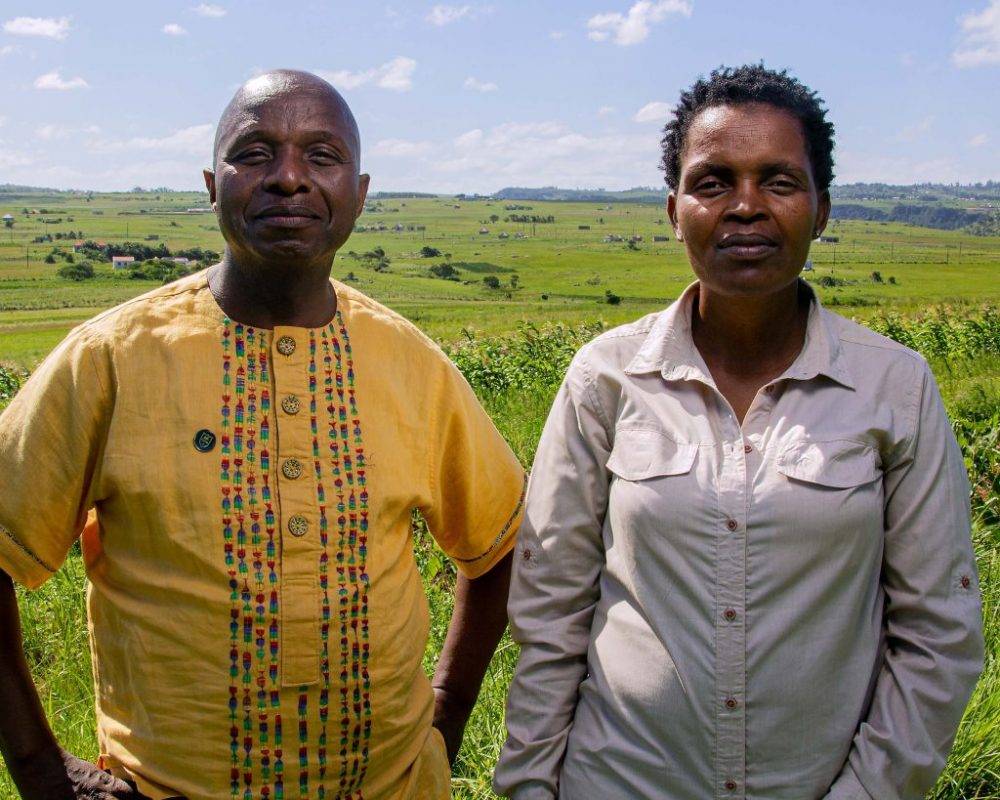 Nonhle Mbuthuma and Sinegugu Zukulu
Without culture and spirituality, nature is not safe because people understand the interconnection between human beings and nature, according to Mbuthuma. People who ignore culture and spirituality see nature as something that can be destroyed.
“In court, it was quite difficult for Shell to understand that we have a right to practise culture and our spiritualities, which are protected in the Constitution. They said that it is silly that with the high rate of unemployment in South Africa, there are people that are protecting the so-called culture.
“When we talk about our ancestors residing in the ocean, most developers are always saying we are defending ghosts because they don’t understand the role of culture and the role of spirituality to nature, which plays a big role in the protection and preservation of nature.”
Mbuthuma knows that she is dependent on nature to live long and so needs to stand up and defend the rights of nature, adding that she is also defending the next generation through championing the environment.
“My future relies on nature. But people don’t understand that. They think the future is dependent on creating jobs, but creating jobs that are not sustainable, you are cutting your life short. That’s why we keep fighting, no matter how difficult the fight is.
“I know that being an environmentalist you are accused of being, ‘you don’t care about people, you care about butterflies’. What we need is to have more environmentalists to save Mother Earth.”
Mbuthuma traces her love of nature to growing up on the Wild Coast. “My childhood, growing up where every species that is around you, you know what role it plays. It’s not something that you learn from school; it’s part of your life. It’s not just the species that are around — there is food, there are medicines, there is everything in nature. If there is life in nature, why can’t you stand up for it?”
She believes the government’s “obsession with fossil fuels is cutting our future short”.
“The economy of the Wild Coast is reliant on the ocean. But if you pollute the ocean, you bring poverty to the Wild Coast, which is something that is going to be irreversible. Everybody on the Wild Coast is dependent on the ocean for survival. Now, this is something that they just put as an alternative to our communities of the Wild Coast, that if we bring oil and gas to the ocean, we’ll create jobs.
“But they just forget that oil and gas or fossil fuels is a short-term development but the damage or the burden that will be left behind, these indigenous communities will be left with that burden. And it will be irreversible. You’re not only destroying the ocean, you’re destroying the lives of the people.”
Here, she cited Shell’s decades-long pollution of the Niger Delta. “Nobody can come to South Africa to say that we will manage the environmental effects on the ocean. Why is this going to be done perfectly or better here?” she said, noting that the Mpondoland marine protected area is a major sanctuary necessary for species’ survival and “deserves to be respected”.
Mbuthuma says the Wild Coast needs to stay wild “because the more it is wild, the more we do ecotourism, the more we protect nature. Not extractivism, not fossil fuels — those are short term and those are destruction.”
The five other global recipients of the 2024 awards went to Alok Shukla from India for the Asia region; Teresa Vicente of Spain for Europe; Murrawah Maroochy Johnson of Australia for Islands and Island Nations; Andrea Vidaurre of the United States for North America; and Marcel Gomes of Brazil for South and Central America.