Up in smoke: Concern is mounting over the thousands of tonnes of toxic dust, produced by emissions from steel firm Cisco in Kuils River, Cape Town, which are unaccounted for. (David Harrison)
About 8 800 tonnes of toxic electric arc furnace dust, produced by the Cisco steel mill in Kuils River, Cape Town, from August 2017 to October 2019, is unaccounted for and what dust remains, residents fear, has not been managed in compliance with environmental regulations.
According to industry standards, electric arc furnaces, used in the steel-milling process, produce a minimum of 15kg of dust as a waste by-product for every tonne of steel.
The atmospheric emissions licence granted to Cisco in 2019 by the City of Cape Town shows that the company specified an “actual production capacity” of about 5 000 tonnes a year — 10 000 tonnes over the two years of operation.
Before being released into the atmosphere, the dust should be filtered out of the emissions from the arc electric furnaces as it contains heavy metals that are toxic and hazardous to people and to the environment.
An analysis of satellite images by a former Kuils River resident, who prefers to be identified only as Liezel, produced a rough estimate of about 1 000 tonnes of dust.
At an informal site inspection initiated by concerned residents and attended by the Democratic Alliance’s spokesperson for environment, Dave Bryant, in March 2022, after the Turkish owners, Kamal, abandoned the steel mill, about 1 200 tonnes were estimated to be lying in the yard.
The dust had been stored in unsealed polypropylene bags, instead of “impervious containers”, as required by the metro’s Integrated Waste Management by-law of 2009. It also stipulates that the containers must be “intact and not corroded or in any other way rendered unfit for safe storage or transportation”.
But if the steel mill produced 10 000 tonnes, where is the rest of the dust?
There is no record of sale of any dust in the historical financial results included in the Industrial Development Corporation’s business rescue plan, after the previous shareholders absconded without repaying a R450 million loan to it.
An email from Thembelani Mandini, of the City of Cape Town, in March confirmed that the dust did not go to the only provincial government landfill site for hazardous waste disposal, at Vissershok.
“We checked our special waste disposal records and found no record of any disposal by DHT Holdings (Pty) Ltd t/a Cape Town Iron & Steel or lately Cisco,” Mandini wrote to Liezel.
She also confirmed that the company, now operating under new management as Kamal-Cisco, had not yet submitted a waste management plan, as required by the by-law.
An email from Alet van Staden, of the Western Cape department of environmental affairs and development planning, asks of Cisco’s safety health environment risk and quality systems coordinator, Jacqueline Jansen van Vuuren: “What happened with the waste generated by the previous company that was left on-site? They need to provide us with a response on the waste. What happened [to] it? Who removed it, Where has it been disposed [of]?”
In her email response, Van Vuuren says: “This waste was never disposed of, they could not pay anyone anymore to come and dispose of the waste. All this waste was taken to one central area in the back of our yard when we started to come back to the plant.
“We are now getting quotes from waste companies to come and dispose of this waste for us.”
Our investigation showed that the remaining dust was sold for export, to a company called Goldsea.
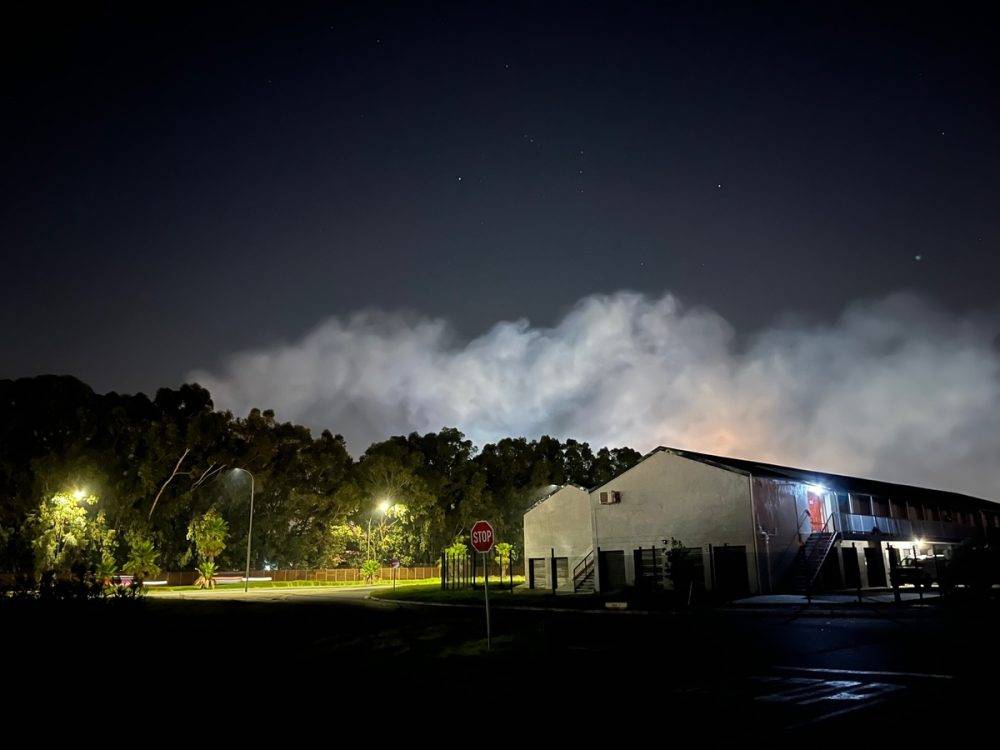 Up in smoke: Concern is mounting over the thousands of tonnes of toxic dust, produced by emissions from steel firm Cisco in Kuils River, Cape Town, which are unaccounted for.
Kimberly Torres, of Goldsea, confirmed in March last year that the company had purchased dust from Cisco, but refused to say how much because she was “not at liberty to disclose this information”.
“What I can say to you on record is that we followed a very stringent process with environmental affairs, so that we can take the material off site and literally export it,” she claimed.
Torres terminated the call with an undertaking to provide an email to address our queries, but did not do so, despite repeated requests.
In terms of section 5 of the Integrated Waste Management By-law, 2009, of the City of Cape Town, Cisco is obliged to keep records of any hazardous waste produced, which must include the classification, the quantity, the quantities re-used, recycled, recovered, treated or disposed of and by whom the waste was collected and managed.
Furthermore, in terms of section 5(6)(a), Cisco should not have handed over hazardous waste to Goldsea “unless it is accompanied by a declaration in which the content of the consignment is fully and accurately described”.
In addition, in terms of section 14A of the Regulations for Hazardous Chemical Agents (2021) of the Occupational Health and Safety Act, the company is obliged to prepare a safety data sheet for any hazardous chemical agent and to provide that data sheet to any interested or affected person.
Asked for comment, the executive chairperson of Goldsea, Eric Bapetel, also declined to confirm how much dust had been removed or to confirm that the dust had been transported and managed in compliance with the city’s by-laws.
He said his reluctance was “not a reflection of any illicit activities but a necessary precaution in today’s competitive business landscape”.
Kamal-Cisco also declined to provide the records requested in terms of the Promotion of Access to Information Act.
In July last year, a Kuils River resident spotted bags on the back of a flatbed truck, turning into the Silo Exchange storage facility in Bellville.
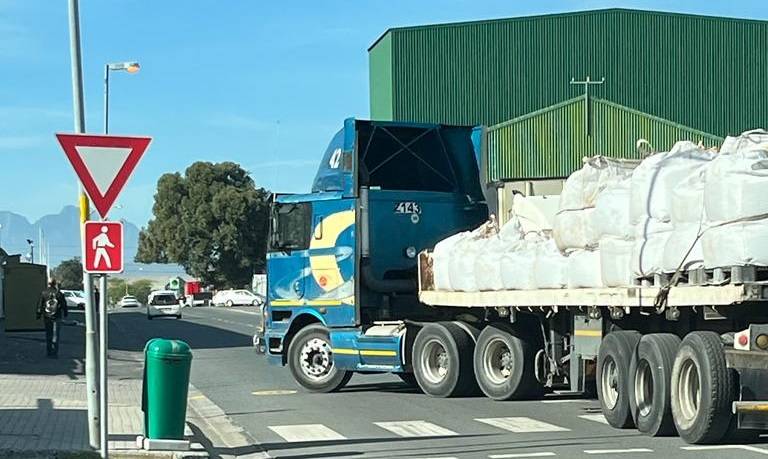 Trucked up: The hazardous environmental waste was apparently taken to the Silo Exchange storage facility in Bellville, Cape Town, for storage but a company representative said she had no documentation for it.
Further inquiries to Silo Exchange showed Torres’s claim to be false.
Manager Tanya Jacobs confirmed that Goldsea was a client of Silo Exchange, but when asked about the storage of electric arc furnace dust at the facility by Goldsea, she responded by asking: “Is that what it is?”
She confirmed that she had not received any documentation for the material being stored.
“The only information I have with the client is the lease agreement — that’s basically it. When it comes to the material itself, I don’t have any analysis of the material.”
And when asked if the electric arc furnace dust was being stored in compliance with environmental regulations, Jacobs said she was not aware of any regulations relating to the storage of the dust: “What regulations … I’m not certain what regulations you’re talking about.”
She undertook to get back to the Mail & Guardian, but neglected to do so, and also did not respond to email queries.
So, where is the missing dust?
None of the municipal, provincial or national environmental authorities could account for the toxic waste and pointed fingers at each other.
The City of Cape Town declined to make any comment on compliance with its Integrated Waste Management by-law, instead referring the query to the provincial environment department and the national department of fisheries, forestry and the environment.
Media liaison officer Liezel Steenkamp said the issue was “complicated” but that the city would respond “insofar as it relates to the city’s mandate and responsibilities in this space”.
Steenkamp went on to claim that both the provincial and national departments had “issued directives and compliance notices to Kamal-Cisco in relation to the storage and management of the [electric arc furnace] dust waste” and would “need to respond to their findings and follow-up actions on this matter”.
But the Western Cape environmental department denied having issued any directive or compliance notice.
“The Directorate: Environmental Law Enforcement has to this date only played a supportive role to the competent authority (City of Cape Town Air Quality Management) and does not have an active investigation into any allegations at the Cisco site, therefore none were issued from [the department],” senior communications officer Alet Steenekamp said.
The national environment department also could not account for the toxic dust, but confirmed that a site inspection had been conducted on 17 January and that Kamal-Cisco was in “substantial compliance” with a compliance notice, relating “primarily to the storage of the waste in an environmentally sound manner”.
Acting chief director for communication and advocacy Peter Mbelengwa said “an additional variation of the timeframe was issued to Cisco to allow them to fully reach compliance with the storage requirements by 28 April”.
But he declined to account for the missing toxic dust or to comment on the transportation of it.
“The [department of fisheries, forestry and the environment] cannot provide comment in relation to the transportation of the waste as such was not included as a requirement in the compliance notice.”
When asked whether “the Kuils River community was being poisoned through a failure of the city to ensure the company operated in compliance with the AEL [atmospheric emissions licence]” the city declined to respond.
But then, in a further follow-up, the city said that Cisco had “provided the city with records to show that it produced 1 671 tonnes of [electric arc furnace] dust, from August 2018 to July 2019” and that “certificates of safe disposal demonstrated that 1 023 tonnes were sold to a third party, for metal recovery purposes”.
This accounts for about 17% of the “actual production capacity” specified in the atmospheric emissions licence, over two years of operation.
The statement went on to explain that “compliance with the Integrated Waste Management by-law would be regulated through Integrated Waste Management plans required in terms of the by-law” but also confirmed that no waste management plan had been submitted by Cisco.
The city said it had been “focusing more on education and awareness than issuing fines” and businesses had been “supported in becoming compliant”.
A safety data sheet for electric arc furnace dust states “particulates or fumes generated from this product may be irritating to the eyes, skin and respiratory system and may cause fever, chills and muscular aches”.
“Excessive and repeated exposure to dust, through inhalation or ingestion, may cause dermatitis; asthma; pneumonitis; pneumonia; bronchitis; siderosis; diffuse pulmonary fibrosis; nasal perforation and nasal cavity damage; eye inflammation; central nervous system damage; kidney damage; liver damage; gout and lead poisoning,” it says.
Under the management of the previous owners, DHT Holdings Africa, in Kuils River, submitted no less than 450 complaints about noise, air and soil pollution — and medical ailments, which included headaches, asthma, sore throats, nose bleeds and sinus problems.
An industry expert, who asked to remain anonymous, confirmed that the figures provided in the atmospheric emissions licence application for the volume of gases released through the emission abatement system “did not add up” and suggested it was “hopelessly undersized”.
This would explain the fugitive emissions and would account for the medical problems experienced by residents, he said.
“Why does the swimming pool of Kuils River resident and chair of the Vredelust Ratepayers Association — Earl Polman — turn green every time the steel mill operates?” he speculated. “It’s the calcium in the dust … it causes an imbalance in the pH levels of the water, which stimulates the algae.”
Dust samples collected by residents at five locations around the steel mill from March 2018 to March 2019 — analysed by Biograde Laboratories in Pretoria — found elevated levels of a variety of heavy metals, including calcium, cadmium, cobalt, chromium, copper, iron, manganese, lead, vanadium and zinc.
A study conducted by the South African Medical Research Council in 2020 found elevated levels of heavy metals in soil samples collected from 34 pre-schools within 5km of the steel mill.
“This study provides evidence of exposure to heavy metals in a vulnerable group — pre-school children. Metal concentrations in soil samples were below the South African reference levels; at certain pre-schools, arsenic and zinc concentrations were found to exceed Canadian soil reference levels,” the report states.
“The accumulative carcinogenic risk exceeded the maximum acceptable level.
“To protect the affected communities, and children in particular, this study provides evidence of the need for action, including the institution of mandatory buffer zones between pollutant-generating activities and human settlements.”
The industry expert confirmed that any visible plume of smoke must contain dust particles.
“The average eye can only see particulate matter of 50 microns or more. Anything coming out of a stack should thus not be seen.
“If you can see dust, which is larger than PM50, then one can imagine how many more particles there are, which you cannot see.”
So, where is the dust?
All the available evidence suggests it was not captured — and went straight up into the atmosphere … and down over Kuils River.