Paul Mashatile said that the issues between ANC Gauteng chair Panyaza Lesufi and the DA's Helen Zille would be resolved at some point. (File photo)
Cyril Ramaphosa’s proposed government of national unity appears to have made it over the first hurdle and goes into Friday’s National Assembly session with an agreement on speaker, deputy speaker and president.
The ANC has secured the support of the Democratic Alliance (DA) , the Inkatha Freedom Party (IFP), Rise Mzansi and the Patriotic Alliance (PA) in these crucial votes, with the proposal still being discussed by its national executive committee at the time of writing on Thursday.
The parties have secured a broad agreement on how they will work together and were busy working out the details around what positions each would hold in a new administration ahead of Friday’s first sitting.
It is not clear at this point whether the DA will take up cabinet seats or whether it will rather take on roles in chairing parliamentary committees, supporting the ANC on key votes.
Either arrangement will give the ANC and its partners a substantial majority in the National Assembly, but how they will manage to take advantage of this with such divergent interests among the parties will be perhaps the greatest challenge facing Ramaphosa’s new government.
IFP president Velenkosini Hlabisa provided the first insight on the outcome of the two weeks of intense negotiations among the parties on Wednesday night, when he confirmed that they would participate in a government of national unity with the ANC and the DA. Hlabisa also confirmed that a deal had been secured with the two parties and the National Freedom Party (NFP) at provincial level.
Both the ANC and the DA had agreed to back IFP provincial chairperson Thami Ntuli as premier, but agreement with the NFP on this was still being sought.
“The IFP has agreed to form part of the government of national unity.
“We are working towards forming a government in the province of KwaZulu-Natal, having met with the ANC, DA and NFP in the province,” Hlabisa said. “This continues to be a work in progress.”
He said the IFP had been set to meet with the uMkhonto weSizwe (MK) party on Monday but its delegation was stood up by the latter, and left after waiting for four hours.
Hlabisa said he was “confident” that there was the political will on the part of the parties involved in the putative unity government to make it work.
“I have confidence that the parties who are part of this coalition want to take this country forward and not leave it at a standstill,” Hlabisa said.
He dismissed speculation that he would be included in Ramaphosa’s cabinet as a second deputy president, saying this was “either ill-informed or disinformation” as, constitutionally, no such position existed.
The late National Party leader FW de Klerk served as second deputy president in Nelson Mandela’s 1994 cabinet but the 1996 Constitution did away with that transitional arrangement.
Hlabisa said there was a “broad agreement” around Friday’s election of a speaker, deputy speaker and president, and that the details were a “work in progress” which would be finalised by the time the voting for the positions began.
“Other details, in terms of what offers are available, is work that is being attended to by our team but, broadly, the IFP is not that interested in positions.
“By Friday we would have finalised the issue of how we participate in this government of national unity,” he said.
“We are not opposed to it. We understand that we cannot leave the country at a crossroads. We need to take it forward.”
On Thursday, PA leader Gayton McKenzie confirmed on social media that his party would participate in the unity government and was eyeing either the home affairs or police portfolios in return for its support.
A national agreement appears to be on relatively solid ground — along with that in Gauteng, where the DA, PA and IFP votes will secure the ANC the numbers it needs for a collective government.
The ANC is facing internal pushback about the partnership with the DA, and pressure from its allies, but Ramaphosa appears to have the numbers in the national executive committee, which has endorsed reaching out to the centre-right party.
However, in KwaZulu-Natal, the IFP-led coalition faced a final hurdle before Friday’s vote.
MK party president Jacob Zuma made an attempt to win over the NFP and collapse its proposed ANC-IFP-DA coalition to create a hung legislature in the province.
On Wednesday, he met NFP president Ivan Barnes in Umhlanga — with pictures posted on social media ahead of the IFP’s briefing — and the NFP is understood to have discussed Zuma’s offer on Thursday morning.
One participant in the NFP meeting described the situation as “a madhouse”, and the NEF has since announced that it would work with the IFP/ANC/DA.
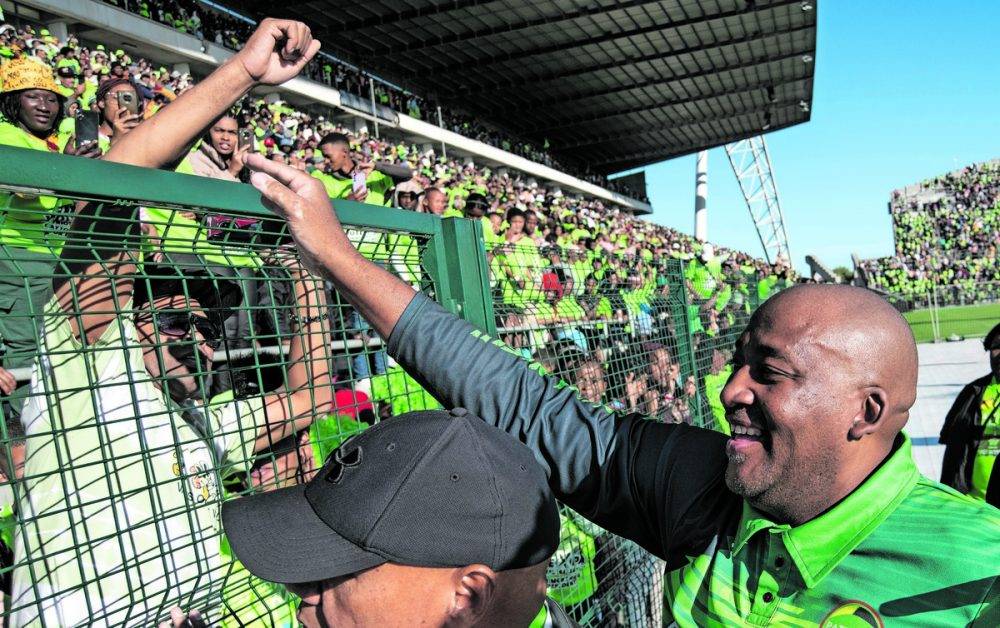 Jostling for position: Leader Gayton McKenzie at the Patriotic Alliance’s rally in Cape Town last month. (Brenton Geach/Gallo Images)
The IFP-led KwaZulu-Natal coalition also faces a possible rebellion by some of the ANC’s 14 MPs in the secret ballot on Friday — should the MK party’s MPs arrive for the sitting in Pietermaritzburg.
The MPs had indicated to the secretary of parliament that they would not attend the Cape Town national sitting but the KwaZulu-Natal legislature was proceeding on the assumption that they would in fact take up their seats.
The extent of the DA’s participation in the national and provincial coalition arrangement has been the subject of much agonising, played out in a series of meetings of its federal executive, which has in principle approved a “hybrid” model, where the party will take both cabinet positions and key positions in parliament.
Several senior DA MPs were opposed to an agreement to enter the executive, preferring a narrower arrangement whereby the party takes key positions in the legislature in return for supporting the government at critical junctures, including electing the president and passing the national budget.
Their argument is that this would allow the DA to retain its identity and to sharpen oversight over the executive.
In KwaZulu-Natal, DA premier candidate Chris Pappas has confirmed that he will resume his role as mayor of Umngeni municipality, but it is understood that the party’s MPLs will take cabinet positions in the province, subject to approval by its national leadership.
Nationally, the Economic Freedom Fighters (EFF) has been left out in the cold and will be stuck on the opposition benches for another five years.
It has also been dumped as a coalition partner at local government level by the ANC in Gauteng and KwaZulu-Natal.
On Wednesday night, Ekurhuleni mayor Nkosindiphile Xhakaza removed the EFF’s Nkululeko Dunga as MMC for finance, while in eThekwini the ANC recalled Mxolisi Kaunda as mayor.
ANC KwaZulu-Natal chairperson Bheki Mtolo said the move opened up space for “greater oversight” by other parties in the metro and that the ANC wanted the changes taking place at national and provincial level to be reflected in the city.
EFF sources believe its poor election performance had stripped it of political currency and that the ANC has been pressured to dump it as part of the political realignment taking place nationally and provincially.
“The dismal showing at the polls means we have nothing to give to the coalition. We have lost our kingmaker status nationally,” the EFF source said. “That means we have to beg for people to follow us but, as it stands, there haven’t been any follow-up meetings with the ANC.”
Dunga told the Mail & Guardian that the ANC was following a national mandate to remove the Red Berets from power.
“The ANC, DA and ActionSA have continued to express their concerns over the EFF getting executive positions and they have removed our party functions from finance.
“What is happening in Ekurhuleni is aligned with the ANC’s decision nationally of a prospect of a government of national unity which calls for the isolation of the EFF,” Dunga said.
Dunga said the party had decided to go it alone as the opposition parties had rejected them in a coalition government.
“The EFF will stand alone because the DA has declared us as the number one enemy which is bizarre because the ANC is the one that is governing,” Dunga said.
The implications of dumping the EFF are already being felt in the Johannesburg metro, where the party did not arrive for the vote on the budget, tabled by the ANC.
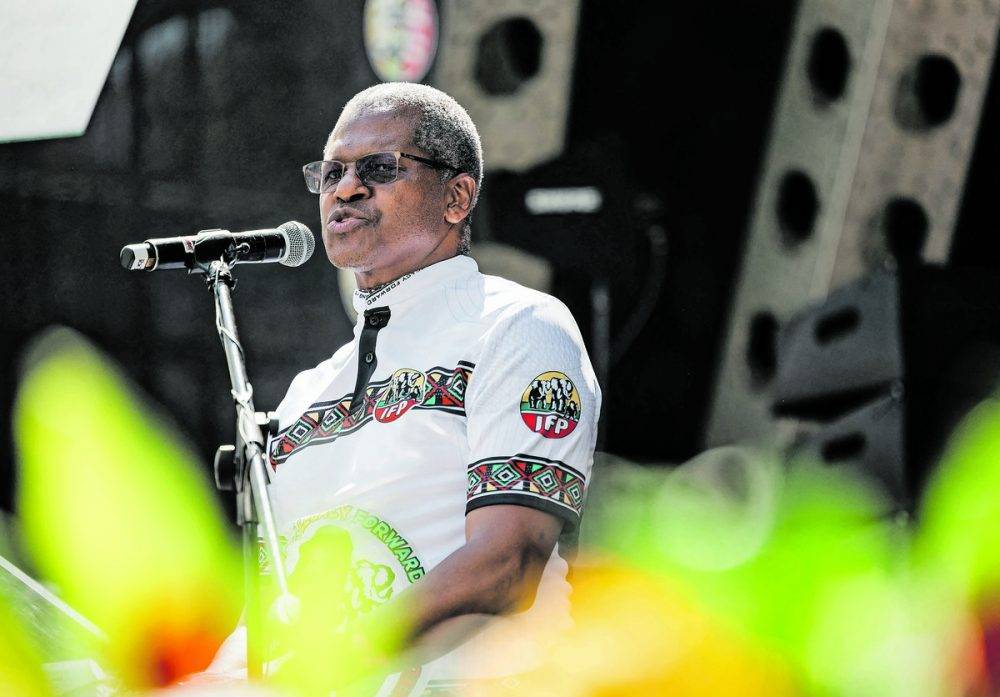 Inkatha Freedom Party leader Velenkosini Hlabisa attends the party’s election manifesto launch in Durban in March. (Rajesh Jantilal/AFP)
For the first time since the formation of the coalition government — involving the EFF, ANC, African Transformation Movement, the African Independent Congress and other small parties — that the Johannesburg metro had failed to pass a budget.
A source in the ANC in Johannesburg said the party expected it would end up working with the DA in the city going forward but this would be determined by the national and provincial leadership.
Parliamentary officials on Thursday said newly elected MPs were arriving ahead of Friday’s sitting and were being orientated.
There was no indication that the MK party was rethinking its boycott of the sitting after the constitutional court on Wednesday dismissed its bid to interdict parliament from convening, pending the hearing of its legal challenge to the outcome of the elections.
The party alleged the vote was rigged but gave no evidence in its founding papers. The court said there was no merit in the application.
The secretary of parliament, Xolile George, reiterated that, in terms of section 53 of the Constitution, the National Assembly was considered quorate and able to elect the president if a third of its members were present.
The MK Party had contended that a minimum of 350 members were needed to constitute the chamber, hence it could not elect the president without its 58 MPs.
George said any member not sworn in on Friday could take the oath at a later date.
“The door is not closed … So, as and when those members present themselves, they will be sworn in.”
George said the president would be sworn in in Pretoria on 19 June.
The budget for all processes involved in setting up the seventh parliament was R58 million. In 2019, the budget was R43 million.
The increase was due to the fact that parliament had to rent the Cape Town International Convention Centre because the National Assembly was gutted in an arson attack on 2 January 2022.