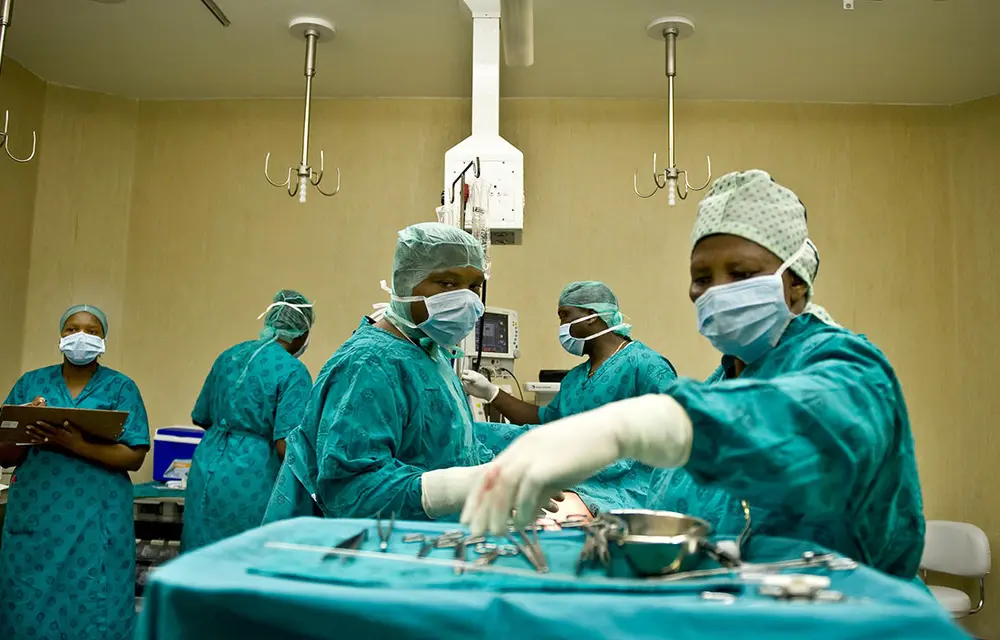
Clean: The Witpoort Recovery Centre in Brakpan was found by the forensic investigators to be ‘well managed’. (Delwyn Verasamy/M&G)
A forensic investigation has found that JSE-listed Life Healthcare Group irregularly channelled R112 million of taxpayers’ money meant for drug recovery patients in Gauteng into its bank account.
“Staggering” director fees of nearly R9.7 million for three people in one year and salaries of R24.9 million in the 2022-23 reporting period, which is more than R4.9 million “in excess” of claim forms submitted, are among the findings of the forensic inquiry commissioned by Gauteng’s social development department into its funding of nonprofit organisations (NPOs).
Despite the investigation recommending disciplinary action against four senior social development department officials for “gross dereliction of duty” and failing to secure state money, nothing has happened to the managers.
The inquiry was conducted in the first three months of 2024, and the four officials implicated are deputy director general Onkemetse Kabasia, Solly Ndweni, the chief director of NPO partnership and development research, Themba Msimanga, the director for partnerships and funding, and Phumla Nkosi, the regional director for Ekurhuleni.
Life Healthcare owns the Nkanyisa Recovery Centre, an NPO funded by the provincial department since 2016 under its substance abuse prevention and rehabilitation programme, according to records seen by the Mail & Guardian. Nkanyisa has two recovery clinics, one in Randfontein in the West Rand and another, the Witpoort centre in Brakpan in Ekurhuleni.
The Nkanyisa Recovery Centre was formerly known as Life Esidimeni, from where about 1 500 mental-health patients were removed by the Gauteng government in 2016 and taken to cheaper, unlicenced and under-resourced care centres, resulting in more than 140 deaths from a range of causes including starvation and gross neglect.
Life Esidimeni, which rebranded to Nkanyisa in September last year, was found to have a bank account “only used to receive grant funding and to transfer immediately to the Life Healthcare Group bank account”.
“It is irregular for a government subsidy meant for the NPOs to be channelled to a private company,” the investigators wrote.
According to the 2022-23 service level agreement Nkanyisa has with the department, the Randfontein centre received R62.4 million, while the Brakpan facility was granted nearly R49.9 million — bringing the total amount allocated to the NPO to more than R112.2 million.
But the department grants R16 000 per patient or bed occupied, meaning funding would be R8 million for Randfontein, which has 500 beds, and R5.4 million for Brakpan, with a capacity of 340, leaving about R98.9 million spare for Nkanyisa.
(John McCann/M&G)
It is that amount that the forensic report said was funnelled into the JSE-listed company. It said Life Healthcare Group denied access to its bank statements, but government subsidies were traced to its accounts.
“The NPO transfers all funds received from [the social development department] into a central bank account and all the expenditure transactions are processed from the central office,” reads the report.
These transactions included about R9.7 million paid to three Nkanyisa directors — chief executive Puseletso Jaure, group risk manager Zeenath Patel and head of insurance Prathna Sookoo.
“The board of directors have permanent jobs and their participation in the work of the NPO cannot by any imagination remunerate them such staggering amounts,” the report said.
Jaure, the Nkanyisa chief executive, acknowledged that Life Healthcare was aware of the investigation, saying the company understood it as part of a wider forensic audit into NPO funding ordered by the Gauteng premier’s office.
“We have fully cooperated with the independent auditor who the department appointed — we fully complied with that. Just to add that over the eight years of the [service level agreement], Nkanyisa Recovery Centre has been audited on an annual basis as well,” Jaure said.
“So, it’s not like there were no audits done, and we fully complied with all the auditing measures from an NPO governance perspective,” she said, adding that the auditor general’s office also looked into Nkanyisa as part of its audit of the department of social development.
Jaure said she could not comment adequately on the report’s findings that there was price inflation on the beds Nkanyisa has, versus the funding received, but that the facility, like “any other entity” had to pay for food, clothing, blankets, premises, human resources payroll services and legal fees, among other costs.
“Life Healthcare provides management services to Nkanyisa for the operations of the recovery centre with what we call an ‘arm’s length cost recovery basis’. So, while our emphasis is on patient-centred and compassionate care … we are basically using Life Healthcare’s management services to support the NPO,” said the chief executive.
“We [Life Healthcare] invested in the facilities for the purposes of the service. If we don’t use [the money] we return it to the department,” she said, adding that more than 4 800 patients had come through its clinics.
Jaure “categorically refuted” allegations that government money was channelled for director fees, saying the R9.6 million cited in the report “represented the salaries paid by the Life Healthcare Group and not by the NPO”.
“Nkanyisa is an NPO but has the backing and support of the management services from Life Healthcare. So, the directors are actually full-time employees of Life Healthcare [and] receive their regular salaries from their employer, the Life Healthcare Group, but they do not receive any additional compensation for their roles as directors of the NPO,” she said.
‘Harsh’: The Brakpan recovery centre is ‘fancy’ but not caring, according to two former patients. (Delwyn Verasamy
/M&G)
Nkanyisa was found to have breached its agreement to have a minimum occupancy rate of no less than 80% of all funded beds.
“Our examination of the number of actual beneficiaries against [targets] shows that the actual numbers are [less than] 80%. The actual beneficiary numbers fluctuate from month to month,” the investigation stated.
It added that Nkanyisa met its capacity target once in the period March to September 2022, with patients referred to the two centres by the department or other NPOs.
This week, the M&G spoke to five recovering drug addicts from Katlehong, who were referred to the Brakpan centre by the social development office in Thokoza.
All five Nkanyisa patients, who are battling nyaope addiction and asked to remain anonymous, said they stayed at the Brakpan facility for less than five days each between June 2022 and February last year, and that the treatment they received was “uncaring and harsh”.
Three of them said they have been able to maintain sobriety, but not thanks to Nkanyisa. Teboho* instead attributed his recovery to the help he received at the South African National Council on Alcoholism and Drug Dependence (Sanca) day clinic in Palm Ridge, Katlehong.
Teboho showed the M&G his graduation certificate after going through Sanca’s eight-week programme in May 2022, having ditched Nkanyisa’s Brakpan centre two months earlier.
“The biggest issue I had with Witpoort [the Brakpan facility] was that they wanted to bully me into buying the cigarettes they sold inside the home and not bring my own. I was buying a loose cigarette retailing for 50 cents here in Katlehong for R5 in Witpoort.
“Nyaope was my biggest addiction, not cigarettes,” Teboho said, adding that he was also not allowed to bring his own groceries and snacks.
“They have a tuck shop inside and you load credits — for example, R400 in your account — that you use to buy things like sugar because the sugar they add in the morning porridge is not nearly enough for me and my taste,” he added.
Teboho said the Sanca day clinic was “more humane” than the “fancy” Brakpan home, adding that he had learnt trade skills such as welding and carpentry which kept his mind active to help avoid relapse and which he could also use to earn an income.
Straight and narrow: Two former Nkanyisa patients
Another recovering addict, Jabu*, proudly showed the reading material he received from Sanca, calling it “my personal Bible” because it shares “motivational” tips to keep him from relapsing. One of the documents characterised addiction as a disease that “was not an easy task” to shake off, taking “time, patience and practice”.
“When a drug addict who has reached their goal of sobriety uses drugs, they have relapsed. This does not mean that they are a failure or that their stint in rehab did not work. It simply means that the symptoms of their disease have reappeared and adjustments need to be made to their treatment model,” it says.
Jabu, who completed his eight-week programme in December last year, said it was ironic that his recovery came thanks to a day clinic, which he thought would be harder because he was not locked away from the temptations of the township.
“I left Witpoort in June because of the harsh treatment I got from the workers and Teboho told me about the Palm Ridge Sanca. It is not as fancy as Witpoort, but I am grateful for the help I got there,” Jabu added.
Despite Sanca receiving good reviews, its workers seem to receive lower salaries than Nkanyisa employees. The investigative report said remuneration at other NPOs funded by the government paled in comparison to the Life Healthcare subsidiary.
“Social workers at NPOs are generally getting paid a net salary of R14 500. However, we found that, at Life Nkanyisa, a senior social worker gets paid a gross salary of R43 300 with a net salary of R29 197,” the report said.
“Social auxiliary workers are paid a gross salary [of] between R8 000 and R11 000 at other NPOs. However, at Life Nkanyisa they earn a gross salary of R30 196 with a net salary of R21 198.
“According to the financial information received, the labour costs equate to roughly 49.7% of total NPO costs, which is well over R6 million per quarter,” the report added.
It said the transactions were handled by a “cash management system used by the Life Healthcare Group”, concluding that the money to Nkanyisa was not grant funding because the NPO “issues invoices to the department” as a service provider appointed through a tender would do.
These views are supported by a 2023-24 document from the department of social development, which said that it funded “100%” of the NPO’s needs, including its rental leases and renovations costing more than R7.9 million that Nkanyisa did not use and is languishing in the listed parent company’s accounts.
“At this stage, the payment of R7 968 056.47 resembles fiscal dumping and is a direct contravention of the PFMA [Public Finance Management Act]. We still need to obtain and review [social development] internal documentation to determine how and who approved this payment.
“The department should request that the R7 968 056.47 paid to the NPO be returned,” the report recommended.
The centres were, however, found to be “well managed” and Nkanyisa had “reasonable systems and processes in place to effectively manage the affairs of the NPO”.
Straight and narrow: Two former Nkanyisa patients went from the Brakpan centre to a Sanca facility to deal with their addiction to nyaope. One of them, Teboho*, has been clean for two years and proudly shows his certificate and the documents he uses to remain so.
“We walked through the accommodation areas, laundry, kitchens, dry and wet stores, and found everything to be clean and hygienic, except at Randfontein where we noticed rising [damp] on the walls of several buildings.”
The clean facilities correlate with what Nkanyisa said on its website it prides itself on, stressing that it partnered “with the South African government to provide professional, quality and cost-effective healthcare services to the most vulnerable segment of South Africans”.
“These services are provided on contract [and] awarded through the treasury tender process.
“All tender prices are based on 100% service delivery, including accommodation [with] nutritious meals overseen by a dietician, clothing and linen, recreational and therapeutic activities, medication, a professionally trained multi-disciplinary team to provide individualised programmes, and healthcare services,” states the website.
The M&G sent detailed questions to social development spokesperson Motsamai Motlhaolwa, who acknowledged receipt and said he would respond. He had not done so at the time of going to print.
Social development provincial spokesperson Motsamai Motlhaolwa said: “The matter is under investigation, and as a department, we are not aware of any report on the matter.”
*Not their given names.