77 people died and when the building they lived in burnt down in Johannesburg.
One year after the disastrous fire that engulfed the Usindiso building in Marshalltown, Johannesburg, and killed 77 people, victims say the Gauteng government has played games with them by moving them from one shelter to another like “animals”.
“There is no life here,” 31-year-old Munira Rajab, who lived on the fourth floor of the Usindiso building, told the Mail & Guardian during a visit to the Denver shelter on the outskirts of Johannesburg’s city centre. It houses scores of homeless people including 12 who were affected by last year’s fire.
“We are far from the city centre so we can’t even get jobs easily, and there is no money for me and my child to survive. It has been one year but we are in the same situation that we were in after the fire.”
Rajab, who has a 16-month-old daughter, said she is the sole breadwinner after her husband — a Tanzanian — was deported after failing to produce his documentation to the Usindiso commission of inquiry into the fire. She says his documents were burnt in the inferno.
In May, a report by the Khampepe commission of inquiry into the cause of the fire found that many of the tenants were undocumented people from Tanzania, Malawi, Zimbabwe, Mozambique, Lesotho and Kenya. Following the inquiry, 32 people from other countries were arrested and placed in a repatriation centre.
The commission said it collected 340 written statements from victims.
Human rights groups, including ProBono.Org, took the matter to the Johannesburg high court and argued that the victims “were valuable witnesses” in the inquiry. In December 2023, the department of home affairs was interdicted from deporting the victims until the commission of inquiry had made its findings.
After the Usindiso fire, 248 people agreed to be moved to various shelters, according to court documents, although some refused to be relocated for fear of deportation.
A Malawian told the M&G this week that she had been asked to provide her immigration documents to the commission but could not do so because they were burnt in the fire. She said she had then run away from the scene.
“They were asking for my documents and I knew that they were going to provide me false hope that they won’t deport me but knowing the situation I had to get away,” the 32-year-old mother of two children said.
Some survivors of the fire are still detained at the Lindela Repatriation Centre in Krugersdorp, awaiting deportation.
A woman who lost her husband in the fire said she has not had any stability since the incident, and has not been able to bring her five children to live with her in a shack that is about 3m wide.
The Denver shelter, which is along a gravel road off Main Reef Road, consists of 220 zinc shacks, 15 communal toilets at the property’s entrance and power lines stretching into the air to provide electricity.
According to one of the victims, Johannesburg electricity utility City Power organised a raffle for some of the shelter’s inhabitants to be given jobs as labourers at the shelter.
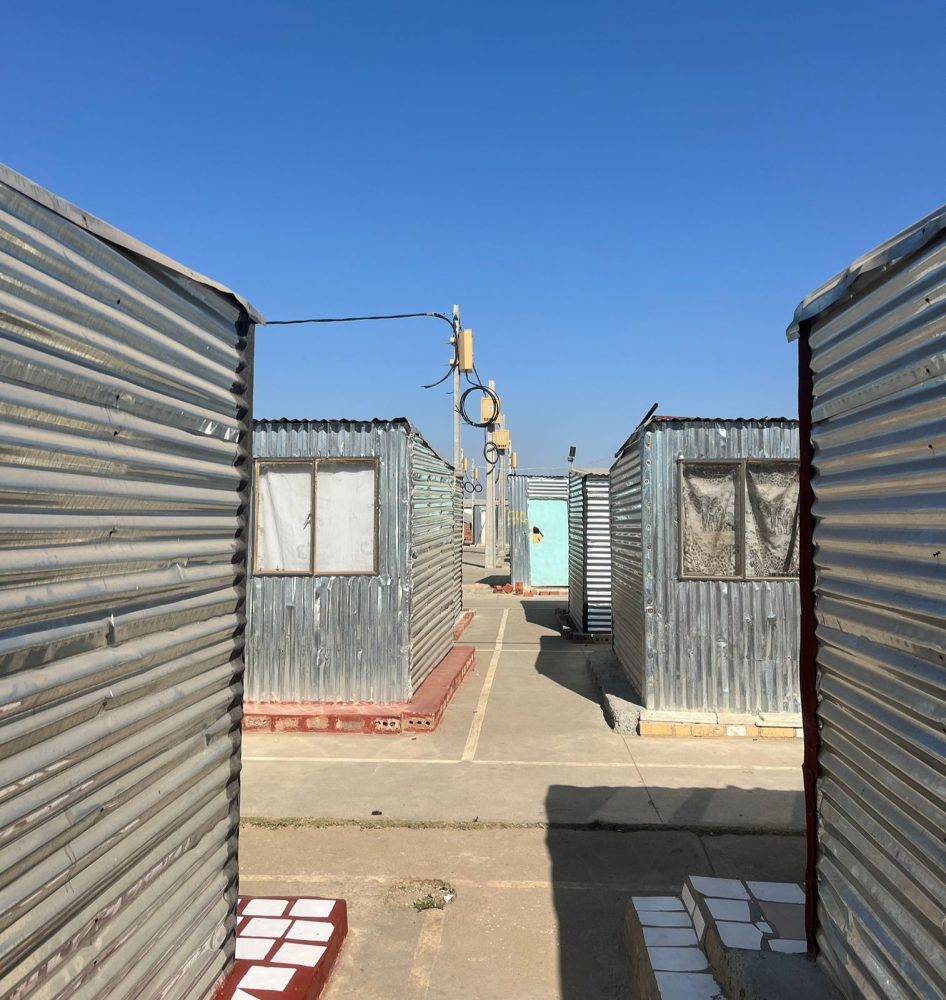 The inmates of the Denver shelter say they have not heard from city officials nine months after after moving in
“They put our name in a bowl and then pull out maybe 10 names and then if your name gets pulled out, you get a job — if you’re lucky,” said Thobika Biyela, 27, who was one of the casual labourers.
A person in City Power’s communication department confirmed that a raffle was organised for the shelter’s residents to get employment.
The victims said they had been initially promised that Denver was a temporary shelter, but it had now been nine months since officials had communicated with them.
“We have so many questions for them: is the electricity going to be temporary? What about the victims that are still living on the roads? What happens when the victims come back from hospital? Is the government going to take our accommodation away to house them? There are no answers on this,” said Biyela.
Usindiso was one of 188 “bad buildings” in Johannesburg that are under investigation by city authorities, former mayor Kabelo Gwamanda previously said. The Khampepe commission confirmed it had analysed buildings in the inner city that have been flagged as “hijacked”.
Johannesburg’s new mayor, Dada Morero, says reclaiming hijacked buildings is a “bigger” problem than initially thought.
The inmates of the Denver shelter are among more than 25 000 homeless people in Gauteng, according to the 2022 Census.
The provincial department of social development has identified eight shelters for the homeless in Johannesburg, including the Immaculata shelter in Rosebank, Frida Hartley in Yeoville, the Wembley Stadium shelter, the City of Johannesburg shelter for the homeless on Kotze Street and MES in Jeppestown.
Sister John, who manages the Immaculata Shelter, said there had been a spike in homeless people coming to the facility in recent years.
“Johannesburg is a city and that is causing the influx — people come for jobs and oftentimes they can’t afford the stay here so they are then left homeless while they look for security.”
She urged the government to develop abandoned buildings into decent shelter for the homeless.
““There was Usindiso and I’m sure there are many other abandoned buildings in Johannesburg. Why doesn’t the department of social development evaluate these buildings and put people to live in them? It’s that simple; they have the money and the ability to do that,” she said.
“Just one building; get an engineer involved even and see how it turns out so that we can get people off the street and into a space where they can think and find security to move on to the next step of their lives.”