Point of departure: President Cyril Ramaphosa signs the Basic Education Laws Amendment Bill (above). Basic Education Minister Siviwe Gwarube, from the DA, did not
attend the signing.
With tension gripping Tshwane, and the standoff in the national unity government due to basic education legislation continuing, the country’s biggest parties are in urgent need of a mechanism to settle their differences.
They agreed at a dinner meeting in Cape Town last month to establish a structure for this purpose. In terms of the agreement, setting it up would fall to a multiparty committee but,
three weeks later, that committee has yet to be established. President Cyril Ramaphosa’s office confirmed to the Mail & Guardian this week that its members had not yet been named.
The meeting at Tuynhuys was prompted by the Democratic Alliance’s (DA) public warning to Ramaphosa that signing the Basic Education Amendment Bill would place the future of the 100-day-old government of national unity (GNU) at risk.
Ramaphosa did sign the Bill, but suspended implementation of some parts of it for 90 days to allow the parties to find a way out of an impasse over provisions on language policy.
Basic Education Minister Siviwe Gwarube did not attend the signing, underscoring the DA’s resolve to fight the measure, in court, if need be. Party leader John Steenhuisen has since described taking the law on constitutional review as a last resort.
The standoff over this law, as well as the National Health Insurance, was foretold. These pre-existing differences informed the DA’s insistence from the outset, in the statement of intent to form a coalition, that decisions be reached by consensus.
DA federal chairperson Helen Zille’s handwriting was all over the makeshift agreement finalised an hour before the DA helped to secure Ramaphosa sufficient votes to be elected president by the National Assembly, including this clause.
Political analyst William Gumede said a mechanism to resolve policy disagreements, especially those that seem intractable, was vital to the survival of any coalition and, ideally, should be set up early and remain in place for the life of a power-sharing pact.
“It is absolutely critical to have a structure where senior party leaders can meet regularly, generally every two weeks, to discuss policy issues and resolve conflicts early.
“It provides a safety net and the absence of such a mechanism has been the reason why many coalitions at a local level have failed.”
In the case of the GNU, it was necessary to give content to the initial agreement to make decisions by consensus, given that this is not an established part of the political setup in a country that has long been dominated by the ANC.
“We are not in a political culture of consensus. Though they agreed to it, it is not a principle which the ANC fully understands,” Gumede said, adding after 30 years as the majority party it may well believe that, ultimately, its view would carry because it is the biggest party in the coalition.
“That is not what consensus means,” he said.
Nor did it mean endless discussion. “It means talking with criteria.”
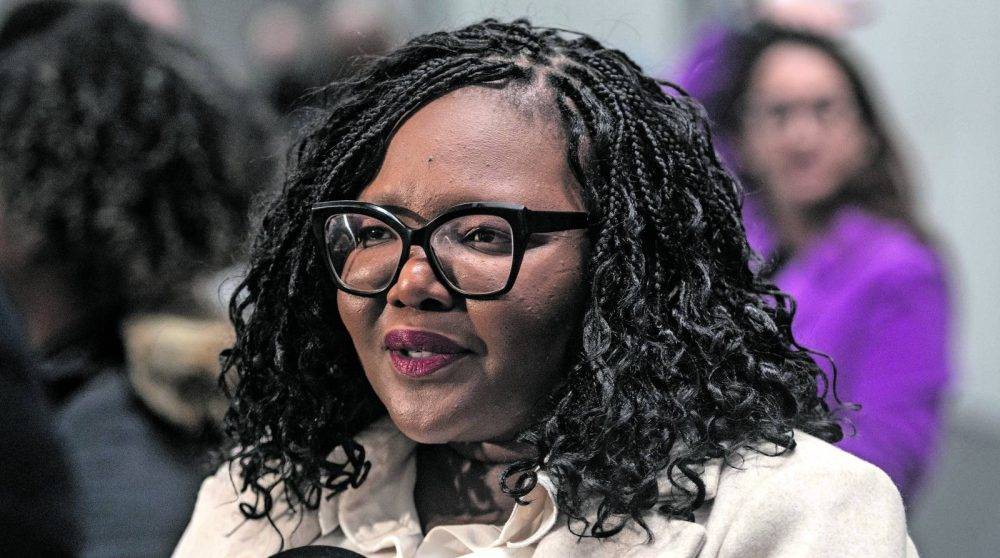 Basic Education Minister Siviwe Gwarube did not attend the signing of the Bela Bill. (Brenton Geach/Getty Images)
Gumede said while coalitions in smaller municipalities had failed because they lacked a way of resolving policy conflict, in the big metros such as Johannesburg and Tshwane, with their vast budgets, tension was rather about wrestling for control of patronage networks.
It meant that negotiations were driven not by policy considerations, as should be the case, but by the demand for positions and a winner-takes-all mentality.
Last week, Zille warned the ANC’s ousting of Cilliers Brink as mayor of Tshwane posed a threat to the stability of the national government.
Steenhuisen struck a more measured tone, suggesting what happened in Tshwane would affect cooperation in other provinces but did not pose an immediate and direct threat to the national coalition. It would not be “business as usual” in Nelson Mandela Bay or
Ekurhuleni, he warned. Beyond that, the fallout would harden the DA’s sentiment towards working with the ANC at any level.
But Steenhuisen added that the deep differences of opinion within the national unity government on legislation should not be cast as a dealbreaker.
His tone, and Ramaphosa’s concession in the shape of delaying implementation of the Bill, speak to an understanding between them that they must keep the coalition intact
for the same reason it was formed in the first place — the outcome of the May election left the two biggest parties with no other viable option.
Brink’s ousting last week is the latest move in the game of political chess between the parties in Gauteng metros that has long bedevilled Johannesburg, Ekurhuleni and Tshwane. In addition to the instability this has brought at city level, there are also concerns that the conflict could seep upwards and contaminate the fledgling GNU.
DA Gauteng leader Solly Msimanga told the M&G that he has called on the leadership of the party to reach out to the ANC at national level to find a way out of the crisis because there appeared to be little good faith at a local level. It might be a wise call.
Political analyst Lawson Naidoo suggested party leaders should be mindful of the signals the situation in Tshwane sends and the risk of it clouding the positive sentiment that has greeted the national coalition.
“The picture gets troubled when a situation like Tshwane arises.”
Msimanga said that while ANC provincial chair Panyaza Lesufi and provincial secretary TK Nciza claimed they were willing to consult the DA about a possible coalition, this was far from the reality.
“They are not willing to talk. I’ve written to them formally and requested that we meet and engage and talk about how we deal with the issues at provincial level, and possibly deal with what needs to happen to stabilise municipalities, but this has been snubbed,” he said.
Msimanga said he had asked the DA national leadership to speak to their counterparts in the ANC because this had proved to be easier than speaking directly to the party in Gauteng.
He was not aware whether the parties were looking to replicate their national working relationship at other levels.
“When we have had engagements with their national leaders, they have shown interest in talking to us beyond these few metros in Gauteng.
“They have spoken to us about the possibility of us working together in Nelson Mandela Bay and possibly working together in eThekwini,” he said.
However, he said, while these talks were being mooted, the ANC in Gauteng was damaging the relationship that was being built.
The DA formed a coalition with the Good Party in the Western Cape in August to remove the ANC from government in the Theewaterskloof municipality. This infuriated some ANC leaders in Gauteng, who felt their party was being mistreated by the DA in the province, without any consequence for the national unity government.
Last week, Zille wrote to ANC secretary general Fikile Mbalula and negotiator David Makhura demanding that Brink be returned to his position, warning that failure to do so could undermine talks on stabilising hung metros.
She accused Lesufi of pressuring the ANC national leadership to keep the DA out of power and said he had ignored its instructions.
The ANC in the province and nationally has not taken kindly to this, criticising the DA for trying to divide the party and behaving like “cry babies”.
On Monday, ANC deputy secretary general Nomvula Mokonyane told journalists at the ANC’s Luthuli House headquarters in Johannesburg that Zille’s assertions were “her own views”.
Gauteng secretary Nciza insisted the region was not out of step with the ANC nationally saying that, if it had defied Luthuli House in firing Brink, “we would be talking about
something else”.
Despite tension between the DA and ANC, the smaller parties in the GNU said they believed the coalition would make it to the end of its term.
Freedom Front Plus leader Pieter Groenewald said while the coalition had its challenges, the party was happy with the rewards that came
with it.
“Together we have been able to hit the ground running despite being doubtful about it in the beginning.
“We have been able to see a positive change in the country. Everyone is doing their part and will continue to until the end of the term,” he said.
Similarly, Patriotic Alliance leader Gayton McKenzie said he was confident that the unity government was strong enough to continue working, despite the discord.
United Democratic Movement leader Bantu Holomisa said while Ramaphosa had created an inclusive working environment for all the par- ties involved, the success of the GNU would depend not only on the structures put in place but also on the political maturity of the parties.
For Rise Mzansi leader Songezo Zibi it was too early to judge the GNU. But a clearer picture would emerge once it had adopted its budget for the 2025-26 financial year, and that budget and its associated programmes had been rolled out.