Firm: Democratic Alliance finance spokesperson Mark Burke said the DA will not bend on increasing VAT to make up a budget shortfall. Photo: DA/X
The deferred 2025 budget has evolved into an advanced exercise in political compromise after any VAT increase was probably rendered academic by continued resistance in the ruling coalition and the ANC itself.
The treasury was this week weighing alternative ways to raise revenue after a marathon cabinet meeting offered no way out of the impasse, only the trite brief that it does so in a way that supports growth, respects fiscal constraints and shields the poor and middle income groups.
In that meeting on Monday, the Democratic Alliance (DA) rejected a proposal to raise VAT by less than half the 2% Finance Minister Enoch Godongwana had been poised to announce on 19 February.
The notion that the ANC could get an increase of below one percent approved with the help of the Economic Freedom Fighters has been dismissed, notably by EFF leader Julius Malema.
The proposal of a smaller increase is seen in political and finance circles as an attempt by ANC leaders to deny the DA another chance to claim it had prevailed on behalf of the poor, as it trumpeted after Godongwana had to abandon his prepared budget. DA leaders believe the threat of breaching coalition lines is a bluff.
The party’s finance spokesperson, Mark Burke, said it did not bode well for a coalition the government held up to investors as a guarantee of stability. “It’s disappointing but not surprising that to avoid this reality, senior members of the ANC might make statements that are not good for the stability of the government or the country.”
He reiterated that the party would not yield on taxes, and said the treasury did not face a true revenue shortfall but rather the consequences of routine misspending. “We’ve been explicit that we’re against any VAT, income and company tax increases. We don’t have a revenue problem, we have a growth problem and a problem with inefficient spending.”
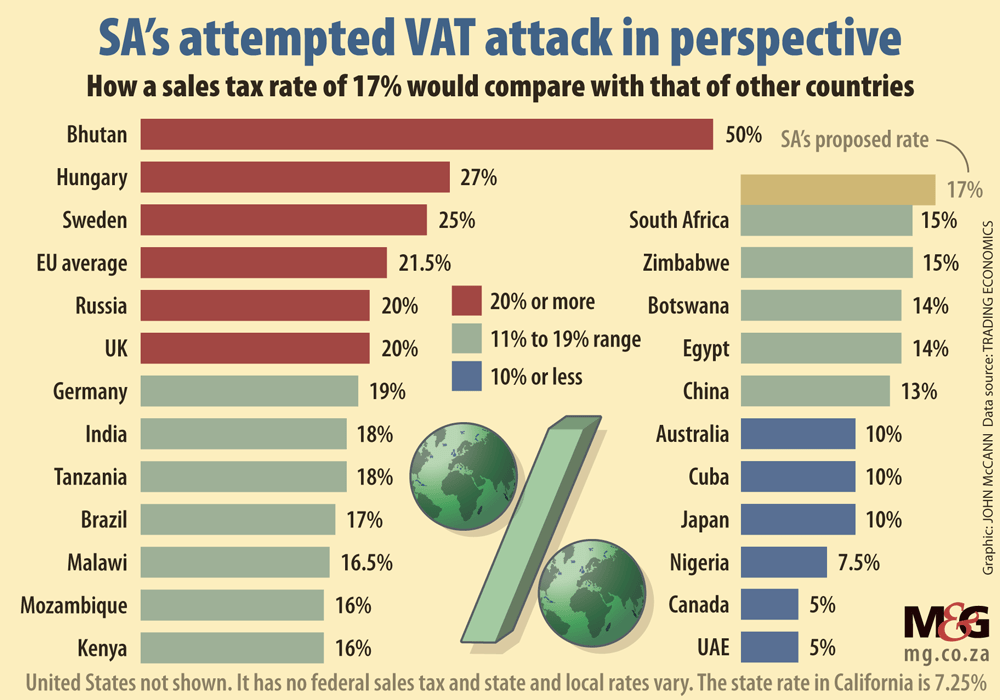 (Graphic: John McCann/M&G)
He said the 0.75% VAT increase presented to cabinet last week was “not trivial” for two reasons.
“VAT has never dropped once since its introduction in South Africa in 1991; once it goes up, it stays up. Which also explains the second reason. Even if it’s a ‘small’ amount extra, it will likely hurt us for generations — it’s a big amount over time.
“If a family spends R5 000 on non-VAT-exempt items before a 0.75% VAT increase, then that family would need to fork out an extra R32.60 every month. Every year, it adds up to almost R400 extra.”
Matthew Parks, the parliamentary coordinator of trade union federation Cosatu, made a similar calculation and reached the same conclusion.
“If you are spending R4 000 a month on goods, the 0.75% hike is an extra R30 out of your pocket every month.”
He described any VAT hike as “politically toxic”.
“We did not support it and a lot of the ANC guys did not support it. People are divided.”
Godongwana acknowledged as much last month while trying to sell VAT as a progressive tax increase because the poor could be insulated by increasing the basket of zero-rated items. In the main, economists were as sceptical as the labour movement.
“I don’t buy that argument,” said Peter Attard Montalto, Krutham consultancy’s global lead on capital markets and the political economy.
“It ignores the income tax levels just above the poor. I think that is actually a political problem for the ANC; I don’t think they think about the impact on the lower middle class. So I think this idea that it is progressive is just very odd.”
Montalto said on a policy level a VAT increase made sense because it provided a permanent spending increase, but in the political context it did not.
“It is all about the politics. You can’t ignore the politics; we can’t ignore the distributional impact,” he said.
“We can’t all just say, ‘Oh, there were no other cuts you could have done.’ It does not make any sense to me and I do think there is more wasteful expenditure to cut elsewhere. From a policy perspective, as an economist, I like the VAT hike. At a very practical level, it just does not make sense to me.
“There is clearly a desire by the ANC not to give the DA an effective win and you can understand that at some level, but this is much bigger and more dramatic than that.
“The most interesting stuff for us has not been the DA, it has been the ANC and I think there is deep dissatisfaction within the caucus among ANC ministers around this, so this idea that the ANC is pro and the DA is anti is not the story.”
It has been argued repeatedly that to balance the budget, the finance ministry should cut government departments, agencies and programmes that yield little and dispose of parastatals that drain the fiscus.
“Not to sound like a broken record, but we don’t have a revenue problem. We need to fix our inefficient spending and grow the economy,” Burke said, arguing that concessions on ports and rail networks could provide vital stimulus.
“The only ‘revenue’ measure we’ve suggested is to properly capacitate Sars [South African Revenue Service] in line with what the commissioner has been calling for, because we’re leaving billions on the table every year in tax revenue already due that should be collected under the current tax rates.”
Sars commissioner Edward Kieswetter believes tax rates have reached an inflection point and the treasury should rather give the revenue service the resources to improve compliance and collection. This, he said, could rake in an additional R450 billion.
Cosatu, too, has taken up the call.
“Give Sars R2 billion and link it to improving tax collection by one percent a year,” Parks said.
It was a more innocuous way of finding money to replenish health and education budgets, and help fund the extension of the social relief of distress grant, than a limited pause on Government Employee Pension Fund (GEPF) contributions.
“That would give breathing space to the state for a year, but it would be a difficult sell. The public is scarred by state capture. It does not trust the state.”
That idea was initially floated by Cosatu and found support thanks to the catchline of contributions for the 2023-24 financial year totalling R59.4 billion, the same sum Godongwana hoped to raise through a 2% VAT increase.
Montalto said a glance at the health of the fund, as per the findings of a 2021 actuarial valuation by Alexander Forbes plus subsequent investment performance, suggested it was not as over-funded as proponents of a payment holiday may think.
“We think it is probably 10 percentage points lower, before you take the buffer out. This idea that you can raise R60 billion from it is probably pushing it.”
He said there was no framework for implementing a GEPF payment holiday and although there was time to draft one before the start of the new financial year, it was still not obvious that there was “significant room to do a complete holiday”.
Burke said it was a temporary fix, not the course correction needed.
Economists at Investec warned that although the financial risk premium improved on the back of the initial premise of stabilising debt while balancing new spending with tax increases, this would not support growth.
“The reality is that there is no room for complacency; tough choices regarding the composition of government expenditure are imperative. Relying on tax increases to finance new spending is unsustainable in the long term.”
Investec economists listed the remaining options as adjustments to other taxes, using the Gold and Foreign Exchange Contingency Reserve Account, reducing spending or increased debt issuance.
Liberty economist Zandile Makhoba said without tax hikes, spending cuts were inevitable and should hit pockets of largesse, ideally if implausibly the public wage bill. “Let those be sorted out so that that money can be better used.”
Whatever approach Godongwana takes on Wednesday, last month’s budget postponement and the leaks that preceded it may well prompt change in how the budget cycle works.
Burke said coalition rule meant, at a minimum, that the budget can no longer come to the cabinet at the last minute. Senior officials have said that earlier, more extensive consultation was needed and that this probably meant the end of blanket secrecy regarding budget-making.
“I think it was a straw man, to be honest, about the confidentiality point and the market moving and you can’t tell the cabinet. Cabinet discusses highly sensitive classified information, but you can’t discuss the VAT hike?” Montalto said.
He thinks the treasury is considering changes and these will be apparent — and instructive — in the negotiation period between now and the medium-term budget policy statement.
“I think one is acutely aware that this is unsustainable and a new system will have to be done.
“In any other country these things work on a far more transparent basis where … everything is debated in the press and there is a maturity that allows that to happen. South Africa needs a bit more self-confidence.”