Caregivers: The Gauteng department of social development has ordered centres which care for abandoned infants to close but some are going to court to fight this.
Members of Baby Savers South Africa, a national coalition of organisations that provide temporary protection for abandoned infants, are taking legal action after the Gauteng department of social development issued a directive to shut down such centres.
Baby savers, or baby drop-off boxes, are secure devices where mothers who are not able to take care of their infants can safely and anonymously leave them. The devices trigger an alarm in the centres where they are installed to alert caregivers that a baby has been left in one.
The coalition comprises 27 organisations across Gauteng, Mpumalanga, Western Cape, KwaZulu-Natal, the Eastern Cape and Namibia.
The Gauteng social development department however believes that such facilities encourage child abandonment and deny children their rights to identity and family.
“The baby box takes away any form of responsibility of the biological mother to care for the child and further disregards the future role and responsibility of the biological father,” it said in a letter sent to organisations in 2023, declaring baby savers illegal and ordering their immediate closure.
Since then, seven out of 12 baby-saver organisations in Gauteng have closed their operations, fearing legal repercussions, but others are fighting back.
“We, as baby-saving organisations, see the work that we do to ensure safe child protection, but the Gauteng department of social development sees it as a criminal aspect,” said the founder of New Beginnings Baby Home, Tahiyya Hassim.
New Beginnings Baby Home, which houses 30 abandoned or abused children, began operating during the Covid-19 pandemic after Hassim noticed a spike in child abandonment cases.
Hassim is in the process of re-registering her organisation as a child and youth care worker.
The Door of Hope Children’s Mission is one of several organisations that will be heading to the Pretoria high court to appeal a decision by the Gauteng department to deny their applications for child and youth care worker re-registration in order to continue operating as baby-saver centres.
“Understandably, we don’t want to close our saver. What if a mom comes and finds the saver is closed, what will she do with her baby?” asked Nadene Grabham, the co-founder of Baby Savers South Africa and operations director at Door of Hope Children’s Mission.
The Love of Christ Children’s Home in Midvaal in Gauteng was forced to switch from a baby-savers organisation housing 60 children to a daycare centre after the Gauteng department refused to renew its licence.
“We had a sense that the department of social development was putting in excessive roadblocks and we found that the Gauteng DSD [department of social development] actually has an agenda to close down baby homes in favour of foster care,” said its spokesperson, Faith Abrahams.
Baby Savers South Africa has initiated legal proceedings against the department and contends in its court papers that certain provisions of the Children’s Act — which the Gauteng department relied on in issuing the directive — are unconstitutional.
“Our primary fear, and whole reason for fighting for Baby Savers, is the loss of an innocent little life.
“The right to life surpasses all other rights — and a baby saver is a safe alternative to unsafe baby abandonment. Do babies’ lives not matter?” Grabham said.
So far, the directive has only been issued in Gauteng, with other baby savers around the country — there are 45 nationwide — unaffected.
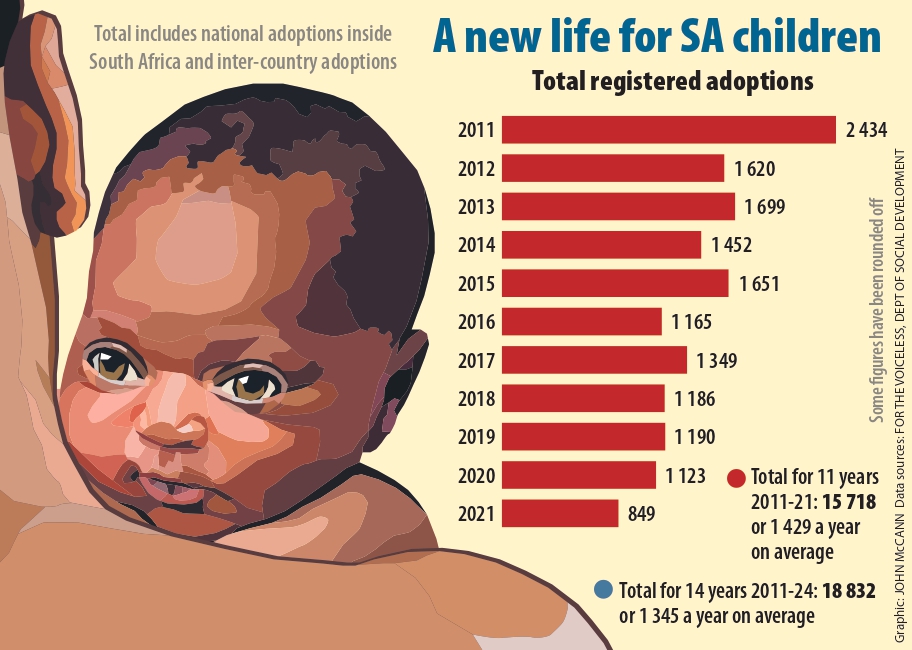 (John McCann/M&G)
The Choices Crisis Pregnancy Centre in the Western Cape says it has not had any action from its provincial department.
“They have not troubled us or given us any directive as yet, but we support the court application in Gauteng,” the centre’s Sandy Immelman said.
According to the national department of social development, more than 250 cases of abandoned children were reported in 2023, with KwaZulu-Natal recording the highest number at 92.
In the Eastern Cape, 40 infants have been abandoned since March last year, all found alive and placed with families or children’s homes.
But Baby Savers South Africa estimates that more than 10 000 babies are abandoned annually, with the majority found dead. According to Door of Hope, for every abandoned baby found alive, another two are found dead.
While the statistics are alarming, Grabham said the numbers might in fact under-represent the true scale of the problem.
“Baby savers should only be used as a last resort, when all other options or help have failed, but we do not have safe-haven laws in South Africa, so mothers are judged and belittled when they want to place their babies for adoption because they are not able to care for their babies,” she said.
According to nonprofit, Pregnancy Help Network, formerly known as Africa Cares for Life, South Africa has about 75 pregnancy help
centres, which are primarily co-ordinated under the network.
A 2023 report by Child Welfare South Africa highlighted that abandonment often occurs in informal settlements and poor urban areas as a result of poverty, lack of social support, stigma and limited access to reproductive healthcare.
“These factors often intersect and create desperate situations for mothers, particularly young and unmarried women,” the report said.
The reasons for child abandonment are varied and often include violence such as rape, said Baby Savers co-founder Whitney Rosenberg.
In the third quarter of 2024-25, the South African Police Service recorded 11 803 rape cases. In the same period in 2023-24, 12 211 cases were reported.
Detailing one such case of abandonment, a caretaker at a centre in Johannesburg recalled hearing its doorbell ringing at about 2am, to find a tearful mother in a hospital gown holding an infant wrapped in a bedsheet, begging her to take the baby.
“The mother was shaking and said she was asked to fill in forms for the birth of the child at the hospital but she did not want to acknowledge the child because he was conceived through rape,” the caretaker, who asked not to be named, told the Mail & Guardian.
“That’s when she remembered seeing us advocating for safe havens for babies at a shopping centre, so she used her remaining data to google our address — luckily we were close by but she walked over 7km to us.”
Under South African law, child abandonment is a criminal offence, with charges ranging from concealment of birth to attempted murder.
A child is considered abandoned when the parent or guardian has not made contact with the child for at least three months or has failed to contribute to the child’s upbringing or support during that time.
According to the Children’s Act, the department of social development or other relevant authorities can remove a child from a home without a court order if there are reasonable grounds to believe the child is in danger and is in need of immediate protection.
Birth parents in South Africa generally do not retain parental rights after abandoning a child.
If a parent returns and tries to reclaim rights after abandonment, they would need to apply to the children’s court and prove that it’s in the best interest of the child to restore those rights.
A report compiled by Baby Savers South Africa about cases of abandonment, describes how a Reaction Unit South Africa found a partially wrapped baby in a stormwater drain in Verulam, north of Durban, in February.
The mother was found after the unit circulated a poster looking for her. According to the report, the infant had been left unattended for 17 hours.
In January, a newborn was rescued from a pit latrine in Diepsloot in Johannesburg, by community members who pointed a finger at a 19-year-old neighbour who had recently given birth. The baby was taken to Rahima Moosa Mother & Child Hospital for care.
In December, occupants of a house in Lerato Park in Kimberley heard an infant crying and, upon investigation, discovered a baby boy.
Such cases will continue to occur if the department of social development shuts down baby saver organisations across the country, Grabham warned.
“That is why we need to protect baby-saving organisations from incidents like this,” she said.