Incarcerated: Judge Nathan Erasmus on Thursday sentenced Jacquen ‘Boeta’ Appollis, Steveno van Rhyn and Kelly Smith (above), convicted earlier this month of kidnapping and trafficking Joslin Smith, to 10 years in prison for the former and life imprisonment for the latter crime.
In a sombre and methodical judgment, Judge Nathan Erasmus on Thursday sentenced Kelly Smith, Jacquen “Boeta” Appollis and Steveno van Rhyn each to 10 years in prison for kidnapping and to life imprisonment for trafficking Smith’s daughter, Joslin.
Justice might have been served on the perpetrators but the whereabouts of the girl, who was six years old when she went missing from the Middelpos area of Saldanha Bay on 19 February last year, remain unknown.
Thousands of viewers had logged onto the livestream of the case at least an hour before proceedings started.
“Today we get justice!” “This is what we are here for,” “Joslin, we love you so much,” “Justice for Joslin,” some wrote. The trial has gripped South Africa, and also attracted international interest.
The community — described by Erasmus as uniting during the ordeal — remains heartbroken. But there is still hope, it was heard this week during sentencing proceedings, that Joslin would be found.
And there were still people searching for the blue-green-eyed child.
“This is the most difficult element in any trial,” Erasmus said as he began the sentencing, reiterating that decisions of such magnitude could not be made in anger. Instead, they should reflect mercy, where appropriate.
Departing from standard practice, he directly addressed the accused to explain the court’s reasoning.
All the factors he described showed their moral blameworthiness, he said, and even though they were on drugs at the time, “it was no excuse”.
“If it led you to the commission of the offences, you had the opportunity to tell me. You simply didn’t do that.
“In fact, it seemed through the course of this trial, that you, Mr Van Rhyn and Miss Smith, found it amusing … didn’t take it seriously.
“There is nothing that I can find that is redeeming and deserving of a lesser sentence than the harshest I can impose.”
He said that all three would have their names added to the child protection register.
In determining a fair and just sentence, he said, the court had to balance multiple considerations: the personal circumstances of each accused, the nature of the offence, the interests of the community and the broader purpose of sentencing.
“There is an outcry from the community for retribution,” he said.
“Yes, it is part of the purpose of the sentence because those that harmed society must pay for their deeds.”
He emphasised that punishment must also deter others who would “dare to undermine the moral values of society”.
While the defence had urged the court to focus on rehabilitation, Erasmus said, in this case, it would not be a priority.
He commended probation officer Errol Pietersen for his comprehensive pre-sentencing reports on all three of the accused, produced under tight time constraints at the judge’s own request.
“Pietersen’s report was one of the most comprehensive I have seen.”
Turning to Appollis, Erasmus acknowledged two previous encounters with the law but said they would not weigh in sentencing.
He described Appollis as having come from a supportive home with opportunities for success, which were derailed by substance abuse.
Although he had acted as a father figure to Joslin and Smith’s other two children, Erasmus said, “It doesn’t seem as if you were gainfully employed for any substantial period and were, for a great extent, reliant on Smith for subsistence.”
Pietersen’s report described Appollis’s demeanour as lacking remorse and displaying twisted truths, even on the eve of sentencing.
“In your personal circumstances, I do not find any mitigation factors,” Erasmus concluded.
Addressing Van Rhyn, Erasmus echoed Pietersen’s assessment — a “menace to society”.
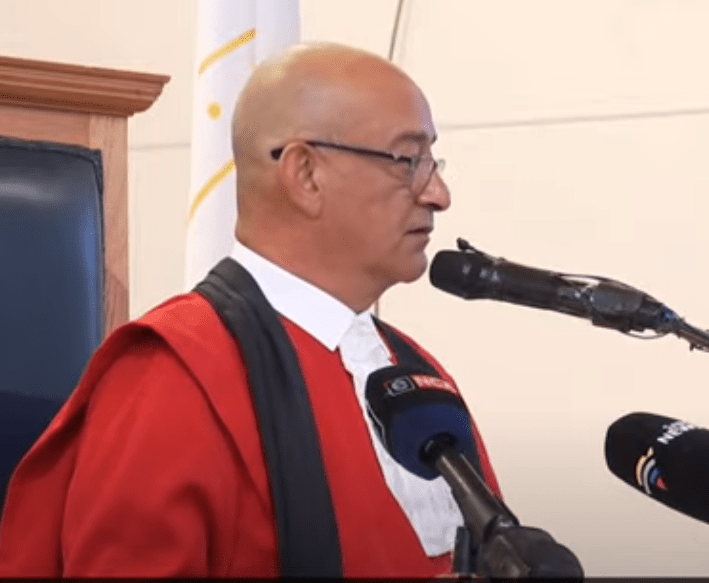 Judge Nathan Erasmus
He acknowledged Van Rhyn’s troubled upbringing, marked by long absences of his father due to work and alcohol abuse. Despite some support from his mother, Van Rhyn had embraced a life of crime beyond drug use.
Erasmus rejected the suggestion that he had been rehabilitated, citing his failure to comply with prior parole conditions and continued criminal behaviour, including violent offences and housebreaking.
“I had expected a person who had gone through what you have — whose father was murdered at a young age — to understand the consequences,” Erasmus said.
“Your attitude in this court shows one who doesn’t care … You yourself are a father of a young daughter.
“You have shown absolutely no remorse and no concern.”
Judge Erasmus found no mitigating circumstances.
Smith was described by Pietersen as “manipulative”, a conclusion supported by victim impact statements and family reports.
“You went as far as to blame your parents for your conduct in this matter,” Erasmus said. “Besides on one occasion earlier, and yesterday, I saw no indication of remorse.”
Although the court acknowledged Smith has two other minor children, Erasmus said their care arrangements meant her role as a caregiver carried less mitigating weight.
“You were born under difficult circumstances but your grandparents cared for you and gave you the opportunity for a stable life,” he said, adding that unlike her co-accused, Smith had completed her schooling.
Still, she had rejected familial support after descending into drug use.
“In the personal circumstances, I do not find mitigating circumstances,” he said.
Erasmus reaffirmed that sentencing must strike a balance. While not bound solely by statutory minimums, the seriousness of the crime demanded a severe response.
“I don’t need to stress the seriousness [in the] kidnapping of a six-year-old, depriving her of freedom of movement and liberty,” he said.
Defence counsel had argued there was no evidence that Joslin had been harmed. Erasmus dismissed this claim outright.
“There is no merit in such an argument. Depriving someone of liberty and movement cannot at least go without emotional harm.”
In recounting the events, Erasmus described the callousness of Smith’s prior remarks to an evangelist, Nico Coetzee, in August 2023, when she expressed her desire to “get rid of her child” to improve her life with Appollis. “How callous is that?” Erasmus asked.
The court also considered Smith’s prior stints in rehabilitation and a pattern of interventions, including when the Andrews family had cared for Joslin.
A day before her disappearance, Smith was reportedly enraged over a chicken theft accusation against Appollis and had vowed revenge on the complainant.
“Your conduct there seemed not to be an isolated incident,” Erasmus observed.
“You put the blame on others for treating your child like a commodity and selling her off.
“Van Rhyn and Appollis went along — both of them parents. Your daughter, Mr Appollis, would have been three years old at the time.”
Central to the decision to convict Smith was Coetzee’s testimony.
During a prayer service on 3 March last year — weeks after Joshlin’s disappearance — Coetzee recognised Smith and recalled her earlier statements.
He said Smith had said she would be willing to accept as little as R5 000 if the buyers could not afford the R20 000 she wanted.
Coetzee also testified that, according to Smith, the sale would take place in January or February last year. He said that Smith had told him the Middelpos area would “be like a movie scene” when the child went missing.
He had told his employer what Smith had said, long before it came to be in the public domain.
The state said Coetzee’s evidence corroborated that of Lourentia Lombaard, who was accused number four in the matter before she turned state witness.
Lombaard testified that she overheard Smith telling Appollis that she had received money from a sangoma for the child. When he asked her how much it was, she said R20 000.
Lombaard told the court she and Van Rhyn had been promised money for their silence.
Erasmus has said there would be a separate trial for Lombaard, to determine whether she should be granted indemnity.
However, while sentencing the trio on Thursday, he said Lombaard “did nothing to protect” Joslin.
Smith, Appollis and Van Rhyn did not testify.
The courtroom was heavy with grief and tension this week, when the final arguments and victim impact statements were delivered.
On Tuesday, a series of probation reports compiled by Pietersen were read into the court record. They offered a disturbing psychological profile of the trio, underlining themes of drug abuse, denial and a near-total absence of remorse — most notably from Smith.
Pietersen had described Smith as the probable mastermind behind the crime. Although she had matriculated and was employed at the time of her arrest, she struggled with tik addiction and had a long history of volatile behaviour, particularly toward her children and other close relatives.
The report laid bare Smith’s manipulative tendencies, her lack of contrition, and her refusal to accept responsibility.
During interviews, she fabricated accounts of being sexually abused as a child and falsely claimed rejection by her parents in what Pietersen characterised as an attempt to solicit sympathy. He found her disengaged and self-serving.
“She merely speculated that her daughter could be trafficked as a ‘sex slave’ but she believes her daughter to be alive,” Pietersen wrote, adding that Smith appeared more concerned about avoiding prison than with the fate of her missing child.
In an emotional victim impact statement read to the court on Wednesday, Smith’s biological mother, Amanda Daniels — who is caring for Smith’s two remaining children — condemned her daughter’s actions.
“You have broken this family apart,” Daniels said.
She said Smith had told her that she would “talk” about what really happened to Joslin when she was in court but Smith never testified.
“I feel like my heart has been ripped from my body,” Daniels said in the statement, read out by court preparation officer Deonett Boltney.
Appollis was described by Pietersen as quiet and reserved, and as having admitted to using drugs including tik, dagga and Mandrax.
Although he had prior convictions for theft and violating the Marine Resources Act, Pietersen said that Appollis had once lived a relatively ordinary life, participating in club rugby and showing consideration for others.
The report suggested that Appollis might have been manipulated by Smith.
During interviews, he became emotional when reminded of his own two minor daughters and the trauma Joslin must have experienced.
Had it not been for drugs, Appollis might have lived a good, law-abiding life. But it was troubling that he continued to profess his innocence, falsely claiming Joslin had gone to school on the day she disappeared — a claim easily debunked.
Pietersen recommended that he should be incarcerated.
Van Rhyn, the father of a five-year-old, has a long criminal history that includes robbery, drug trafficking and housebreaking. He is also awaiting sentencing in a 2022 murder.
He had left school after grade six and fell into a life of crime and substance abuse.
Pietersen could find “not one iota of remorse” in Van Rhyn, who denied involvement in Joslin’s disappearance and blamed the police, the witnesses — and even the judge.
“He has a propensity toward criminal activities and is, therefore, a threat to society at large,” Pietersen said, recommending the maximum sentence for him.
Court proceedings were dominated not only by arguments in mitigation and aggravation of sentence, but also by the emotional pleas of those who had searched for Joslin, taught her or sought to give her a better life.
Among them was Natasha Andrews, whose family had wanted to adopt Joslin, and Cecelia Oliver, a community member involved in the search for the child.
Oliver detailed in her witness statement how she was still so traumatised by the ordeal, she could not look at or put on the clothes she wore when searching for Joslin.
Joslin’s teacher, Edna Maart, also gave a statement, painting a picture of a vibrant, intelligent girl whose life was brutally interrupted and how that had affected her school, Diazville Primary, and classmates.
During her testimony, Maart told the court Smith had told her the child had been kidnapped by Nigerians.
But the anguish of Joslin’s disappearance was perhaps most heartbreakingly conveyed in the statement of Daniels: “I cried my eyes out on Mother’s Day. Did you not wish you had your three children with you [on that day]?” she said.
She described how Smith’s eldest son had been mocked at school, taunted by peers saying his mother was a drug user who had sold his sister. “I’ve had to fetch your child out of school because of your wicked deeds,” she said.
Throughout the trial, the three accused gave inconsistent testimony and attempted to discredit witnesses.
Allegations of police torture from Appollis and Van Rhyn at the time of their confessions — which became the subject of a trial within a trial — were dismissed by medical professionals and police.